
Review · LEXINGTON AND CONCORD DAY TRIPS
Lexington, MA Battle Green Walking Tour with Costumed Guide
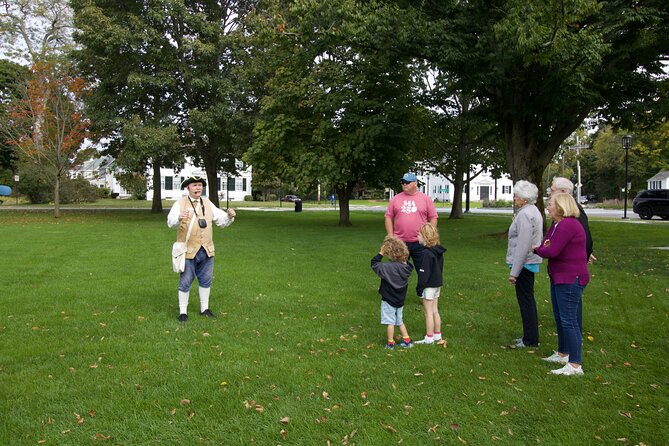
Lexington Battle Green is not just a pleasant patch of grass in a Boston suburb. It is the place where the opening clash of the American Revolution took shape, and the tour helps you connect the monuments, cemetery, and tavern to the people who were here on April 19, 1775. The costumed guide gives the hour a sense of living history without turning it into a stage show.
I like the way the tour puts Captain John Parker and the local militia at the center of the story, rather than treating the Green as a collection of plaques. I also like the small maximum of 20 people, which gives you a fair chance to hear the guide and ask questions. The main drawback is that the experience is short, and some guides may be more engaging than others, especially if you are bringing young children.
Key points to know before booking
- The hour stays on Lexington Battle Green, covering the Minuteman statue, monuments, Old Belfry, Old Burying Ground, and nearby sites.
- The costumed guide adds context about spies, military plans, local leaders, and what happened after the first shots.
- A $15 price makes this a strong value if you want more than the information on the signs.
- Groups are capped at 20 people, so this is more personal than a large coach tour.
- The tour returns to its starting point at 1875 Massachusetts Avenue.
- Good weather matters, and the experience can be canceled for poor conditions.
Why Lexington Green deserves an hour
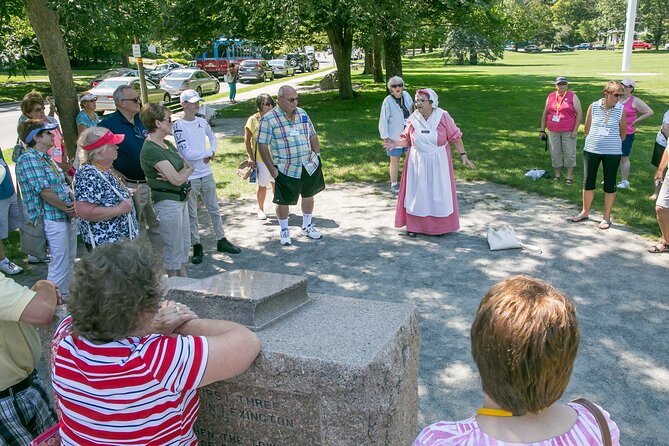
The first thing to understand is that Lexington Green is a place of memory as much as a place of battle. The ground is treated as consecrated because men died here, and several militiamen killed in the clash are buried at the Revolutionary War Monument.
That gives the tour a tone different from a standard sightseeing walk. You are not simply checking off a statue and taking a photograph. You are moving around a compact historic site while the guide explains who gathered here, what they believed was coming, and how confusion shaped the first shots.
The hour is long enough to give the setting meaning, but not so long that the story turns into a lecture. If you have already visited Boston’s major Revolutionary-era sights, this is a useful trip into the nearby towns where the conflict actually began.
More Lexington and Concord day trips
- 90-Min Narrated Trolley Tour of Lexington and Concord, MA
★ 4.5 · 358 reviews - From Boston: Full-Day Historical Lexington & Concord Tour
★ 4.8 · 111 reviews - Lexington & Concord 250th Birthday Tour with Concord Museum Entry
★ 4.5 · 83 reviews
Meeting the costumed guide at 1875 Massachusetts Avenue
The meeting point is at 1875 Massachusetts Avenue in Lexington, and the tour ends at the same location. That makes the outing easy to fit into a day, since you do not need to arrange a second pickup point or figure out where to meet afterward.
The tour is offered in English and uses a mobile ticket. Confirmation arrives when you book, and you can choose among available start times. The average booking lead time is about nine days, so I would reserve ahead if your Boston schedule is fixed, especially during popular travel periods.
The group limit is 20 people. That is small enough for a guide to answer questions, though the experience will still depend on where you are standing and how clearly the guide speaks. One family group had trouble with tour headphones that picked up interference. If headphones are used during your departure, ask how they work before the walk begins and stay close enough to follow the guide directly.
Lexington Green, where the opening clash unfolded
The main stop is the Green itself. The tour takes you around the notable sites surrounding this National Historic Landmark, using the physical setting to explain the action.
The story here is not just British soldiers against colonial militia. You get a look at the pressure building before the battle, the information the local people had, and the choices facing the militia. Guides have also explained the role of spies, local warnings, and military strategy, details that are easy to miss if you only read a short sign.
This is where a live guide earns the $15 price. A plaque can tell you that a battle happened. A good guide can explain why the militia was assembled, what Captain Parker and his men were trying to do, and how the situation spun out of control.
The Green is open ground, so you can see why movement and position mattered. Your guide may point out where the key events occurred, helping you turn a broad historical account into a sequence of locations.
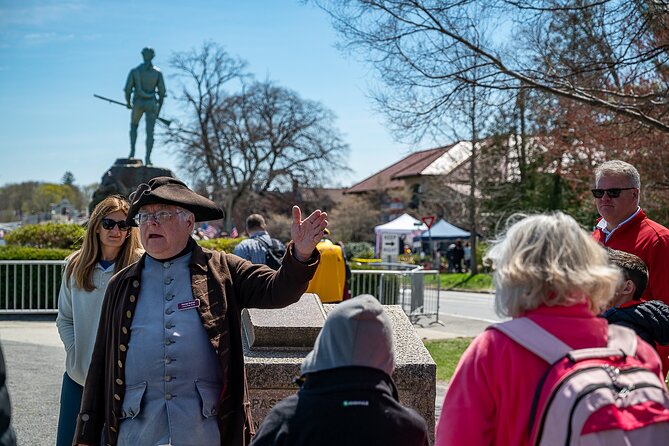
The Henry H. Kitson Minuteman statue
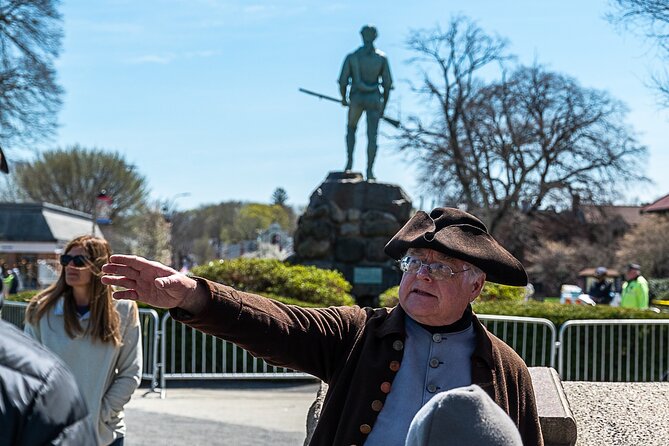
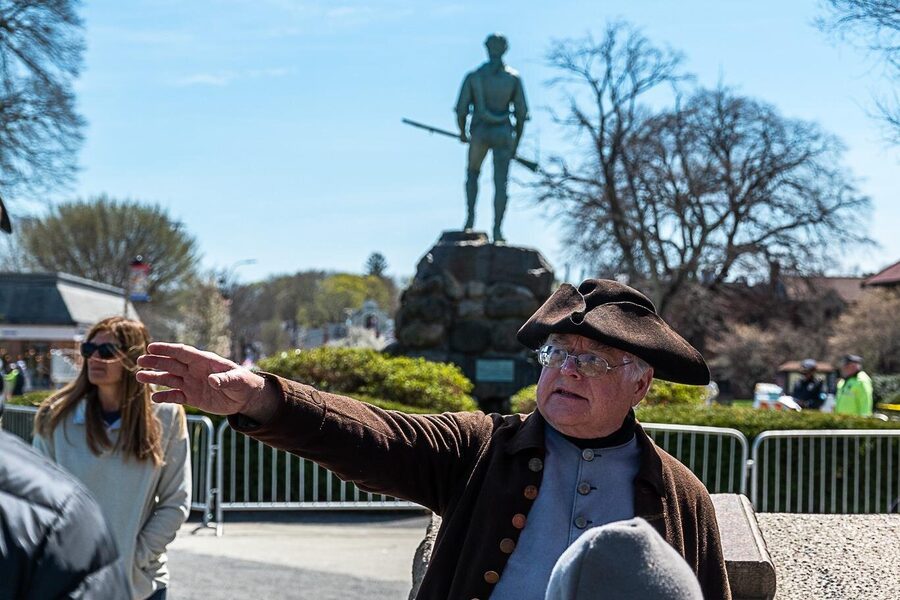
The Henry H. Kitson Minuteman statue is the most familiar image on the Green. It shows a colonial militiaman ready for action, and it gives the tour a natural starting point for discussing the Minutemen and the men who answered the alarm.
The statue is easy to recognize, but the guide can add the human details that a photograph cannot provide. The point is not only to admire the sculpture. It is to understand the difference between the popular image of a ready-made revolutionary army and the local militia members who had to decide what to do in a tense, fast-moving moment.
This stop is especially useful if you are visiting with children or with someone who does not know the early events of the Revolution. The statue gives the story a clear visual anchor. You can see the figure, then listen as the guide connects it to the people and decisions of the day.
More walking tours in Boston
- Boston: Freedom Trail History Small Group Walking Tour
★ 5.0 · 6,450 reviews - Harvard University Campus Guided Walking Tour
★ 4.5 · 3,632 reviews - Boston Freedom Trail Walking Tour with Costumed Guide
★ 4.5 · 2,531 reviews - The Full Revolutionary Story Epic Small Group Boston Walking Tour
★ 5.0 · 2,356 reviews
The 1799 Revolutionary War Monument
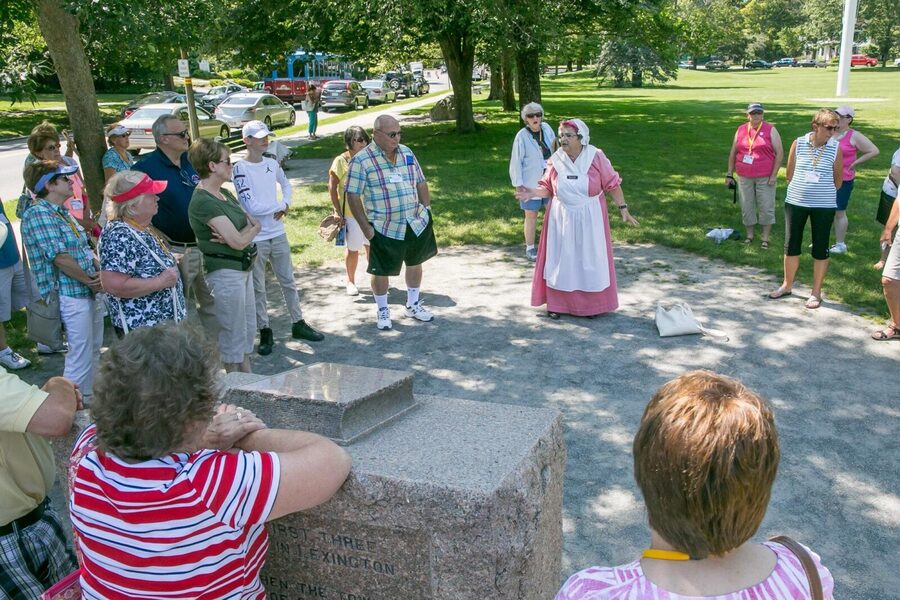
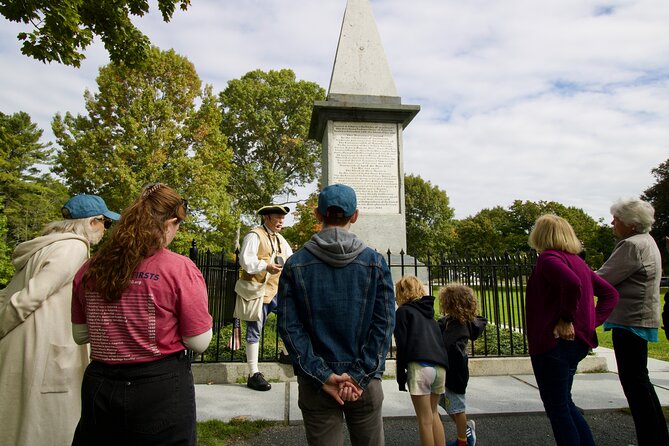
The granite Revolutionary War Monument dates to 1799 and marks the burial place of seven militiamen killed in the battle. This is one of the most important stops because it brings the human cost of the clash into view.
The monument can look simple at first. Its importance comes from what is below it and from the timing of its construction. The guide helps place it in the longer memory of the Revolution, showing how the town honored its dead and preserved the Green as a place of respect.
I would give this stop your full attention. It is easy to focus on the famous first-shot story and forget that real men died here. The monument slows the pace and gives the tour a quiet center.
Captain John Parker and the local militia
The monument to Captain John Parker is tied to one of the most repeated lines from Lexington’s history: his order to stand firm and not fire unless fired upon, followed by his warning that if the British meant to have a war, it should begin there.
The guide can help separate the familiar wording from the larger story. One of the best parts of a live explanation is hearing how historians sort legend from evidence. A particularly strong guide may explain what records support, what became part of later tradition, and how the two versions differ.
That distinction matters. You get a more useful understanding when the guide does not treat every famous sentence as perfectly documented. Several departures have been led by guides such as Laurie Pelletier, John, and Gerry, who were praised for careful explanations, clear storytelling, and a serious approach to the subject.
The Old Belfry and the alarm of April 19
The Old Belfry is connected to the alarm that called the militia to the common. It helps explain how news traveled and why local men gathered so quickly.
The belfry is a small structure, but its role gives the story momentum. You can picture the alarm moving through the town and understand that the militia was responding to a developing crisis, not attending a planned ceremony.
This is a good place to ask questions. How did people know where to gather? What did they think the British were going to do? What information had reached Lexington before the soldiers arrived? The answer depends on the historical evidence, and a live guide can address those points in a way an audio recording cannot.
The Old Burying Ground and the people behind the story
The Old Burying Ground adds another layer to the visit. Captain Parker is buried here, along with ministers John Hancock and Jonas Clarke and an unknown British soldier.
The cemetery is a highlight because it widens the story beyond the brief clash on the Green. You see names tied to the town’s religious, military, and civic life, along with the grave of a British soldier whose identity was not recorded.
I like the cemetery stop because it makes Lexington feel like a real community rather than a stage set preserved for tourists. The famous events took place among homes, churches, families, and local leaders. The burial ground gives you a chance to consider the people who carried the consequences after the fighting moved on.
Buckman Tavern and the nearby historic setting
Buckman Tavern is one of the key sites associated with the tour area and the events surrounding the battle. It helps you place the militia in a local setting rather than imagining the Green as an isolated field.
The exact balance of time at each site depends on the guide and the pace of the group. This is a walking tour focused on the Green, not a long interior museum visit. If you want an extended look inside every historic building, you may need additional time on your own.
Still, seeing the tavern in the context of the Green is valuable. The building, the road, the monuments, and the burying ground work together. The guide’s job is to connect those pieces so you understand how the town functioned when the battle began.
What the guide adds that signs cannot
The strongest reason to book this walk is the guide. You can walk around Lexington Green alone, read the markers, and take in the monuments. You will get the setting, but you may miss the chain of events and the uncertainty surrounding the militia’s response.
A live guide can answer questions in the moment. You can ask about the order not to fire, the role of local intelligence, the people involved, or what happened after the British left. The story did not end on the Green. The colonial militia continued attacking the British troops during their return toward Boston.
That wider view was a major strength of guides such as Laurie Pelletier, who explained pre-battle influences, spies, local information, military plans, the battle itself, and the pursuit afterward. If your guide offers this level of detail, the hour will feel full.
Not every departure will be equally polished. One guide was described as nervous and still new to the work, while another was seen as informed but not especially engaging with children. That is a fair warning for families. The history is strong, but the presentation can vary.
Is $15 a fair price?
At $15 per person, this is one of the easier history experiences to justify in the Boston area. You are paying for about an hour with a live guide, a small group, and a story that is much easier to follow with narration than by reading a few plaques.
The value is highest if you are visiting Lexington for the first time, have a genuine interest in the American Revolution, or want to understand how the town’s monuments fit together. It is less compelling if you prefer total independence, dislike scheduled walks, or already know the battle in detail.
The price also leaves room in your budget for additional sightseeing around Lexington. Since the tour returns to its starting point, you can continue exploring afterward rather than losing time to a separate transfer.
Who should book this walking tour?
I would recommend it to adults interested in American history, couples looking for a focused outing from Boston, and families with older children who can follow a serious historical story for an hour.
It is also a good choice if you have already visited Boston’s Freedom Trail and want to see the place where the Revolution’s opening violence took place. The setting is quieter and more compact, and the guide can add detail that gives the wider story more shape.
For younger children, use some caution. One family-oriented departure was informative but not especially engaging for kids, and the tone is more historical than playful. A beautiful fall day or light rain will not necessarily ruin the walk, but bad weather can lead to cancellation.
Practical details worth knowing
The tour lasts about one hour and is offered in English. A mobile ticket is used, and service animals are allowed. The site is near public transportation, and most people can take part.
Wear shoes suited to a short outdoor walk and check the forecast before you go. The experience requires good weather. If the operator cancels because of poor conditions, you can choose another date or receive a full refund.
Your booking is non-refundable if you cancel or request a change for another reason. Plan carefully before reserving, since the booking cannot be changed simply because your schedule shifts.
Should you book the Lexington Battle Green tour?
Book it if you want the story behind the monuments, not just a quick look at them. At $15, the live explanation is a good buy, especially when your guide can distinguish documented events from later legend and explain what happened after the first shots.
Skip it if you want a self-guided wander at your own pace or if your children need a highly theatrical presentation. For most history-minded visitors, though, this is a practical, low-cost way to make Lexington Green meaningful.
FAQ
Where does the tour start?
The tour starts at 1875 Massachusetts Avenue, Lexington, Massachusetts 02420.
Where does the tour end?
The activity ends back at the meeting point.
How long is the tour?
The walking tour lasts approximately one hour.
How much does the tour cost?
The price is $15 per person.
What language is the tour offered in?
The tour is offered in English.
How large can the group be?
The tour has a maximum of 20 travelers.
Which historic sites are covered?
The walk includes Lexington Battle Green and sites such as the Henry H. Kitson Minuteman statue, the Revolutionary War Monument, the Captain John Parker monument, the Old Belfry, the Old Burying Ground, and nearby Buckman Tavern.
What happens if bad weather cancels the tour?
If the tour is canceled because of poor weather, you will be offered a different date or a full refund. The booking is otherwise non-refundable and cannot be changed for another reason.
Newest Boston tours we have written up
- Boston’s Freedom Trail: A Self-Guided Audio Tour★ 4.0 · 18 reviews
- Boston’s Freedom Trail: A Self-Guided Tour of All 16 Sites★ 5.0 · 14 reviews
- Washington D.C. Cherry Blossom,Baltimore 3-Day Tour from Boston★ 4.5 · 7 reviews
- Boston Self-Guided Audio Tour Bundle: Freedom Trail & More★ 4.5 · 5 reviews
- True Crime Tour of Boston★ 4.0 · 17 reviews
- Family Friendly Guided Bike Tour of Boston★ 4.5 · 22 reviews
- Freedom Trail Experience★ 5.0 · 8 reviews
- Self-Guided Audio Tour of Boston North End★ 4.5 · 3 reviews
Lexington and Concord Day Trips, compared.
90-Min Narrated Trolley Tour of Lexington and Concord, MA
Read our review →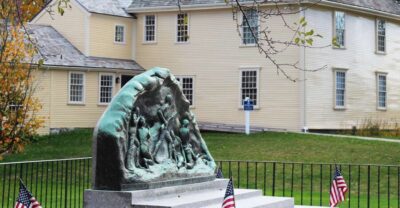

Lexington & Concord 250th Birthday Tour with Concord Museum Entry
Read our review →

Private Day Trip to Lexington and Concord from Boston
Read our review →
Full-Day Minivan Tour of Revolutionary Boston, Lexington and Concord
Read our review →

Boston Lexington and Concord Revolutionary War full day tour
Read our review →Browse the lists this tour appears in