

Review · BOSTON MUSEUM AND ATTRACTION TICKETS
Boston: Children’s Museum Entry Ticket
The Boston Children’s Museum puts hands-on play at the center of the day. The big draw is the three-story climbing structure, but you’ll also find building projects, science activities, art, health lessons, and imaginative play under one roof. It is the sort of place where children learn by touching, testing, and trying again.
I like the mix of active and quieter exhibits, especially the Construction Zone and the authentic 100-year-old Japanese House. I also like that toddlers have their own PlaySpace instead of being expected to keep up with older children. The main drawback is simple: at $28 per person, the visit costs enough that you’ll want to stay for several hours to make it worthwhile.
Key points to know before you go
- Climb three full stories: The central climbing structure gives older children a physical challenge and burns off energy indoors.
- Build in Construction Zone: Families can work with materials, solve problems, and make things together.
- See an authentic Japanese House: This 100-year-old house introduces Japanese customs and daily life in a setting children can explore.
- Find activities for several ages: PlaySpace is made for toddlers, while Kid Power and STEAM Lab suit children ready for more involved activities.
- Plan for a full indoor day: The ticket is valid for one day, which is useful on rainy weather days or when outdoor plans fall apart.
- Know the supervision rule: Every child age 15 or younger must be accompanied by an adult age 16 or older.
What the Boston Children’s Museum is really like

This is not a museum built around glass cases and long labels. It is a place for children to move, touch, build, climb, experiment, and make a bit of noise. You can expect a family-focused setting where the exhibits ask children to take part rather than simply look.
The museum works best when you allow your child to set the pace. One child may spend a long time building in Construction Zone, while another heads straight for the climbing structure or STEAM Lab. You will get more from the ticket if you treat the day as open-ended play rather than a timed list of attractions.
The experience is also useful for mixed-age families. Toddlers have a dedicated PlaySpace, while older children can tackle physical challenges and science-based activities. That range helps prevent the common family problem of one child having fun while another simply tags along.
More museum and attraction tickets in Boston
- Boston Tea Party Ships and Museum Admission
★ 4.5 · 2,512 reviews - Boston: View Boston Observation Deck Entry Ticket
★ 4.7 · 1,451 reviews - Boston: Hop-On, Hop-Off 20+ Stops Trolley Ticket
★ 4.2 · 607 reviews
Start with the three-story climbing structure

The iconic climbing structure is likely to be one of the first things your child notices. It gives children a chance to climb through multiple levels, test balance, and work out how to move through a larger physical space.
I like this exhibit because it has a clear purpose beyond being a playground. Children practice agility and coordination while deciding how to get from one section to another. It also gives active children a way to use their energy indoors, which is especially helpful on a wet or cold Boston day.
You should expect this area to appeal most to children who like physical challenges. Younger toddlers may be better served by PlaySpace, and adults should keep the supervision rule in mind. Children age 15 and under must have an adult age 16 or older with them.
The climbing structure can also shape the rhythm of your visit. It is a good early stop if your child arrives full of energy, or a useful reset after quieter exhibits. I would not rush through it just to reach the next room. For many children, the physical challenge is the main event.
Build, test, and change your plan in Construction Zone
Construction Zone is one of the strongest reasons to choose this museum over a more traditional attraction. It gives families a place to build and create together, turning simple materials and open-ended tasks into a shared activity.
The value here is not a finished product. It is the process of deciding what to make, trying a solution, and changing it when the first idea does not work. That kind of play gives children room to think for themselves, while adults can help without taking over.
I especially like this exhibit for families who want to do something together rather than watch children play from the side. You can ask questions, suggest a different approach, or simply let your child take charge. It is also a good stop for children who may not be drawn to formal science lessons but enjoy making things with their hands.
Allow time for unfinished projects. The museum’s hands-on design means that an exhibit can hold attention longer than its name suggests. Construction Zone is not just a quick photo stop. It may become the place where your family spends much of the afternoon.
Learn through Kid Power and the STEAM Lab

Kid Power introduces health and fitness through interactive activities. Instead of presenting health as a lecture, the exhibit uses movement and participation to make the subject easier for children to understand.
This can be a useful balance after the climbing structure. The themes overlap, but the experience is different. The climbing area focuses on physical coordination, while Kid Power connects activity with broader ideas about taking care of your body.
The STEAM Lab offers a different kind of challenge. It is the place to look for experiments and problem-solving, especially if your child likes to ask how things work. The museum describes activities across science, technology, engineering, art, and mathematics, so you can expect a hands-on approach rather than a classroom-style lesson.
You might find that the STEAM Lab suits older children better than toddlers, though the museum’s broad age range means each family will judge that differently. If your child is eager to test, build, or solve, put this area high on your list. If your child wants to run and climb, start elsewhere and return later.
More museums and galleries in Boston
- Museum of Fine Arts Boston General Admission Ticket
★ 4.5 · 106 reviews - Lexington & Concord 250th Birthday Tour with Concord Museum Entry
★ 4.5 · 83 reviews - Boston: Museum of Ice Cream Entry Ticket
★ 4.2 · 45 reviews - Salem Witch Tour from Boston by Train with Museum Tickets
★ 4.0 · 42 reviews
Step inside the 100-year-old Japanese House
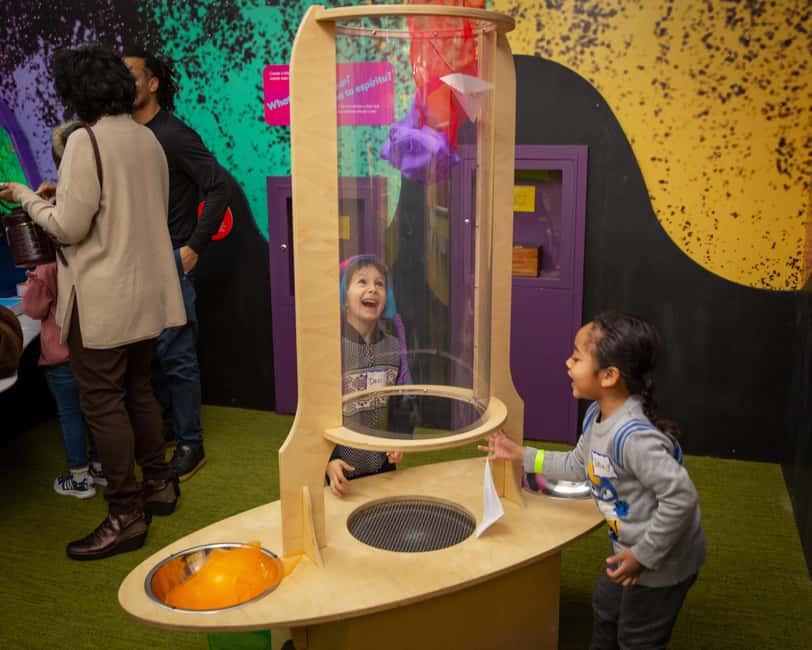
The Japanese House gives the museum a cultural dimension that goes beyond active play. It is an authentic 100-year-old house that introduces Japanese culture and traditions through the setting itself.
That matters because children can learn from the space as well as from the activities inside it. A real house gives context to ideas about daily life, family routines, and cultural traditions in a way that a display panel alone cannot.
This is a calmer stop than the climbing structure or Construction Zone. I would use it as a change of pace, particularly if your group needs a quieter stretch during the day. It may also appeal to children who enjoy imaginative play and pretending to live in another kind of home.
The Japanese House is one of the museum’s most distinctive features. Many children’s museums offer climbing and building areas, but an authentic century-old house gives this visit a more specific sense of place. You should not expect a long historical tour. Instead, think of it as a child-friendly introduction to Japanese culture through an actual domestic setting.
Give toddlers their own room in PlaySpace
PlaySpace is designed specifically for toddlers. That focus is important because very young children can struggle in exhibits built for bigger bodies, faster movement, and more complex tasks.
Here, your toddler can explore at a pace suited to early childhood. The dedicated setting gives younger visitors a better chance to engage without competing with older children at every turn.
I like having PlaySpace in the same museum because it makes the ticket more practical for families with siblings of different ages. One adult can help a toddler in a gentler play area while another adult supervises an older child nearby, depending on your family’s needs and the museum’s current layout.
The museum requires a ticket for everyone after their first birthday. Infants under age one enter free. That is a small but important detail when you are working out the total cost for a young family.
Use art, puzzles, and imaginative play to fill the gaps

The museum is not limited to its named exhibits. During the day, you can expect opportunities to create art, solve puzzles, and take part in imaginative play.
These activities help make the visit feel less like a route from one major attraction to the next. If the climbing structure has a wait or your child is ready for something quieter, art and puzzle areas provide an easy change of pace.
They also suit different learning styles. A child who does not want to climb may prefer creating something. Another child may skip the art and spend time working through a puzzle. You do not need to make everyone do every activity, and that freedom is part of the museum’s appeal.
The museum also offers engaging programs and rotating exhibits. Since those displays change, the exact experience can vary from one visit to the next. I would check what is available for your date if a particular program is important to your family, but the changing exhibits are useful for local families who may return more than once.
Why the one-day ticket can be good value

The price is $28 per person, and the ticket is valid for one day. At first glance, that is a serious admission charge for a family outing, especially since everyone over age one needs a ticket.
The value improves if you stay for a large part of the day. There are enough different types of activity to create a full schedule: physical play, building, cultural exploration, science, art, puzzles, toddler activities, and rotating exhibits. You are not paying for a brief look at one attraction.
The ticket is also easier to justify when Boston weather disrupts outdoor plans. A rainy Sunday can turn into a full indoor day here, with enough variety to keep children occupied for hours. One recent family outing had two children enjoying the museum all day during rainy weather, which is exactly the situation in which this admission makes the most sense.
Still, I would be honest about the cost. If your child is very young and likely to tire quickly, or if you only have a short window in Boston, $28 may feel steep. The museum rewards time. Plan to stay long enough for your child to move between active, creative, and quieter exhibits.
Practical details that shape your visit
The experience is listed as a one-day admission, with starting times based on availability. The host or greeter language is English. The museum is wheelchair accessible, which is useful for families who need an accessible setting.
Children age 15 and under must be accompanied by an adult age 16 or older. Adults who arrive without children must leave a government-issued photo ID at the Admissions Desk under the museum’s Unaccompanied Adult Policy. This is worth knowing before you arrive so the rule does not catch you by surprise.
Weapons and sharp objects are not allowed. Smoking, vaping, alcohol, and drugs are also prohibited. These are standard rules, but they matter when you are packing for a family day and want to avoid a delay at entry.
You can cancel up to 24 hours before the activity for a full refund. A reserve now and pay later option is also available, letting you hold a place without paying at the time of booking. Those policies are helpful if your Boston schedule depends on weather or changing family plans.
Who will get the most from this museum
I would recommend the Boston Children’s Museum most strongly to families with toddlers through school-age children. PlaySpace gives toddlers a clear place to begin, while the climbing structure, Construction Zone, Kid Power, STEAM Lab, and rotating exhibits offer more challenge for older children.
It is also a good choice for siblings with different interests. One child can build, another can experiment, and a third can focus on imaginative play. The variety reduces the pressure to keep everyone interested in the same activity at the same time.
Rainy-day visitors are especially well served. The museum provides a full indoor plan when outdoor sightseeing is uncomfortable or impossible. A school-age child who needs to move will find more to do here than in a quiet gallery, while adults can take part in some activities or supervise from nearby.
You may want to reconsider if your family dislikes interactive settings or prefers a short, structured attraction. This is a hands-on children’s museum, not a peaceful art museum. The noise, movement, and open-ended play are part of the experience.
Should you book the Boston Children’s Museum?
Book it if you want a full indoor day built around active learning and play. The three-story climbing structure, Construction Zone, Japanese House, PlaySpace, and STEAM Lab give you enough variety to justify the $28 price when you can stay for several hours.
I would make it a priority for a rainy Boston day, families with children of mixed ages, and toddlers who need a dedicated play area. I would be more cautious if you have limited time or only one child who tires quickly, since the admission makes the most sense when you use the museum as a substantial part of your day.
For families who like to build, climb, experiment, and create together, this is a practical and flexible choice. The museum gives children room to lead the day, which is often exactly what makes a family outing work.
FAQ
How much does admission to Boston Children’s Museum cost?
Admission costs $28 per person.
How long is the ticket valid?
The ticket is valid for one day.
Do infants need a ticket?
Infants under age one are free. Everyone after their first birthday requires a ticket.
Must children be accompanied by an adult?
Yes. All children age 15 and under must be accompanied by an adult age 16 or older.
Is the museum wheelchair accessible?
Yes, the museum is wheelchair accessible.
Can I cancel my booking?
Yes. You can cancel up to 24 hours in advance for a full refund. A reserve now and pay later option is also available.
More tickets worth booking in Boston
- New England Aquarium Admission Ticket in Boston
★ 4.0 · 446 reviews - Boston: Franklin Park Zoo Entry Ticket
★ 4.3 · 430 reviews - View Boston Observation Deck Admission Tickets
★ 4.5 · 314 reviews - Boston: LEGO® Discovery Center Entry Ticket
★ 4.6 · 36 reviews
Newest Boston tours we have written up
- Boston’s Freedom Trail: A Self-Guided Audio Tour★ 4.0 · 18 reviews
- Boston’s Freedom Trail: A Self-Guided Tour of All 16 Sites★ 5.0 · 14 reviews
- Washington D.C. Cherry Blossom,Baltimore 3-Day Tour from Boston★ 4.5 · 7 reviews
- Boston Self-Guided Audio Tour Bundle: Freedom Trail & More★ 4.5 · 5 reviews
- True Crime Tour of Boston★ 4.0 · 17 reviews
- Family Friendly Guided Bike Tour of Boston★ 4.5 · 22 reviews
- Freedom Trail Experience★ 5.0 · 8 reviews
- Self-Guided Audio Tour of Boston North End★ 4.5 · 3 reviews
Boston Museum and Attraction Tickets, compared.






Boston Pass: 40+ Things To Do – Includes Franklin Park Zoo
Read our review →
Boston Pass: Save up to 50% – Includes Franklin Park Zoo
Read our review →Browse the lists this tour appears in