
Review · SALEM TOURS
Salem Bewitched Tour With Tarot Reading
Salem’s past and its pop-culture present meet on this compact walking tour. You’ll hear about the 1692 witch trials at Pickman House, the Witch Trials Memorial, the Old Burying Point Cemetery, and Bridget Bishop’s former property, then pose beside the Bewitched statue of Elizabeth Montgomery. The finale is a personal 15-minute tarot reading with Cynthia, the multilingual guide.
I like the small maximum of six people, which gives the walk a more personal feel than a large city tour. I also like the route’s mix of solemn sites and lighter stops, especially the move from the memorial to the broom-riding Samantha statue. The main drawback is pace: eight stops in two to three hours means most visits are brief, and admission to the Witch House and Peabody Essex Museum is not included.
Key points at a glance

- A compact route through Salem’s witch-trial landmarks: Visit the Witch Trials Memorial, Old Burying Point Cemetery, the Witch House, and the former site linked to Bridget Bishop.
- A personal tarot reading with Cynthia: The 15-minute reading is included at the Peabody Essex Museum.
- Small groups of no more than six: You can ask questions without competing with a crowd.
- A useful mix of serious history and pop culture: The route includes both the 1692 trials and Salem’s connection to Bewitched.
- Four language options: The experience is offered in English, French, Spanish, and Italian.
- Mostly a walking tour: No private transportation is provided, and moderate physical fitness is recommended.
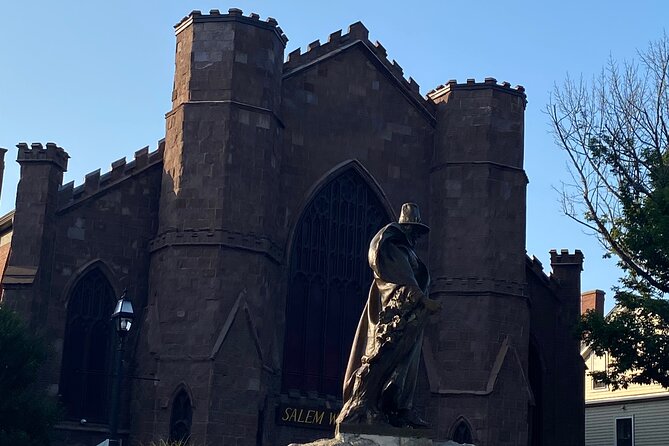
Salem’s darkest story begins at Pickman House
The tour starts at the Peabody Essex Museum on Essex Street, but the first story stop is Pickman House, one of Salem’s oldest houses. This is a smart opening because it gives you a physical sense of early Salem before you reach the memorials tied to the witch trials.
Expect the guide to use the building as a doorway into the town’s past. The visit is short, so this is not a full house tour or a long architectural inspection. It is a story-focused stop, useful for setting the scene before the more solemn parts of the walk.
Cynthia is the guide named in the experience details. She leads in English, French, Spanish, and Italian, giving this tour a practical advantage for multilingual groups. The information supplied about her also describes her as a tarot reader, numerologist, and palmistry practitioner, so the final reading is part of the tour’s design rather than an unrelated add-on.
More things to do in Salem
- History and Hauntings of Salem Guided Walking Tour
★ 5.0 · 14,564 reviews - Salem’s Best Ghost Tour
★ 4.5 · 4,186 reviews - Salem Voodoo, Vampires, and Ghosts Guided Walking Tour
★ 5.0 · 1,931 reviews
The Witch Trials Memorial keeps the victims in view
The Witch Trials Memorial is the emotional center of the route. A granite wall surrounds the memorial on three sides, and the stone threshold carries the victims’ protests of innocence. Inside, benches bear the names and execution dates of the 20 people who were executed.
That design asks you to pause rather than rush through. The open gaps in the wall are especially meaningful: the memorial does not present the trials as a neat, closed story. Instead, the words of the accused seem to enter the space from outside, which makes the site feel restrained and reflective.
You’ll have about 15 minutes here. That is enough to read the names and take in the layout, though it may feel short if you want to linger over every inscription. The memorial is free and appropriate for all ages, making it one of the easiest parts of the experience for families or mixed-age groups.
I appreciate that this stop focuses on the victims rather than treating the trials as a spooky entertainment show. Salem has plenty of witch-themed attractions, but this memorial gives the story a needed human weight.
Old Burying Point Cemetery adds an older layer
A short walk brings you to Old Burying Point Cemetery, also called Charter Street Cemetery. Opened in 1637, it is Salem’s oldest maintained cemetery and one of the oldest in the United States.
The planned visit is only about five minutes. That is enough for a quick look at the old stones and an explanation of the cemetery’s place in Salem, but it is not enough for a detailed grave-by-grave visit. If old cemeteries are a major interest for you, note the location so you can return on your own after the tour.
The cemetery helps you understand that the witch trials were part of a much older settlement. Salem was not created in 1692, and the burial ground makes that clear in a way that a museum display cannot. The stop is brief, but it gives the route useful time depth.
Old Town Hall shows Salem after the trials
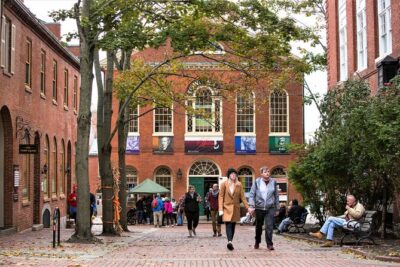
Salem’s Old Town Hall is a Federal-style brick building from 1816. Its Palladian windows, carved wood details, antique chandeliers, decorative columns, and hardwood floors make it one of the more polished architectural stops on the walk.
The building no longer serves as a municipal office. It now functions as a cultural and rental space for the Salem community. You should think of this as an exterior and neighborhood stop unless your guide says the interior is open during your visit. The itinerary allows only about five minutes, so there is no time for a full building tour.
This pause shifts the focus away from witch-trial tragedy and toward Salem’s civic life. That variety is useful. You get a sense of the town’s architecture and public history instead of spending every minute on accusations, imprisonment, and executions.
Same city, a completely different afternoon:
- Bewitched Walking Tour of Salem
★ 5.0 · 1,895 reviews - Satanic Salem Walking Tour
★ 5.0 · 1,635 reviews - Mysteries and Murders of Salem Guided Night-Time Walking Tour
★ 5.0 · 1,488 reviews - The Salem Witch Walk
★ 4.5 · 1,301 reviews
The Bewitched statue brings Salem into the present
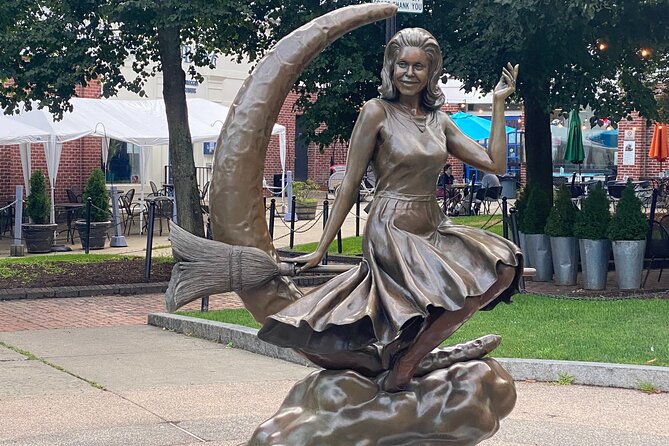
The bronze statue of Elizabeth Montgomery is one of the route’s most playful stops. It shows Montgomery’s character, Samantha Stephens, sitting sidesaddle on a broom beside a crescent moon.
Several episodes of Bewitched were filmed in Salem in 1970, and the city has embraced that connection. The statue is about six feet tall and makes an easy photo stop. You’ll have around 10 minutes, enough to take pictures and hear why a television production became part of Salem’s public identity.
This is a good counterpoint to the memorial. The town is not only a place associated with 1692. It is also a place that turned a television connection into a lasting attraction. If your group includes children, this may be the stop that breaks up the heavier material.
The statue is free, but it can feel less substantial than the historic sites. I see it as a quick cultural footnote rather than a major sightseeing stop. Its value is in the contrast and the photo opportunity.
The Witch House connects directly to the court
The Witch House was the home of Jonathan Corwin, who served on the Court of Oyer and Terminer during the Salem witch trials. It is described as the only surviving building with direct ties to the trials.
That connection makes the house especially important. You are not simply looking at an old structure from the same period. You are seeing the former home of a man involved in the legal process that convicted accused witches. The house also has an earlier Rhode Island connection because Roger Williams lived there before founding Providence Plantation.
One detail adds a dose of modern city planning to the story: the house was moved 11 meters in the 1940s to make room for road widening. Even historic buildings sometimes lose their original position to practical changes.
The visit is listed at about 10 minutes, and admission is not included. That matters when you compare this experience with a tour that includes more indoor visits. You may see the exterior and receive an explanation from the guide, but plan for an admission charge if you want to enter.
Bridget Bishop’s property and the old jail site
Turner’s Seafood at Lyceum Hall marks the location associated with Bridget Bishop. Bishop was the first person executed for witchcraft during the 1692 trials, on June 10 of that year.
The stop is a reminder that the accusations affected identifiable people, homes, and businesses rather than some distant, abstract community. The present-day restaurant setting also shows how modern Salem has been built over the places connected with the trials.
From there, the route continues to the site of the infamous Salem Jail. People accused of witchcraft were arrested and held there before the hangings. The jail itself is not presented as a surviving prison visit, so you should expect a location-based explanation rather than an intact jail interior.
The combined stop takes about 15 minutes and is free. It is one of the better examples of how the tour links ordinary city streets with the events of 1692.
Roger Conant brings the story back to Salem’s founding
The statue of Roger Conant represents an earlier chapter. Sculpted in 1913 by Henry Hudson Kitson, who also created the Lexington Minuteman Memorial, it honors Conant as the founder of the English settlement in Salem.
The stop lasts about five minutes. That is enough to identify the statue and place Conant in the town’s founding story, but not enough for an extended discussion of early colonial Salem.
This is a useful reset before the final reading. After several stops focused on trials and imprisonment, Conant’s statue broadens the story again. Salem was shaped by settlement, civic life, religious conflict, popular culture, and tourism. The route touches each of those themes without pretending to be a full historical course.
The tarot reading gives the tour its personal finish
The tour ends back at the Peabody Essex Museum, where Cynthia provides a 15-minute tarot reading. The experience information also allows about 20 minutes for this final stop, so you should expect a short but personal session rather than a lengthy consultation.
The reading is included, unlike admission to the Witch House and the Peabody Essex Museum itself. That improves the tour’s value for anyone who already wants a tarot experience. You do not need to arrange a separate appointment as part of this activity.
The reading will not appeal to everyone, and that is worth saying plainly. If you want a strictly academic Salem history walk, the tarot element may feel out of place. If you enjoy symbolic readings or want a playful personal ending after the historical sites, it gives the experience a distinctive shape.
Cynthia’s background in tarot, numerology, and palmistry is central here. The personal comments about her cheerful manner and readings that felt strikingly accurate help explain why this part receives such strong praise. Still, you should book it for the experience itself, not as a promise of a particular prediction.
How the timing affects the experience
The full tour lasts about two to three hours. The route contains eight stops, but several are only five or ten minutes long. That makes this a good orientation walk, not a slow museum day.
The short format has clear benefits. You can cover many central Salem landmarks in one outing, learn how the sites relate to one another, and still have time for other plans. It works well on a first day in town when you want to get your bearings quickly.
The tradeoff is that you may not have time to study every inscription, enter every building, or linger at the cemetery. If you prefer long talks at a single site, this pace may feel hurried. If you like moving through a town with a guide and collecting useful context, it should suit you better.
The group limit of six is important. A small group makes it easier to hear the guide, ask questions, and keep the walk personal. It also fits the tarot reading better than a large coach group would.
What the tour includes, and what it does not
The 15-minute tarot reading is included. The walking route and the free outdoor stops are also part of the experience.
Admission to the Witch House is not included, and admission to the Peabody Essex Museum is not included. The museum is the meeting and ending point, but this activity does not automatically function as a museum visit.
Private transportation is not provided. You should be ready to walk between sites, and moderate physical fitness is recommended. Coffee and tea are also not included, so plan your refreshments separately.
The experience accepts mobile tickets and allows service animals. It is near public transportation, which helps if you are arriving without a car. Free cancellation is available if you cancel at least 24 hours before the start time. Changes or cancellations made inside that window are not refunded.
Who will get the most from this Salem walk?
I would choose this experience if you want three things in one outing: an introduction to the witch trials, a look at Salem’s broader identity, and a short tarot reading with a multilingual guide.
It fits first-time visitors who want a compact route through important locations. It also suits couples, small families, and friends who enjoy mixing serious history with lighter attractions. The Bewitched statue and the tarot session make it less formal than a purely historical walk.
It may not be the right pick if you want extensive time inside the Witch House or the Peabody Essex Museum. It is also not ideal if you dislike spiritual or fortune-telling themes. In that case, you may prefer a history-only walking tour and visit the memorial and cemetery independently.
Should you book the Salem Bewitched Tour?
Book it if you value a small group, a multilingual guide, and a route that connects Salem’s 1692 sites with its Bewitched identity. The strongest feature is the personal scale: Cynthia leads no more than six people and ends the outing with a tarot reading tailored to you.
Go in with realistic expectations. This is a brisk overview, not a full museum program. The Witch House and museum admissions cost extra, and the short stop times favor broad context over detailed study.
For a compact first look at Salem with a personal, slightly theatrical finish, I think it offers good value. You get the memorial, cemetery, civic buildings, historic sites, a famous television statue, and a tarot reading without filling an entire day.
FAQ
How long does the Salem Bewitched Tour last?
The tour lasts approximately two to three hours.
Where does the tour begin and end?
It begins and ends at the Peabody Essex Museum, 161 Essex Street, Salem, Massachusetts.
Is the tarot reading included?
Yes. A 15-minute tarot reading with the host guide is included.
Which languages are available?
The experience is offered in English, French, Spanish, and Italian.
Is admission to the Witch House included?
No. Admission to the Witch House is not included.
Is admission to the Peabody Essex Museum included?
No. The museum is the meeting and ending point, but museum admission is not included.
How many people can join the tour?
The tour has a maximum of six travelers.
Newest Salem tours we have written up
- [ESP] History of Salem Witch Trials★ 4.0 · 5 reviews
- Tales of Salem Candyland Tour★ 4.0 · 8 reviews
- Private Walking Salem Legends Tour Professional Guide★ 5.0 · 3 reviews
- Salem Vintage Postcard Tours★ 5.0 · 8 reviews
- Spooky Ramen Tours★ 5.0 · 5 reviews
- Experience Authentic Salem Séance with Entry Pass★ 3.5 · 13 reviews
- Salem Witch Tour★ 5.0 · 6 reviews
- Pirates and Privateers Walking Tour with Real Pirates Admission★ 4.5 · 3 reviews
Salem Tours, compared.
History and Hauntings of Salem Guided Walking Tour
Read our review →


Mysteries and Murders of Salem Guided Night-Time Walking Tour
Read our review →
Wicked Awesome Tours: Witch Trial History and Salem Haunts!
Read our review →Browse the lists this tour appears in