
Review · BOSTON SELF-GUIDED AUDIO TOURS
Boston: City History and Highlights Audio App Walking Tour
Boston’s past comes at you fast on this walk: witch trials, midnight signals, the Boston Massacre, Irish immigration, and two million gallons of molasses. I like the route’s clear historical arc, which carries you from the North End before the Revolution to the early republic. I also like the freedom to pause for cannoli, coffee, or a look inside a church.
The tradeoff is that this is an app, not a person. English is the only language, and a charged phone, working headphones, and reliable GPS matter. One user found the app easy and informative, while another could not get it working at all. Treat the technology as part of the tour, not a minor detail.
Key points to know before you book
- Start at Copp’s Hill Burying Ground: The route opens in the North End and finishes at George Washington’s statue in the Boston Public Garden.
- Hear Boston’s story in layers: Colonial religion, the Salem Witch Trials, Paul Revere, the Boston Massacre, Irish immigration, and the Big Dig all appear along the way.
- Follow GPS directions hands-free: Tracks begin at the right place, so you do not need to keep staring at your phone.
- Plan on more than two hours with stops: The stated time is two hours, but one family took much longer and enjoyed the slower pace.
- Bring your own setup: You need the VoiceMap app, a charged smartphone, and headphones. There is no guide or transportation.
- Expect English audio only: The tour does not provide French, Italian, or other language tracks.
A Boston history walk with a strong beginning and end
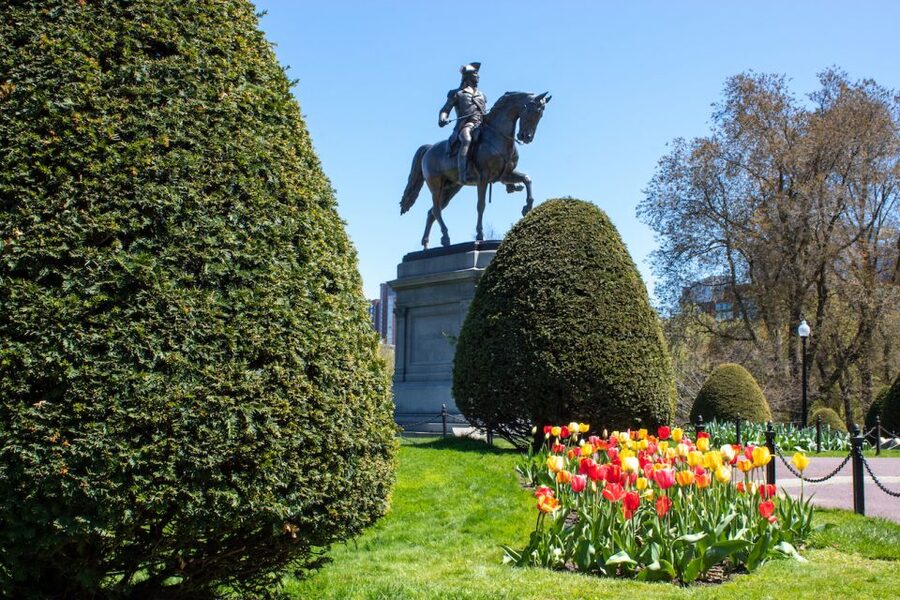
This route works because it joins places that are easy to visit separately into one walkable story. You begin in Boston’s North End, where old burial grounds, churches, narrow streets, and Italian bakeries sit close together. You finish in the Boston Public Garden, beside the statue of George Washington.
That ending matters. The walk does not stop at one famous Revolutionary site and leave you to connect the dots. It traces Boston from the tense years before independence through the city’s later immigrant story and civic growth. The route also adds less expected subjects, including the 1919 Molasses Flood and the engineering project that reshaped downtown.
At $7 per person, I see this as a low-cost way to add structure to your first day in Boston. You are paying for the narration and navigation, not for admission, transport, or a live interpreter. If you already know Boston well, the route may feel basic in places. If you want a sensible first look without committing to a group schedule, the price is easy to justify.
More self-guided audio tours in Boston
- Self Guided Classic Freedom Trail Location Aware (GPS) Walking Audio Tour
★ 4.5 · 258 reviews - Boston Freedom Trail Self-Guided Tour with Audio Narration & Map
★ 4.5 · 98 reviews - Self-Guided Boston’s Beacon Hill Underground Railroad Audio Tour Walking Tour
★ 4.5 · 29 reviews
Starting at Copp’s Hill and Cotton Mather’s grave
The tour begins at the entrance to Copp’s Hill Burying Ground. This is a useful starting point because you are immediately in one of Boston’s oldest neighborhoods, rather than spending the first part of the walk on a generic street.
The audio reaches back to 1692 and the Salem Witch Trials through the grave of Cotton Mather. Mather was a minister at the center of the fear and argument surrounding the trials, so this stop gives the opening section a human face. You are not just hearing that colonial Boston had religious disputes. You are introduced to one of the people tied to a dark and still-famous episode in New England history.
The burial ground itself can require uneven walking and careful footing. The tour is specifically not suitable for people with mobility impairments, so consider the route’s physical demands before booking. You will be walking between stops for about two hours, with no vehicle or guide to shorten the route.
The Old North Church and Paul Revere’s neighborhood
From Copp’s Hill, the route leads toward the Old North Church. This is one of the most important stops because the church’s lantern signal is tied to Paul Revere’s midnight ride and the warning that British troops were moving toward the countryside.
The audio focuses on the years before the Revolution, when tension was building but independence was not yet a settled idea. That context helps you see Revere as more than a statue or a line from a schoolbook. The story includes the people who organized warnings, the Minutemen who were alerted, and the choices made on the eve of open conflict.
The Old North Church is closed on Mondays. On that day, you can see the exterior, but you should not expect the same visit as on an open day. Since the tour itself is always self-guided, the church closure affects the stop rather than the audio format.
This is also where the app’s navigation can be useful. North End streets can feel confusing when you are watching storefronts, church towers, and traffic at the same time. GPS turn-by-turn directions let you listen while keeping your phone in your hand less often.
Little Italy, Paul Revere, and a practical pause

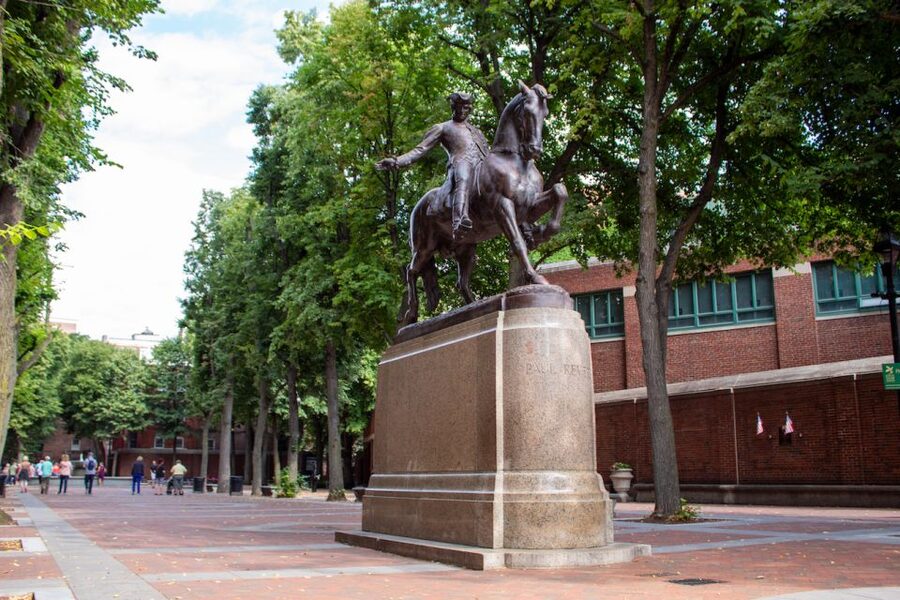
The route passes through Boston’s Little Italy on the way to the Paul Revere House. This is one of the walk’s best combinations of history and daily city life. You hear about a Revolutionary figure while walking past restaurants and bakeries whose aromas make a snack stop tempting.
The Paul Revere House adds a personal scale to the political story. Instead of dealing only with declarations and battles, you get a sense of where a major participant lived. The tour also asks what Revere did after the Revolution, a useful reminder that famous historical figures had long lives beyond their best-known moment.
I would not rush this section. The two-hour estimate is a guide, not a demand. If you want to look around Little Italy or stop for food, pause the audio and resume when you are ready. That feature is one of the strongest reasons to choose an app tour instead of a fixed group walk.
A practical warning: do not assume you can complete every stop at the same speed. One family found the walk took much longer than two hours, though they enjoyed it. Build in extra time if you are traveling with children, stopping for food, or planning to enter sites.
More audio tours in Boston
- Self Guided “Historic Boston Downtown Freedom Trail” Audio/GPS Walking Tour
★ 4.0 · 22 reviews - Boston’s Old North Church Admission with Self-Guided Audio Tour
★ 4.5 · 19 reviews - Boston’s Freedom Trail: A Self-Guided Audio Tour
★ 4.0 · 18 reviews - Boston Harborwalk & Tea Party Self-Guided Walking Audio Tour
★ 5.0 · 17 reviews
The Rose Kennedy Greenway and the Big Dig
After the North End, the route moves toward the Rose Kennedy Greenway and the area reshaped by Boston’s Big Dig. This change in subject is welcome. The walk is not only about the eighteenth century. It shows how Boston continued to change as the city grew and redesigned its roads.
The Greenway gives you a different kind of walking space after the older streets. Here, the audio explains the Big Dig and the decisions behind one of the country’s most costly and famous urban construction projects. You get a look at modern Boston’s public spaces through the story of what used to occupy them.
This portion is also a natural place to rest. You can pause the tour, sit for a while, and restart when you are ready. Since the tour has no meeting time and no guide waiting at the next stop, your pace is entirely yours.
The route’s mix of old buildings and newer public works is a major strength. Boston can sometimes feel like a collection of isolated historical landmarks. This section connects the old city to the present one.
Quincy Market, Faneuil Hall, and Samuel Adams

Next comes the Quincy Market and Faneuil Hall area. You may find street performers here, and the market offers a chance to browse or eat. The tour uses these places to explain Boston’s political life and the role of Samuel Adams, one of the most forceful voices for liberty before independence.
The narration also addresses a familiar question: did Samuel Adams really brew beer? That sort of factoid gives the tour a lighter touch without abandoning the larger story. It is useful for families and for anyone who wants more than a list of dates and statues.
This is likely to be one of the busiest parts of the route, so audio volume and attention may matter. You will be near shops, performers, and other pedestrians. GPS directions are helpful, but you still need to watch where you walk and confirm street crossings yourself.
Faneuil Hall is valuable because it shows politics as public speech and public argument. The tour presents Boston’s fight for liberty through people who debated, organized, and persuaded others. That makes the Revolution feel less like a sudden event and more like a long period of pressure.
The Old State House and the Boston Massacre
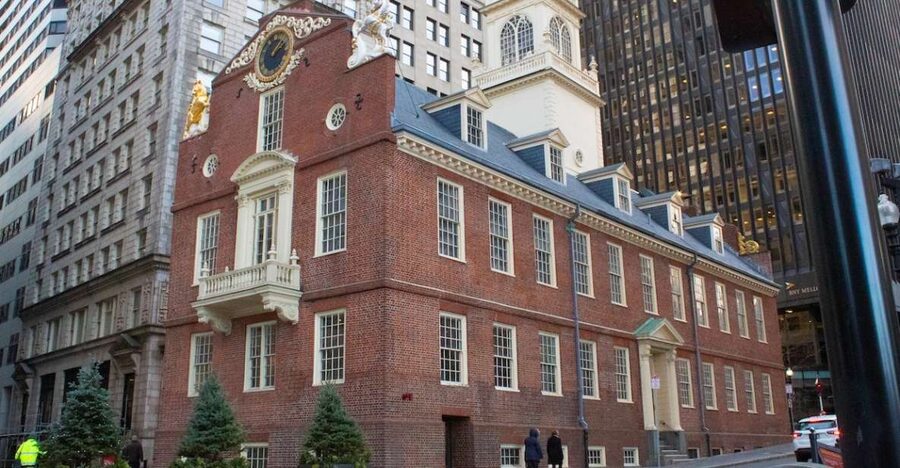
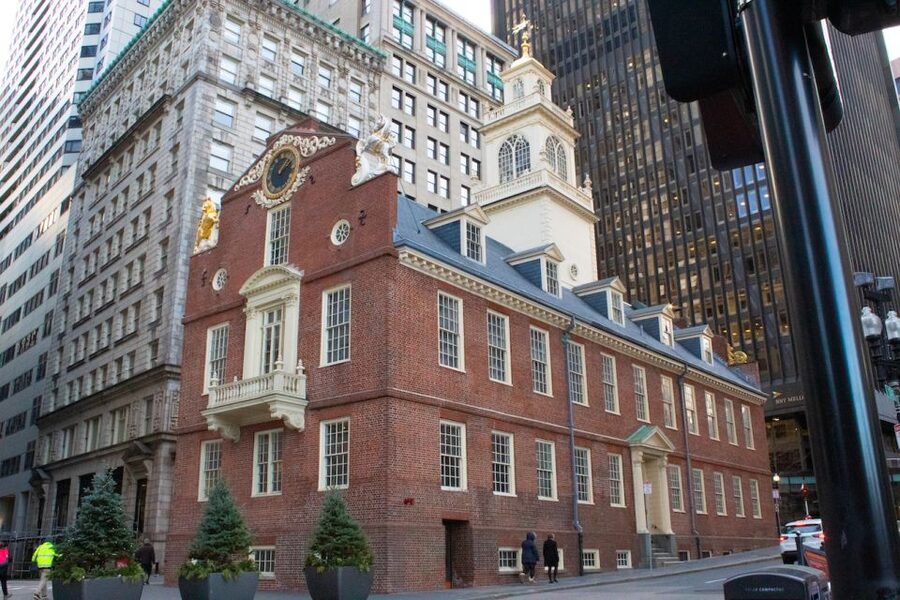
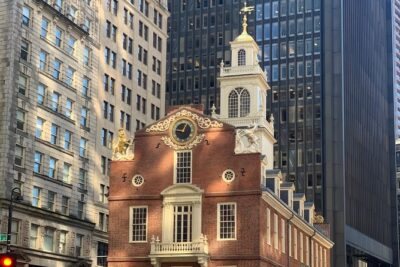
The walk continues to the Old State House, one of the key points for understanding Boston’s colonial government. Here, the audio tells how John Adams defended those accused in the Boston Massacre.
This is an especially good story because it complicates the easy version of the Revolution. Adams supported independence, yet he defended the British soldiers involved in the deadly confrontation. The point is not simply that he was brave or generous. It shows the importance of law and due process even during a time of political anger.
The stop also helps explain why Boston became such a powerful symbol of resistance. Arguments over troops, authority, and violence were not abstract. They played out in the center of town, in front of people who had to decide what justice meant when emotions were high.
If you are interested in American government, this may be one of the most useful stops on the route. If your main goal is architecture, the audio still gives you a reason to look closely at the building rather than simply pass by it.
The Irish Famine Memorial and the choices facing immigrants
The route then turns to the Boston Irish Famine Memorial and the experience of Irish families in the 1800s. The narration focuses on the hard choices many faced during that period, including the decision to remain in Ireland or leave for a new life.
This part broadens the tour beyond Founding Fathers and Revolutionary heroes. Boston’s identity was shaped by repeated immigration, and the Irish story is one important example of how neighborhoods and city life changed over time.
You should not expect a separate immigration walking tour. The subject receives one section within a larger route, but that section gives the itinerary welcome balance. It reminds you that Boston’s story did not end when the Revolution ended.
The memorial is also a useful point for thinking about the city as a place of arrival. The tour connects political freedom with the later struggles of families trying to build a life in a new country. That is a more complete picture than a walk focused only on colonial leaders.
Granary Burying Ground and the road to the Public Garden
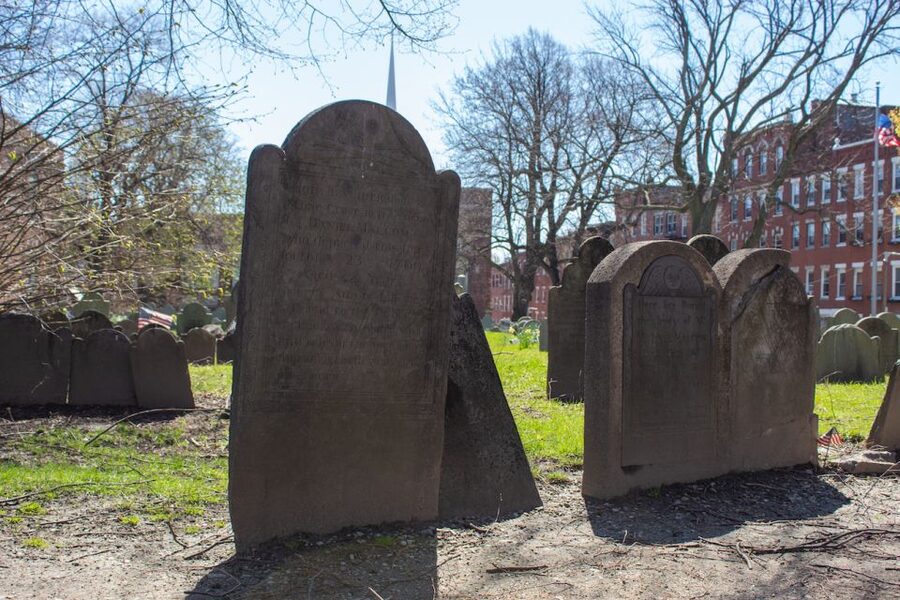
Granary Burying Ground brings the route back to several well-known names. John Adams, John Hancock, and Paul Revere are buried there, and the audio adds local stories about the Old North Church signal and Revere’s later life.
This stop can feel crowded with famous people, so the narration’s details matter. The useful question is not simply who is buried there. It is how these people fit into the political network that shaped Boston and the new United States.
From there, the walk continues toward the Boston Common and the Public Garden. The audio explains what led to the creation of America’s first public park, then brings you to the George Washington statue.
The final stretch gives the tour a satisfying change of mood. You move from burial grounds and political conflict into open parkland. The Washington statue also makes sense as an endpoint because the route has spent two hours tracing the people and pressures that helped create the country.
The 1919 Molasses Flood and Boston’s less polished stories
One of the more unusual subjects is the 1919 Molasses Flood, when two million gallons of molasses congealed in the North End. It is a memorable detail, but it is more than a strange local disaster.
The story shows that Boston’s past includes industrial risk, working neighborhoods, and tragedies that do not fit neatly into the Revolution narrative. Including it gives the audio some variety and prevents the route from becoming a parade of famous men.
This kind of material may be especially useful if you already know the standard Boston sights. You still get Paul Revere and the Old State House, but you also hear about an event that many visitors might miss without local narration.
The tour’s strongest moments come from this mixture: major national history alongside stories rooted in one neighborhood. You get the broad story of America’s birth, then return to the physical streets where ordinary people lived, worked, argued, and suffered.
How the app works, and where it can fail
You download and use the VoiceMap app on your smartphone. The tour begins automatically when you reach the Copp’s Hill starting point, and GPS tracks are designed to play at the correct location. Turn-by-turn directions reduce the need to check your screen constantly.
That convenience has limits. You need a charged phone and headphones, and the audio is in English only. One person had to rely on translated text because no French audio was available, and eventually stopped using the tour. If you need another language, this is not the right choice.
Technical reliability is the main risk. One user could not get the tour to work and ended up walking through Boston without it. I would download the app before reaching the meeting point, check that the audio loads, and carry a backup map or map app. The tour itself does not include a live guide who can rescue a missed turn.
A positive sign is the audio style. Big Al was specifically praised as entertaining and informative, while another person found the tour well done and easy to use. Those comments suggest the narration can carry the walk when the technology behaves as expected.
Who should book this Boston walk?
I would choose this tour if you want a flexible introduction to Boston and are comfortable managing an app. It suits independent visitors, couples, families who like to stop often, and anyone who wants to set the pace without joining a group.
It is less suitable if you want questions answered on the spot, need another language, have mobility limitations, or dislike troubleshooting phone apps. A live guide would be better for those needs.
The $7 price is strong for the amount of ground and subject matter covered. You are getting about two hours of narration, directions, and a route that links many important sites. The value drops if the app fails or if you expect admission to churches, houses, or other attractions to be included.
Book it if you want a structured walk at a very low price and you will prepare your phone before starting. Skip it if technology is likely to frustrate you, or if seeing interiors and receiving personal answers matters more than independence.
FAQ
Where does the Boston audio walking tour begin?
The tour begins at the entrance of Copp’s Hill Burying Ground in Boston’s North End.
Where does the tour finish?
It finishes at the George Washington statue in the Boston Public Garden.
How long does the tour take?
The stated duration is two hours, though your visit may take longer if you stop for food, sightseeing, or time inside nearby attractions.
Is there a live guide?
No. This is a self-guided audio tour through the VoiceMap app, with GPS-enabled turn-by-turn directions.
What do I need to bring?
Bring headphones and a charged smartphone.
What language is the audio tour in?
The audio guide is available in English only.
Can I take the tour on any date?
Yes. You can book any date you want, since the listed times are for reference rather than a required live departure time.
Is the Old North Church open every day?
The Old North Church is closed on Mondays. On Mondays, the tour covers only the exterior of the site.
More history tours in Boston
- Boston: Freedom Trail History Small Group Walking Tour
★ 5.0 · 6,450 reviews - Tour of Historic Fenway Park, America’s Most Beloved Ballpark
★ 4.5 · 3,013 reviews - Boston Food & History: Pizza, North End & Freedom Trail
★ 5.0 · 1,772 reviews - Boston: City Cruises Historical Sightseeing Cruise
★ 4.6 · 1,771 reviews
More self-guided tours in Boston
- Boston’s Freedom Trail: A Self-Guided Tour of All 16 Sites
★ 5.0 · 14 reviews - North End Boston Mafia Exploration Game and Tour
★ 4.0 · 9 reviews - Self-Guided Smartphone Ghost Walking Tour Boston App EMF Reader
★ 4.5 · 6 reviews - Boston Self-Guided Audio Tour Bundle: Freedom Trail & More
★ 4.5 · 5 reviews
Newest Boston tours we have written up
- Boston’s Freedom Trail: A Self-Guided Audio Tour★ 4.0 · 18 reviews
- Boston’s Freedom Trail: A Self-Guided Tour of All 16 Sites★ 5.0 · 14 reviews
- Washington D.C. Cherry Blossom,Baltimore 3-Day Tour from Boston★ 4.5 · 7 reviews
- Boston Self-Guided Audio Tour Bundle: Freedom Trail & More★ 4.5 · 5 reviews
- True Crime Tour of Boston★ 4.0 · 17 reviews
- Family Friendly Guided Bike Tour of Boston★ 4.5 · 22 reviews
- Freedom Trail Experience★ 5.0 · 8 reviews
- Self-Guided Audio Tour of Boston North End★ 4.5 · 3 reviews
Boston Self-Guided Audio Tours, compared.
Self Guided Classic Freedom Trail Location Aware (GPS) Walking Audio Tour
Read our review →
Self-Guided Smartphone Ghost Walking Tour in Salem
Read our review →
Boston Freedom Trail Self-Guided Tour with Audio Narration & Map
Read our review →
Ultimate Historic Salem and Witch Trials Self-Guided Walking Tour
Read our review →
Self-Guided Boston’s Beacon Hill Underground Railroad Audio Tour Walking Tour
Read our review →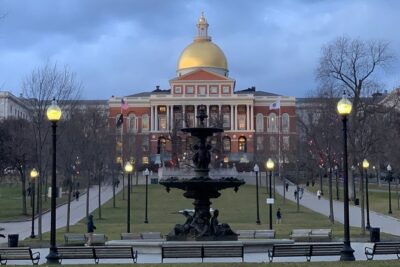
Self Guided “Historic Boston Downtown Freedom Trail” Audio/GPS Walking Tour
Read our review →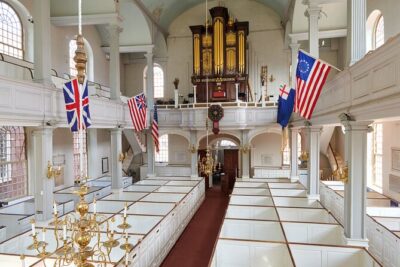
Boston’s Old North Church Admission with Self-Guided Audio Tour
Read our review →
Boston’s Freedom Trail: A Self-Guided Audio Tour
Read our review →Browse the lists this tour appears in