
Review · WALKING TOURS
Building Blocks of Boston : Downtown Walking Tour
Boston’s story comes alive through more than brick buildings on this 2-hour downtown walk. You’ll move from Boston Common and the Civil War monument to South Station, Post Office Square, and the Old State House, while an UltraHD screen brings old photographs, films, and sounds into the present.
I like the small maximum group of 16, which should make it easier to hear and ask questions. I also like the 10-minute indoor break at Winthrop Center, a practical touch in a city where weather can change quickly. The main drawback is that this is an outdoor walking tour, so poor weather can cancel it, and there is no time for long interior visits.
Key details before you book
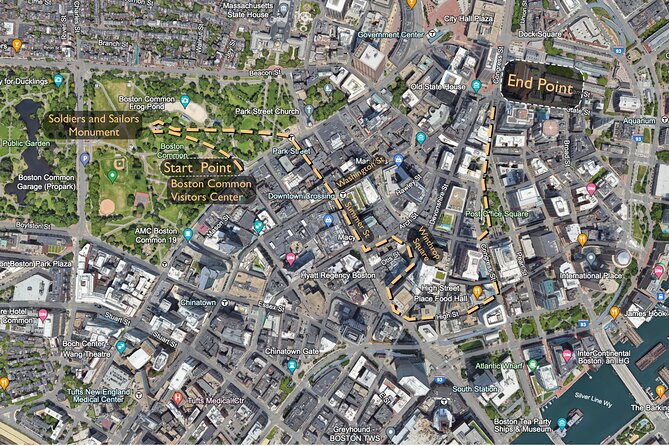
- Boston’s story in one walk: The route connects the Common, Back Bay, Downtown Crossing, South Station, and the Old State House.
- Historic images on an UltraHD screen: Restored photographs, films, and sounds help you compare Boston’s past with what you see now.
- A compact group of up to 16 people: This is a more personal setup than a large sightseeing walk.
- A real rest stop: You get 10 minutes at Winthrop Center with accessible restrooms and air conditioning.
- A one-way route: The tour begins at 139 Tremont Street and ends at 11 Congress Street, about a 15-minute walk from the starting point.
- A useful price point: At $29.40 per person, the tour offers more than a basic orientation walk, especially if you value visual material and historical explanation.
Boston Common: where the city begins
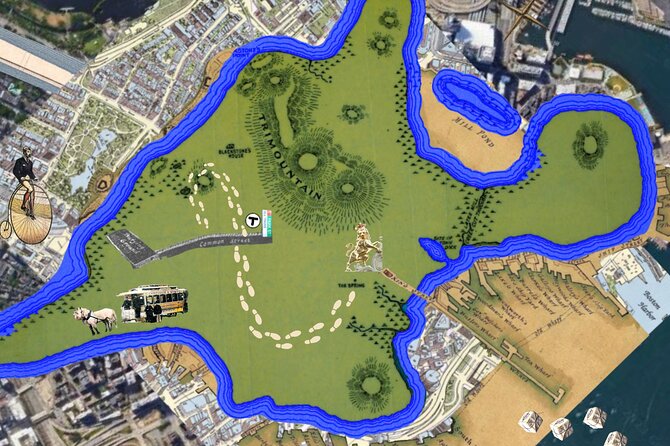
Start at Boston Common, at 139 Tremont Street. This is the right place to begin because the tour frames Boston as a settlement shaped by bold decisions, difficult travel, and people already living on the land.
You’ll hear about the Englishman who lived alone here from 1625 and the determined individual who spent 10 weeks crossing stormy seas to help establish the city in 1630. These details give the opening stop a human scale. You are not simply looking at a park. You are considering the risks and ambitions behind Boston’s earliest days.
The stop lasts about 15 minutes and costs nothing to enter. You should expect an outdoor introduction rather than a long historical lecture. That keeps the pace moving, though anyone hoping to spend time wandering the Common itself will need to return later.
More walking tours in Boston
- Boston: Freedom Trail History Small Group Walking Tour
★ 5.0 · 6,450 reviews - Harvard University Campus Guided Walking Tour
★ 4.5 · 3,632 reviews - Boston Freedom Trail Walking Tour with Costumed Guide
★ 4.5 · 2,531 reviews
The Soldiers and Sailors Monument and the view toward Back Bay
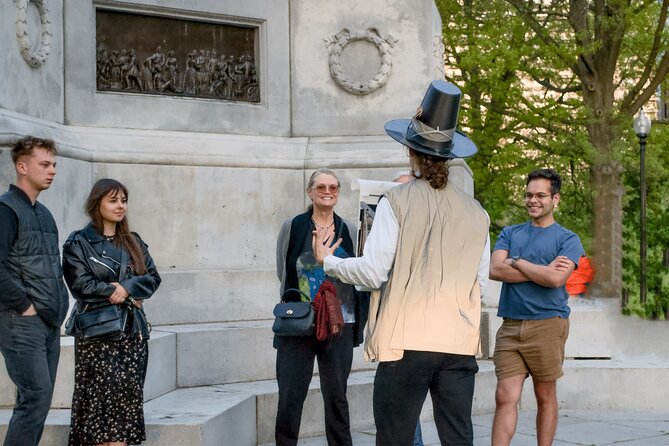
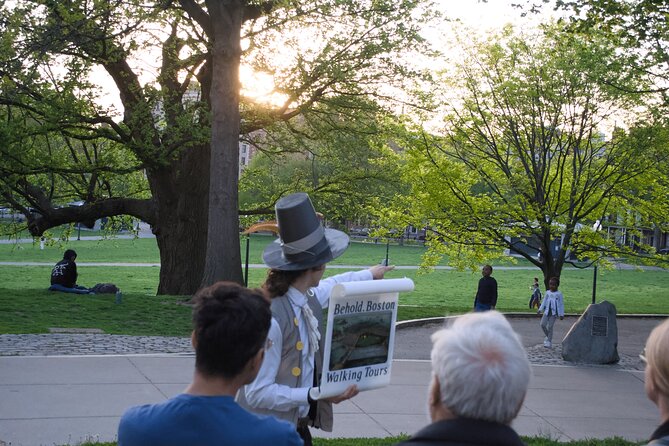
A short walk brings you to the Boston Soldiers and Sailors Monument. The guide uses its symbols to explain the Civil War and connect that period with the people who helped shape Boston.
The location also gives you a strong view toward Back Bay. This is one of the tour’s useful habits: it does not treat each monument as an isolated object. The guide uses what you can see from one place to explain how another part of Boston came into being.
Back Bay was once water. The land was filled in, then developed into a neighborhood for homes and business. That simple change explains much about Boston’s layout. You begin to see the city as something built and rebuilt, not as a fixed collection of old streets.
This stop takes about 15 minutes. The view is likely to mean more after the explanation than it would on a quick self-guided walk.
The Embrace and Boston’s connection to Martin Luther King Jr.
The route continues to The Embrace, a sculpture honoring Martin Luther King Jr. and Coretta Scott King. The stop is short, about five minutes, but the story behind it gives the artwork its meaning.
King met Coretta Scott in Boston while studying at Boston University. The sculpture is therefore tied not only to the civil rights leader’s public work but also to a personal connection formed in this city.
You will not spend a long time here, so treat this as a focused pause rather than a full art tour. The value comes from learning the story before looking closely at the sculpture. It also broadens the tour beyond colonial and revolutionary Boston, bringing in a more recent chapter of American history.
Park Street Church and the first subway story

The walk passes Park Street Church, once the tallest building in America. The church also marks the site of America’s first subway, as well as one of Boston’s busiest streets.
This is a good example of how Boston layers very different eras in a small area. A church, an early transportation milestone, and modern city traffic all share the same space. The guide helps you connect them rather than simply pointing them out.
The stop is part of the route rather than a separately timed visit. You should not expect an interior tour of the church. The strength here is the quick connection between architecture, urban growth, and public transportation.
A few more Boston tours and tickets worth a look
- Boston Duck Boat Sightseeing City Tour with Cruise Along Charles River
★ 4.5 · 9,378 reviews - Boston Hop-On Hop-Off Trolley Tour with 13 Stops
★ 4.5 · 5,576 reviews - Boston: City Cruises Whale Watching Cruise
★ 4.5 · 4,710 reviews - Boston Duck Tour: The Original and World-Famous
★ 4.6 · 3,935 reviews
Downtown Crossing and the Burnt District
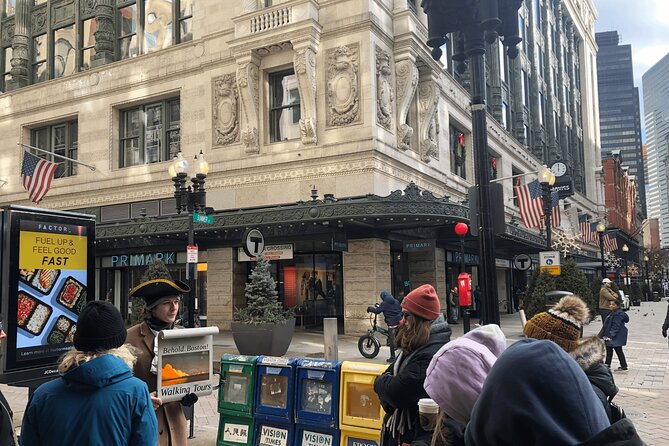
At Downtown Crossing, the tour shifts from individual landmarks to the changing shape of the city. You’ll look at three separate centuries of development and learn why this area was once called the Burnt District after a devastating fire.
Downtown Crossing is useful for understanding how Boston recovered and changed. Fires, commerce, roads, and new buildings all left their mark. The area can feel busy and modern, which makes the historical comparison especially helpful.
This is the longest stop, at about 25 minutes. That gives the guide room to explain the changes rather than rush through them. You’ll want comfortable shoes here, since the route involves moving through central city streets and pausing in public areas.
Winthrop Square: a useful ten-minute pause
Winthrop Square gives the tour a breathing space. You’ll have a 10-minute break among fountains and the new Great Hall at Winthrop Center, with accessible restrooms and air conditioning.
This is more than a convenience. A two-hour walking tour needs somewhere to pause, especially in warm weather or during a busy sightseeing day. You can use the break to cool down, refill your attention, and prepare for the final part of the route.
The walk to Winthrop Square also brings in education and writings that influenced Bostonians and people far beyond Boston. That topic adds another layer to the tour. The city’s influence did not come only from its buildings or political events. Ideas and education mattered, too.
South Station and the changing ways Boston moves
At South Station, the focus turns to transportation. You’ll discuss railways, highways, tunnels, and boats that once passed through or near the waterfront.
This stop is especially useful if you want to understand Boston as a working city rather than only a historic one. Transportation explains why certain areas grew, why connections mattered, and how the waterfront changed over time.
The guide also explains what happened to the connection between North Station and South Station. You’ll hear about Charlie, the familiar figure associated with Boston subway cards. The subject may sound small, but it gives a local detail to a larger story about transit and daily life.
The stop lasts about 15 minutes. South Station can be a practical place to begin or continue your own Boston plans after the tour, though the official route ends farther north near the Old State House.
Post Office Square and Boston’s unusual street pattern
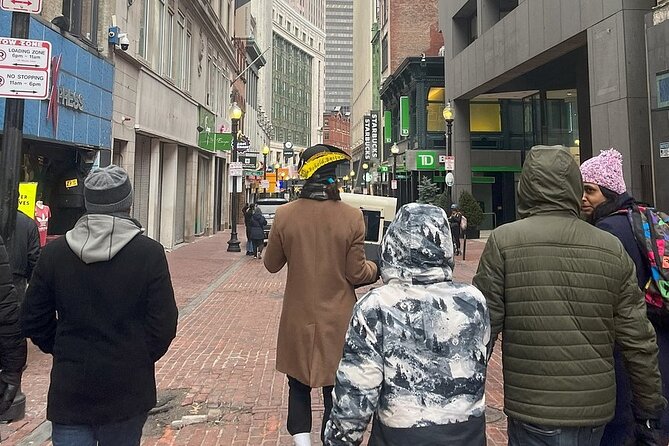
Post Office Square brings a lighter tone. Here, the guide asks if Boston’s streets really began as cow paths and why parking costs so much.
The tour also includes wordplay involving horses or Morse, depending on the mood of the group. This keeps the history from becoming too solemn. Boston has serious stories, but it also has odd details and local humor.
The stop takes about 15 minutes. You’ll consider how older street patterns affect modern movement and why getting around downtown can feel less orderly than in a planned city. The exact level of humor may vary with the group, but the topic gives you a practical way to understand Boston’s streets.
The Old State House: a three-century time capsule
The final stop is the Old State House at 11 Congress Street. It is described as Massachusetts’ oldest public building and as a bright time capsule of Boston’s past.
The guide explains how British symbols were removed and replaced with replicas, then traces the building’s changes across 300 years. This is a strong ending because the building gathers many of the tour’s themes in one place: British rule, local identity, public power, preservation, and change.
The tour ends here rather than returning to Boston Common. Plan on a 15-minute walk if you need to get back to the starting point. You can also treat the ending as a useful handoff into the rest of downtown, since the Old State House is close to other central sights.
The UltraHD visual guide adds real value
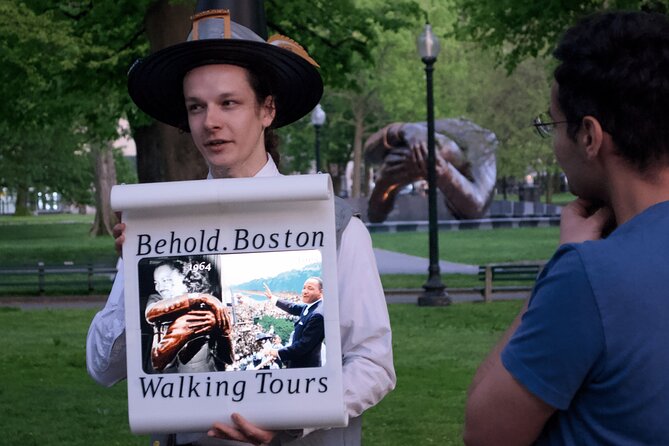
The most distinctive feature is the UltraHD scroll showing restored photographs, films, and sounds connected to the places around you. Historic explanations can be hard to picture when all you see is a modern street. Visual material helps bridge that gap.
I especially like this approach for Boston, where old and new buildings often share the same blocks. A restored photograph can show how a street looked before a fire, a filled waterfront, or a major transportation change. A film or sound recording can also give a better sense of how people used the area.
The screen is not a substitute for seeing the city directly. Its value is in comparison. You look at today’s Boston, then see evidence of what came before. That makes the tour feel more like a guided reading of the streets than a list of dates.
What the guide adds
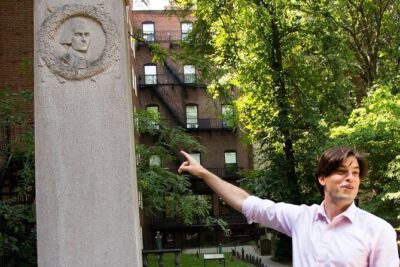
The guide is Arty, and his approach includes detailed research, clear explanations, and a calm pace. He also helps with photographs at historic sites, which is useful when you want a good picture without holding up the group.
The personal recommendations can be helpful at the end of the walk. Arty has suggested a pizza place and other Boston sights, and one visitor also mentioned continuing on to Harvard afterward. You should still make your own plans, but a guide who understands how to connect the tour with the rest of your day can save time.
A maximum of 16 people matters here. You get a better chance to hear the narration, follow the screen, and ask a question than you would in a very large group. The tour is offered in English only.
Is $29.40 a fair price?
At $29.40 per person, this is not the cheapest way to walk through downtown Boston, but it is a reasonable price for a 2-hour-and-5-minute guided experience with visual material and a planned rest stop.
You are paying for three things: the guide’s preparation, the route design, and the UltraHD historical content. If you only want a quick orientation, you can walk past many of these places on your own for free. If you want the connections explained and the past shown alongside the present, the fee makes more sense.
The small group improves the value. So does the range of subjects, from Boston’s founding and the Civil War to public art, subway history, urban fires, education, and waterfront transport. I would consider it a good first-day activity if you want a clear framework for later sightseeing.
Who will enjoy this Boston walking tour?
This tour suits you if you like city history delivered on foot, with plenty of explanation but no long museum visit. It is also a good fit if you want to understand how Boston’s streets, transit, waterfront, and neighborhoods developed.
You should be comfortable walking and standing outdoors for most of two hours. The 10-minute air-conditioned break helps, but it does not turn the experience into an indoor activity.
Most people can participate, and service animals are allowed. The route is near public transportation, which makes reaching the starting point easier. Parking is not included, so driving into central Boston adds cost and planning.
Book at least a day ahead if your schedule is firm. The tour is often reserved about 29 days before the date, so a popular time may not remain open close to departure.
The activity requires good weather. You can cancel for a full refund up to 24 hours before the start time. Cancellations or changes inside that period are not refunded or accepted, while a weather cancellation gives you the option of another date or a full refund.
Should you book Building Blocks of Boston?
Book this tour if you want Boston explained through its streets rather than simply photographed from a bus. The route is well chosen, the group is capped at 16, and the historic images give the guide’s stories something concrete to show you.
Skip it if you prefer to explore alone, spend long periods inside individual landmarks, or avoid walking in uncertain weather. For most visitors who want a useful first look at downtown Boston, $29.40 is a fair trade for two hours of context, local detail, and a route that ends near the Old State House.
FAQ
Where does the tour begin?
The tour begins at 139 Tremont Street, Boston, Massachusetts 02111.
Where does the tour end?
The tour ends at 11 Congress Street, Boston, Massachusetts 02109, near the Old State House.
How long does the tour last?
The tour lasts approximately 2 hours and 5 minutes.
How many people can join the tour?
The maximum group size is 16 people.
What language is the tour offered in?
The tour is offered in English.
Is the Boston Common admission fee included?
Boston Common has free admission, and the tour stops there for about 15 minutes.
Is there a break during the walk?
Yes. The tour includes a 10-minute break at Winthrop Center with accessible restrooms and air conditioning.
Are service animals allowed?
Yes, service animals are allowed.
What happens if bad weather cancels the tour?
Because the experience requires good weather, a weather cancellation gives you the choice of another date or a full refund.
Can I cancel for a full refund?
Yes. You must cancel at least 24 hours before the start time for a full refund. Cancellations within 24 hours are not refunded.
Newest Boston tours we have written up
- Boston’s Freedom Trail: A Self-Guided Audio Tour★ 4.0 · 18 reviews
- Boston’s Freedom Trail: A Self-Guided Tour of All 16 Sites★ 5.0 · 14 reviews
- Washington D.C. Cherry Blossom,Baltimore 3-Day Tour from Boston★ 4.5 · 7 reviews
- Boston Self-Guided Audio Tour Bundle: Freedom Trail & More★ 4.5 · 5 reviews
- True Crime Tour of Boston★ 4.0 · 17 reviews
- Family Friendly Guided Bike Tour of Boston★ 4.5 · 22 reviews
- Freedom Trail Experience★ 5.0 · 8 reviews
- The Ghosts of Boston’s Past Haunted Self-guided Tour★ 3.5 · 4 reviews
Walking Tours, compared.
History and Hauntings of Salem Guided Walking Tour
Read our review →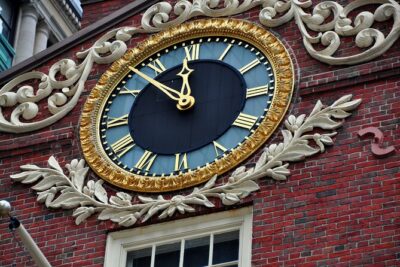
Freedom Trail History Small Group Walking Tour
Read our review →
Harvard University Campus Guided Walking Tour
Read our review →
Boston Freedom Trail Walking Tour with Costumed Guide
Read our review →
The Full Revolutionary Story Epic Small Group Boston Walking Tour
Read our review →

Boston’s Freedom Trail: A Revolutionary Walking Tour
Read our review →Browse the lists this tour appears in