

Review · BOSTON FREEDOM TRAIL TOURS
Boston: Freedom Trail History Tour and Brewery Taste
Boston’s Revolution story comes alive on this 2.5-hour walk from Faneuil Hall to Boston Common, where the stops are not just old buildings but places tied to protest, politics, death, and public debate. I like the route’s focus on 11 of the 16 Freedom Trail landmarks, and I like that the history ends with a proper meal and drink at Democracy Brewing rather than a quick goodbye on the sidewalk.
The small-group format is another strong point. Guides such as Gianna, Nick, and Jon bring a personal touch, and a group of 16 or fewer can make it easier to ask questions. The main drawback is the amount of walking and standing, so this is not the best pick if you have trouble staying on your feet. The North End and Charlestown are also not included.
Key points to know before booking
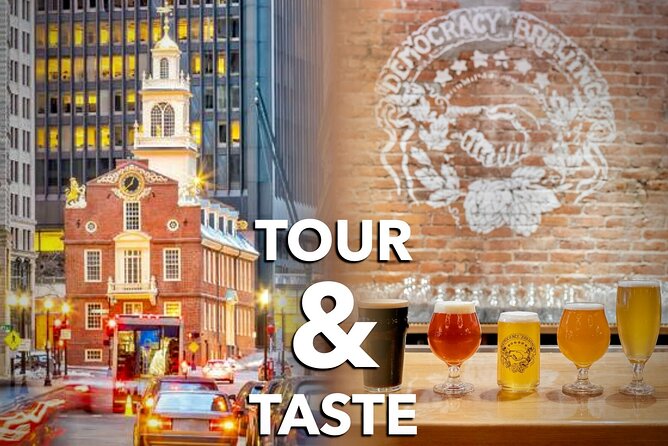
- Eleven Freedom Trail landmarks: You cover a large share of central Boston’s official trail in one morning.
- A clear Revolutionary route: Faneuil Hall, the Boston Massacre site, Old South Meeting House, Granary Burying Ground, and Boston Common connect the major events.
- Guides with local character: Gianna, Nick, and Jon are among the guides named in the tour information, with history and archival experience noted for Jon.
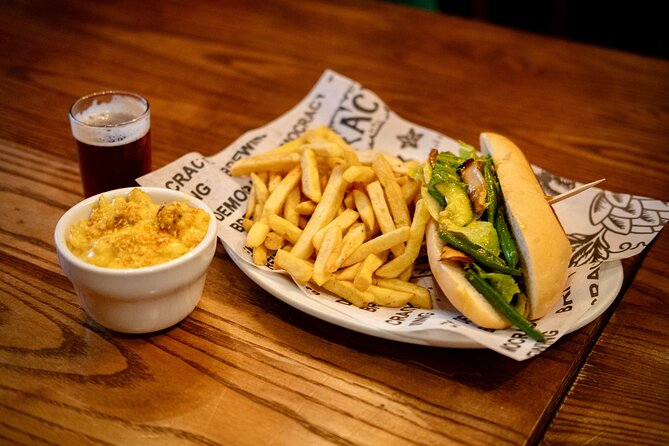
- Lunch is part of the plan: Your visit ends at Democracy Brewing with an all-inclusive New England lunch.
- A drink for different tastes: The tasting includes beer, seltzer, or a mocktail.
- Moderate fitness required: Expect about two hours of walking and standing, with a maximum group size of 25.
Why this Freedom Trail walk works
The Freedom Trail can feel simple at first. Follow the red line, pause at a few brick buildings, take photographs, and move on. The value of a guided walk is the connecting thread: why a crowd gathered at Old South Meeting House, why the Boston Massacre mattered, and how public meeting places helped push Boston toward revolution.
This tour concentrates on the historic core between Faneuil Hall and Boston Common. You are not trying to cover every corner of Boston. Instead, you get a focused route through the oldest parts of downtown, with enough time at the main sites to hear their story without spending a full day on the trail.
I especially like the way the route links public spaces with personal stories. Faneuil Hall is about town meetings and political speech. The Boston Massacre site is about violence and propaganda. Granary Burying Ground brings the era down to individual names and graves. That movement from public debate to personal loss gives the morning a useful shape.
The tour is offered in English and starts at 11:00 a.m. at 121 South Market Street, across from Quincy Market in Faneuil Hall Marketplace. Look for the black-and-white Coach banners. That meeting detail matters because the market area has several entrances and can be busy.
More ways to walk the Freedom Trail
- Boston: Freedom Trail History Small Group Walking Tour
★ 5.0 · 6,450 reviews - Boston Freedom Trail Walking Tour with Costumed Guide
★ 4.5 · 2,531 reviews - Boston Food & History: Pizza, North End & Freedom Trail
★ 5.0 · 1,772 reviews
Faneuil Hall Marketplace sets the political tone
The first stop is Faneuil Hall Marketplace, where you meet your guide and begin with the setting that now serves as one of Boston’s main tourism hubs. The modern market activity surrounds historic Faneuil Hall, which dates to 1742 and is known as the Cradle of Liberty.
Faneuil Hall hosted Boston’s town meeting, so it is an ideal place to begin a story about public argument. Your guide can frame the Revolution as more than battlefield action. It also grew from speeches, meetings, trade disputes, taxes, and anger over who had the right to make decisions.
The listed time here is about 10 minutes. That is enough for an introduction and orientation, but not enough for a long visit inside every building. If you want extensive time in the market or at Quincy Market, plan to return on your own.
The Boston Massacre site puts politics into human terms
The walk continues to the Boston Massacre site, where British soldiers killed five Bostonians in 1770. The event became a powerful political tool, helping colonial leaders turn local anger into wider opposition to British rule.
This is a short stop of about 15 minutes, but it carries a lot of weight. I like that it appears early in the route, because it gives the later stops a sharper context. At this point, the tour is no longer just about attractive old buildings. You are looking at a place where military occupation, public tension, and political messaging collided.
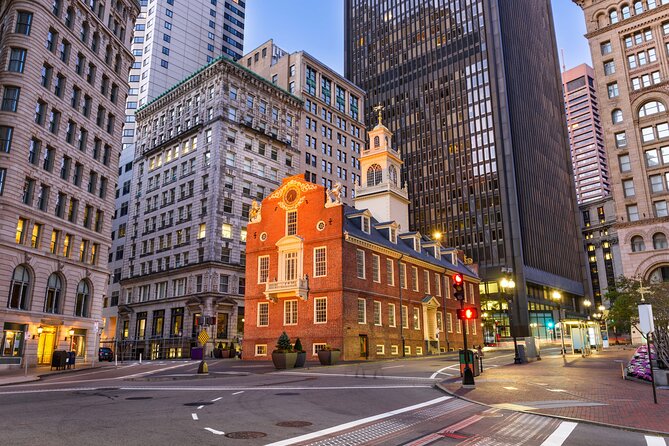
Nearby sites include the former colonial capitol of Massachusetts Bay Colony, dating to 1713 and described as Boston’s oldest public building. You also pass locations tied to publishing and Boston politics. These details help show how government, newspapers, churches, and commerce operated close together in the compact colonial city.
Do not expect a long indoor museum visit at this point. The tour is built around outdoor interpretation and short visits at a series of sites. That keeps the route moving, but you should choose another activity later if you want to explore each building’s interior.
Old South Meeting House connects protest with the Tea Party
Old South Meeting House is one of the most important stops on the route. This Congregationalist meeting house dates to 1729 and is known as the place where the meeting that led to the Boston Tea Party began in 1773.
The building’s importance comes from its role as a public gathering place. Large meetings could turn frustration into action, and Old South Meeting House shows how religious spaces also served civic and political purposes. Your guide can place the Tea Party in the wider dispute over taxation and representation rather than treating it as an isolated dramatic episode.
The planned stop lasts about 15 minutes. That gives you time to understand the building’s role and see the surrounding historic blocks. You also pass the former publishing house of Ticknor & Fields, a reminder that this part of Boston remained tied to books and public opinion long after the Revolution.
The route also points out the former center of Boston politics for more than a century. Details like this are useful because they reveal how much of the city’s power was concentrated within a walkable area.
More pub crawls and brewery tours in Boston
- Boston Freedom Trail History Pub Crawl Small-Group Tour
★ 5.0 · 996 reviews - Boston: History Pub Crawl Tour Along the Freedom Trail
★ 4.9 · 279 reviews - Signature Boston Guided Brewery Tour with snack
★ 5.0 · 271 reviews - Boston: Haunted Pub Crawl of Historic Pubs and Taverns
★ 4.6 · 127 reviews
Franklin, Boston Latin School, and the city’s oldest ground
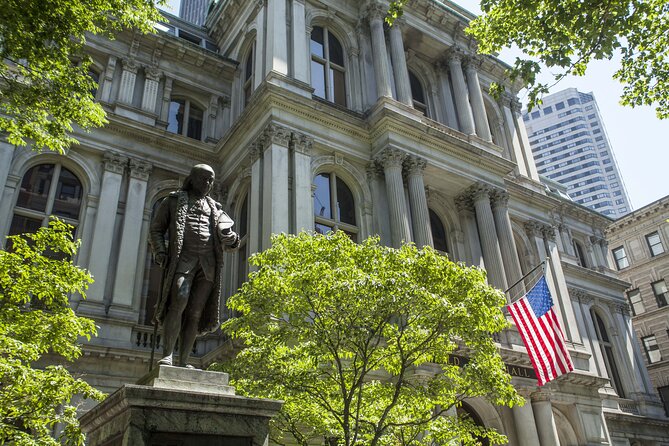
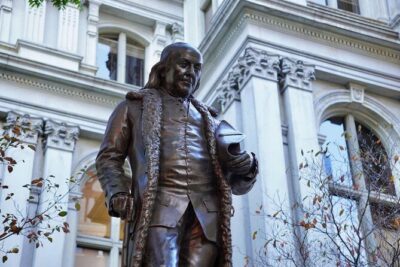
The statue of Benjamin Franklin receives a shorter stop, about five minutes. The location marks the site of Boston Latin School, founded in 1635 and described as the oldest public school in the Americas.
That stop works best as a quick connection between famous people and ordinary civic institutions. Franklin is often remembered as a printer, scientist, diplomat, and statesman, but the surrounding site also points to the importance of education in colonial Boston.
You also pass the First Church of England in Puritan Boston, founded in 1686 and rebuilt in 1754, along with Boston’s first burying space, dating to 1630. These places can be easy to miss if you walk the Freedom Trail without a guide. Their value is partly visual, but the larger point is how closely worship, schooling, government, and burial grounds were packed into the early town.
Because the stop is brief, I would not expect a long talk devoted only to Franklin. Think of it as one piece in a tightly arranged sequence of historic sites.
Granary Burying Ground is the emotional center
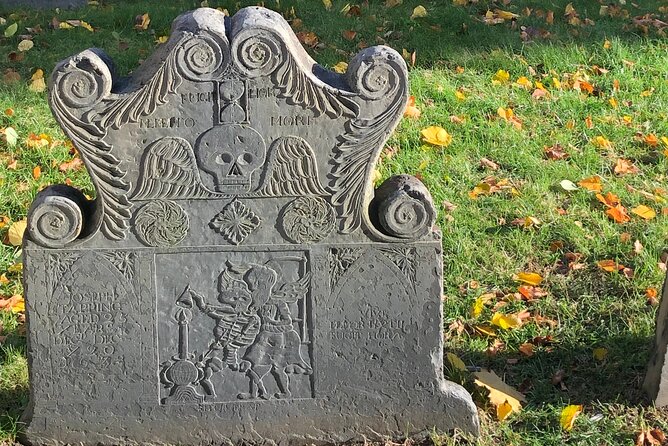
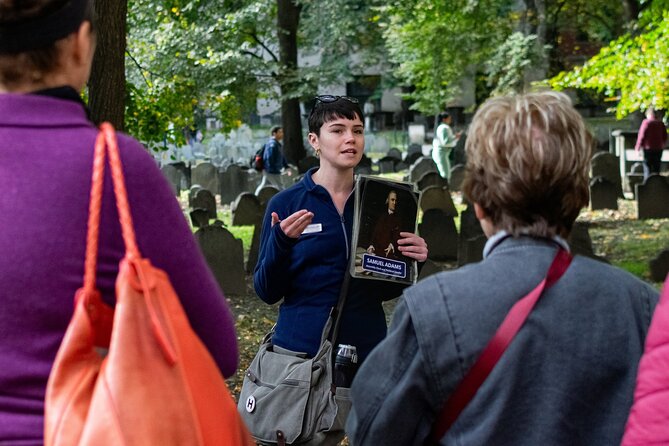
Granary Burying Ground gets about 15 minutes and may be the most memorable stop for many people. Founded in 1660, it is Boston’s third-oldest burying ground and the final resting place of important figures from Revolutionary Boston.
A cemetery changes the pace of the walk. Instead of hearing about crowds and speeches, you see names, dates, and physical reminders of the people who shaped the period. It also makes the past feel less remote. The Revolution was not only a set of famous events. It involved families, public servants, religious leaders, printers, soldiers, and residents whose lives ended in the same city you are walking through.
The tour also passes an active church that was the tallest building in 19th-century Boston, as well as the Massachusetts State House, completed in 1798. The State House is associated with Boston’s nickname, the Hub of the Solar System, and adds a later layer to the route.
I would pay close attention here. The cemetery is a place where a good guide can add useful detail without needing a long lecture. Jon, described as a local historian and archivist, is one guide who may bring particular interest to archival details, while Gianna is noted for combining historical information with a warm, attentive manner.
Boston Common closes the walking portion
The final major outdoor stop is Boston Common, founded in 1634. It is described as the oldest public land in the Americas and once served as Boston’s communal grazing pasture.
Boston Common gives the tour a broad ending. You have moved from meeting halls and street conflict to churches, graves, government, and a public green. The site also helps explain Boston as a town shaped by shared spaces. It was not just a collection of private houses and businesses. The common belonged to public life.
The walk from Faneuil Hall to Boston Common is described as easy-paced, but you still need moderate physical fitness. The tour is about two and a half hours in total, and the route includes repeated periods of standing while the guide speaks. Comfortable shoes are more useful than dress shoes, and a weather check before departure is sensible.
The tour requires good weather. If poor weather cancels the experience, you are offered another date or a full refund. That policy is helpful, but it also means you should keep some flexibility in your Boston schedule.
Democracy Brewing turns history into a full lunch stop
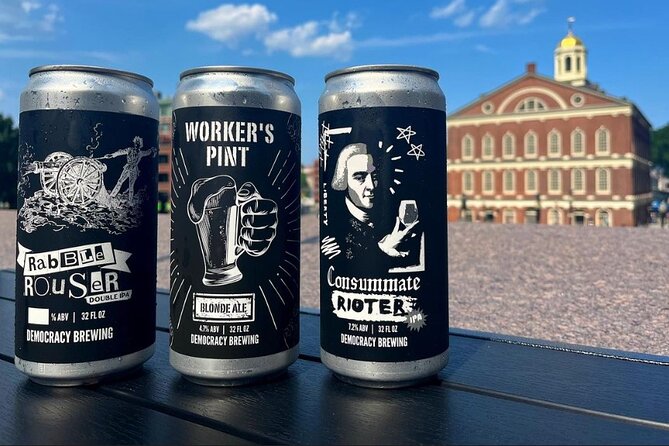
The tour concludes at Democracy Brewing, a worker-owned Boston brewery at 35 Temple Place. This is more than a token tasting. The plan includes a private dining room, a drink tasting, and an all-inclusive New England lunch.
You can choose beer, seltzer, or a mocktail tasting. That makes the final stop workable for people who do not drink alcohol, though the details of the exact food and tasting selections are not specified. The brewery also has a full restaurant menu and a broad selection of beers, so the setting is designed for a proper meal rather than a quick sample at the bar.
This ending is one of the tour’s best practical features. After a morning of walking and listening, you get time to sit down. The lunch also gives you a chance to continue talking with your group or guide, though the tour’s formal route ends inside the brewery.
The restaurant is worker-owned and focused on community support, which gives the final stop a local angle. It is not simply a convenient place chosen because it sits near the route. The food and drink component is part of the experience’s identity.
Is the $79 price fair?
At $79 per person, this is not the cheapest way to walk the Freedom Trail. You can follow the red line independently for little or no cost, and several of the listed outdoor sites do not require admission.
The comparison changes when you count what is included. The price covers a guided walk covering 11 of the 16 official Freedom Trail landmarks, a beer, seltzer, or mocktail tasting, and an all-inclusive New England lunch. You are paying for interpretation, structure, and a meal, not just access to the streets.
I see the best value for someone with one morning in Boston who wants the basic route explained without planning each stop. It can also work well for a local who wants a fresh look at familiar places, especially with a guide such as Nick, whose tour style is noted for pointing out details that may not appear in a standard American history lesson.
The value is weaker if you mainly want to enter every historic building, cover the full Freedom Trail, or spend time in the North End and Charlestown. Those areas are not included. You may need a separate plan for the four official landmarks left off this route, plus the additional neighborhoods.
Group size, pace, and guide style
The maximum group size is 25, though the tour information describes smaller groups of 16 or fewer on some departures. A smaller group usually gives you more room to ask questions and makes it easier to hear the guide in city streets.
Guide style matters on a history walk. Gianna is described as friendly and attentive, with an effort to help people feel comfortable during the walk. Nick is associated with an easy-paced route and historical details beyond the usual textbook version. Jon is described as a local historian and archivist, which may appeal to you if you like source-based stories and small details.
You are not guaranteed a particular guide unless the booking process says so, so treat these names as examples of the people who may lead the tour. The experience is offered in English, and it does not include guides in period costume. That suits you if you prefer a straightforward history walk rather than theatrical reenactment.
Service animals are allowed, and the meeting point is near public transportation. The experience is not recommended for anyone who has difficulty standing for extended periods.
Who should book this Boston tour?
I would choose this tour if you want a compact introduction to central Boston’s Revolution story with a meal already arranged. It suits first-time visitors who want context, couples or friends who like history but do not want a full-day program, and Boston locals looking for a guided route through places they may have passed many times.
It also suits mixed groups. One person can focus on history, another can enjoy the brewery, and someone who does not drink can select a mocktail. The lunch helps make the $79 price easier to assess.
I would skip it if your priority is the complete Freedom Trail, indoor access to every historic site, or a visit to the North End and Charlestown. You should also think twice if long periods on your feet are difficult. The walk is described as easy-paced, but easy pace does not mean no walking.
Book at least a day ahead if your schedule is fixed. The experience is often reserved about 17 days in advance, so popular dates may fill before your visit. Free cancellation is available until 24 hours before the start time. Changes or cancellations inside that window are not accepted for a refund.
FAQ
Where does the Boston Freedom Trail tour begin?
It begins at 121 South Market Street in Boston’s Faneuil Hall Marketplace. Look for the black-and-white Coach banners opposite Quincy Market.
What time does the tour start?
The tour starts at 11:00 a.m.
How long does the experience last?
The experience lasts approximately two hours and 30 minutes, including the walking route and the stop at Democracy Brewing.
How many Freedom Trail landmarks are included?
The tour covers 11 of Boston’s 16 official Freedom Trail landmarks.
What is included at Democracy Brewing?
The tour includes a beer, seltzer, or mocktail tasting and an all-inclusive New England lunch. The stop takes about one hour and ends inside the brewery.
Is the tour suitable for someone who has difficulty standing?
No. The experience is not recommended for people who have difficulty standing for extended periods, and a moderate physical fitness level is required.
Can I cancel for a refund?
Yes. You can cancel at least 24 hours before the start time for a full refund. If poor weather causes the tour to be canceled, you are offered another date or a full refund.
More bar and brewery outings in Boston
- Boston Ghosts Boos and Brews Haunted Pub Crawl
★ 4.5 · 95 reviews - Boston: Boos and Brews Haunted Pub Crawl
★ 4.2 · 73 reviews - Boston Haunted Pub Crawl
★ 4.0 · 62 reviews - Boston: Historic Pubs Walking & Ferry, Food & Drink Tour
★ 4.9 · 56 reviews
More Breweries in Boston
- Boston: Guided Craft Brewery Tour with a Snack
★ 4.9 · 27 reviews - Sushi Making Class at a Local Brewery in Boston
★ 4.5 · 3 reviews
Newest Boston tours we have written up
- Boston’s Freedom Trail: A Self-Guided Audio Tour★ 4.0 · 18 reviews
- Boston’s Freedom Trail: A Self-Guided Tour of All 16 Sites★ 5.0 · 14 reviews
- Washington D.C. Cherry Blossom,Baltimore 3-Day Tour from Boston★ 4.5 · 7 reviews
- Boston Self-Guided Audio Tour Bundle: Freedom Trail & More★ 4.5 · 5 reviews
- True Crime Tour of Boston★ 4.0 · 17 reviews
- Family Friendly Guided Bike Tour of Boston★ 4.5 · 22 reviews
- Freedom Trail Experience★ 5.0 · 8 reviews
- The Ghosts of Boston’s Past Haunted Self-guided Tour★ 3.5 · 4 reviews
Boston Freedom Trail Tours, compared.
Freedom Trail History Small Group Walking Tour
Read our review →
Boston Freedom Trail Walking Tour with Costumed Guide
Read our review →
Boston Food & History: Pizza, North End & Freedom Trail
Read our review →
Boston’s Freedom Trail: A Revolutionary Walking Tour
Read our review →Freedom Trail History Small Group Walking Tour
Read our review →Boston’s Freedom Trail: A Revolutionary Walking Tour
Read our review →
Boston Freedom Trail History Pub Crawl Small-Group Tour
Read our review →Browse the lists this tour appears in