
Review · BOSTON FREEDOM TRAIL TOURS
Boston: Freedom Trail History Small Group Walking Tour
Boston’s Freedom Trail is more than a line of red bricks through downtown. It is a compact lesson in how a city moved from uneasy loyalty to open rebellion, with churches, graveyards, meeting halls, and street corners doing the storytelling. This small-group walk covers the full route from Boston Common to the North End in about two and a half hours.
I like the group limit of 15, which makes it easier to hear the guide on crowded sidewalks. I also like the stop at Granary Burying Ground, where Paul Revere, Samuel Adams, and other major figures are buried. The main drawback is simple: you walk about 2 miles, often outdoors in exposed weather, and the tour can last close to three hours.
The best guides give this tour its character. Names praised in recent feedback include Maura, Nick, Cyrus, Alejandro, Zoe, Jon, and Eric. Their styles differ, but the strongest guides explain the period with energy and context rather than firing dates at you. Bring good shoes, dress for the forecast, and leave large bags behind.
Key points to know before you book
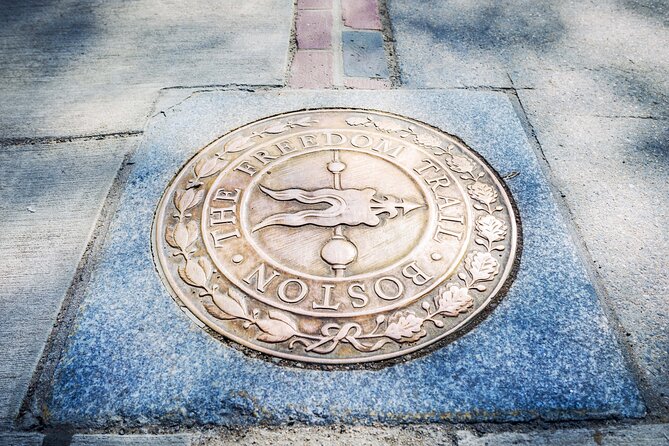
- The route covers all 16 official Freedom Trail landmarks, from Boston Common to Copp’s Hill Terrace.
- A maximum of 15 people keeps the walk more personal than the huge groups often seen downtown.
- The tour covers about 2 miles and lasts 150 minutes, though it may run as long as three hours.
- A short Quincy Market break gives you time for a drink, a restroom stop, or a quick pause.
- The North End finish is useful, putting you near the Old North Church, Italian restaurants, and views toward Charlestown.
- Admission inside museums is not included, so this is mainly an outdoor history walk.
Starting at Boston Common, where Boston’s story opens
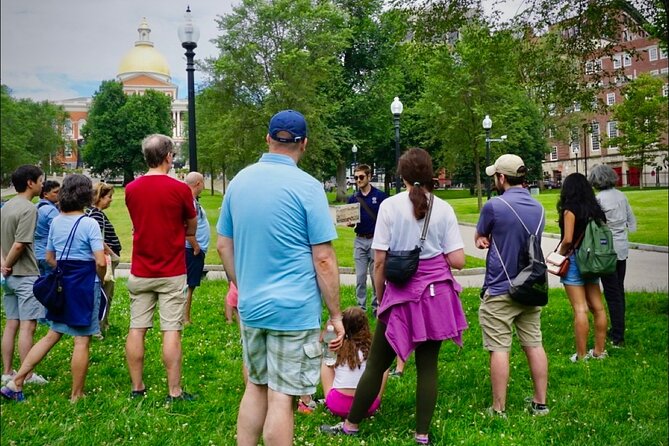
Meet inside Boston Common at the Boston Foundation Monument, on the park’s northern edge opposite 50 Beacon Street. Look for the granite memorial with a bronze relief of two men shaking hands, tied to the Puritan arrival in 1630.
This is a sensible starting point. Boston Common is easy to reach, and the guide can give you the city’s basic setup before the walk becomes a parade of names and dates. You begin with the oldest public park in the United States and quickly move toward the political center of colonial Boston.
The first guided section includes Boston Common, the Massachusetts State House, and Park Street Church. The State House sits on Beacon Hill, with its familiar golden dome, while Park Street Church marks the shift from open parkland into the older streets around downtown.
You do not simply stop for photographs. The useful part is learning how Boston’s geography shaped public life. Churches, meeting places, government buildings, markets, and burial grounds sit close together, so the walk shows how political arguments spread through a small colonial city.
More ways to walk the Freedom Trail
- Boston: Freedom Trail History Small Group Walking Tour
★ 5.0 · 6,450 reviews - Boston Freedom Trail Walking Tour with Costumed Guide
★ 4.5 · 2,531 reviews - Boston Food & History: Pizza, North End & Freedom Trail
★ 5.0 · 1,772 reviews
Granary Burying Ground puts famous names in one place
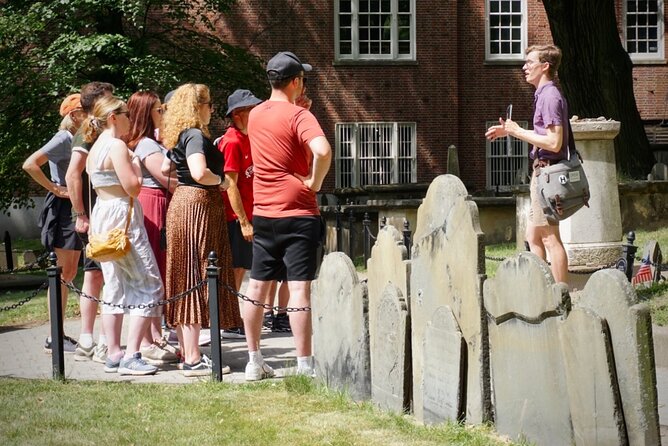
Granary Burying Ground is one of the most meaningful stops on the route, and the tour allows about 25 minutes here. The old graveyard holds the remains of Paul Revere, Samuel Adams, John Hancock, Benjamin Franklin’s parents, and other figures tied to Boston’s early political life.
This is where the tour’s grand story becomes personal. You are looking at actual burial places rather than only hearing about people in a textbook. The guide can connect the names on the stones to the debates, protests, and decisions that led toward war.
The drawback is that graveyards can feel crowded, especially when several tour groups arrive together. A group of 15 helps, but you still need to stay close and listen carefully. If you want time to read every marker, you may need to return on your own.
From here, the route passes King’s Chapel and continues toward the old civic center. The pace is steady, with frequent stops. You will not be walking nonstop, but this is still an active sightseeing experience, not a slow museum visit.
Boston’s early schools, city hall, and book trade
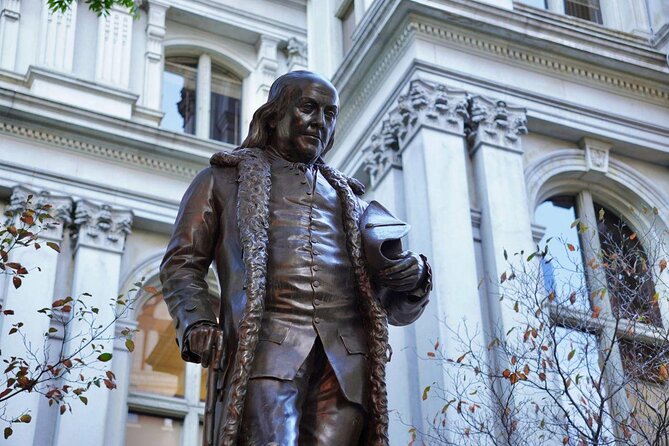
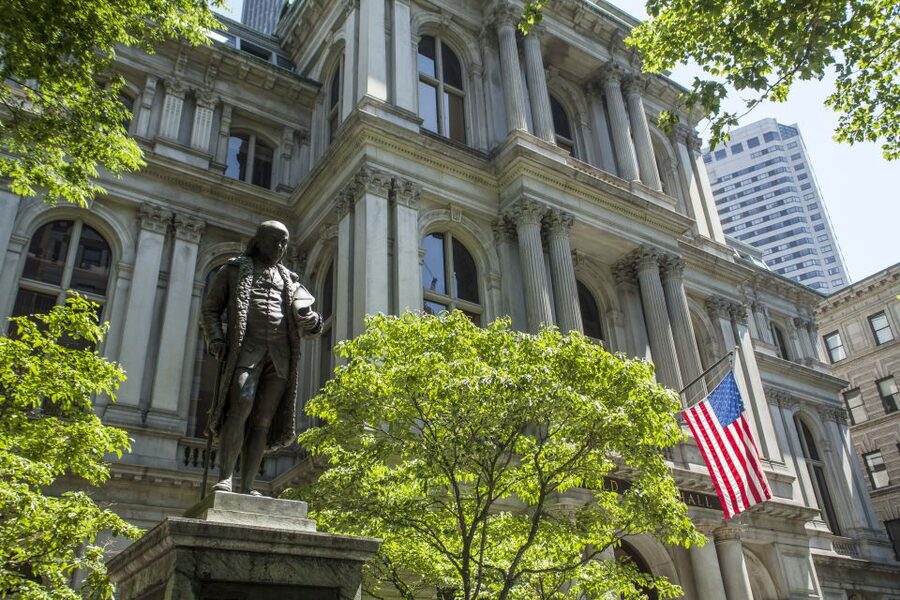
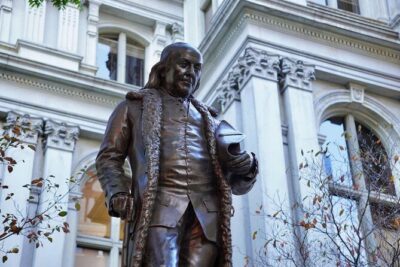
The next stretch brings you past the Boston Latin School site and the statue of Benjamin Franklin. The school is tied to Boston’s early education system, while Franklin offers a chance to consider the city’s connection to one of the most famous printers, writers, and political thinkers of the period.
You also pass Old City Hall and the Old Corner Bookstore. These stops help widen the story beyond battles and famous speeches. Boston was also a city of education, publishing, public debate, and local government. That wider view is useful because the Revolution did not arrive from nowhere. It grew through years of argument and organized opposition.
The strongest guides add small corrections to familiar myths. You may hear, for example, that Paul Revere did not complete the entire midnight ride, or that the tea tax had been cut in half before the Boston Tea Party. Details like these make the history less tidy, but more accurate.
Old South Meeting House shows how protest gathered momentum
Old South Meeting House is one of the most important buildings on the walk. The tour gives it about 10 minutes, enough to explain its role as a gathering place before the Boston Tea Party.
This stop helps you understand the scale of public protest. The conflict was not only fought by generals and government officials. Ordinary colonists gathered, argued, listened, and made decisions in rooms such as this one.
Inside admission is not included, so your experience here depends on the guide’s explanation from the outside unless you return separately. That is worth keeping in mind if you want detailed architectural or museum time. The walking tour gives you the political meaning, not a full indoor visit.
More history tours in Boston
- Tour of Historic Fenway Park, America’s Most Beloved Ballpark
★ 4.5 · 3,013 reviews - Boston: City Cruises Historical Sightseeing Cruise
★ 4.6 · 1,771 reviews - City Cruises Boston Historic Sightseeing Harbor Cruise
★ 4.5 · 1,388 reviews - Boston’s North End Food Tour: Italian Flavors & Heritage Walk
★ 5.0 · 1,322 reviews
Old State House and the Boston Massacre Site
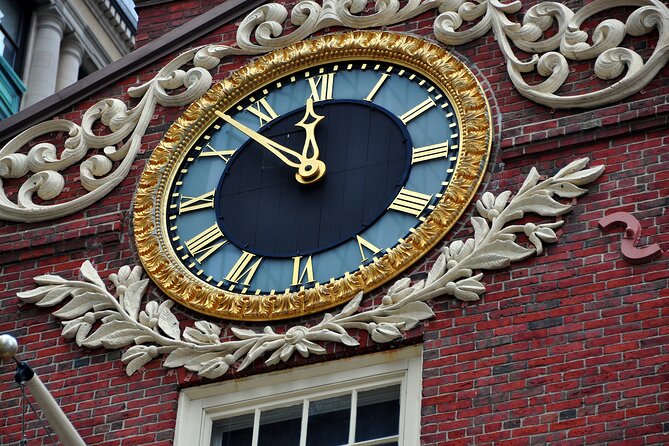
The Old State House is a high point of the route. It was the center of colonial government and later became linked with one of the most famous confrontations between British soldiers and Boston residents.
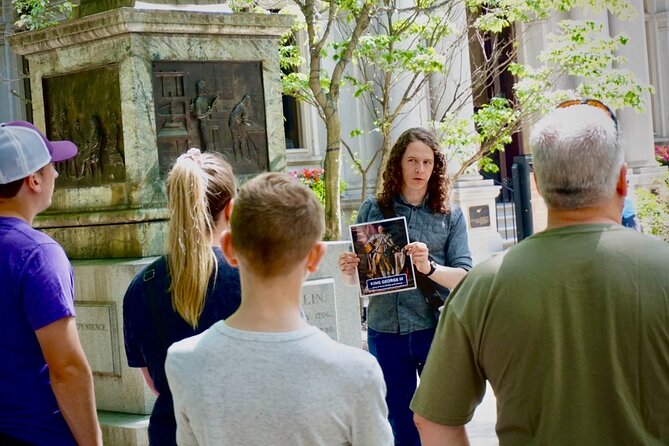
Just outside is the Boston Massacre Site. The guide explains the shooting and the way the event was presented to the public. This is one place where a good guide matters greatly. The label Boston Massacre carries a strong political charge, and the best explanations provide several angles instead of repeating a simple patriotic script.
The tour is especially useful for people who already know the basic story but want more context. A British history teacher praised the way guide Nick separated later myth from the messy facts of the event. You can expect discussion of the soldiers, the crowd, and the way the incident was used to build opposition to British rule.
The stop lasts about 15 minutes. Sidewalk traffic can make it hard to hear, so stand close to the guide and avoid drifting toward the edge of the group.
Faneuil Hall and Quincy Market offer a practical pause
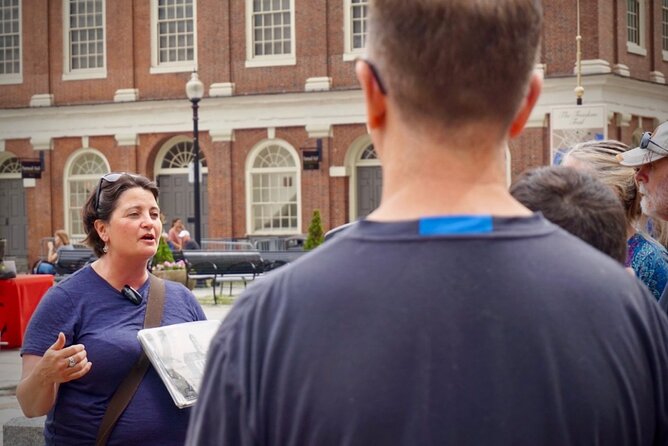
Faneuil Hall comes next, with about five minutes of guided time. Known for speeches and public debate, it remains one of the city’s key historic buildings and a natural place to discuss Boston’s political culture.
The stop is brief because the route has a lot to cover. You will get the main point and the building’s place in the Revolution story, but you should not expect a long indoor visit.
At Quincy Market, the tour allows a 10-minute break. This is a small but valuable feature. You can use the restroom, get a drink, or simply let your feet recover before the North End section. Several people have singled out the midpoint break as helpful, especially on a long walk or in poor weather.
Quincy Market can be busy, so keep track of the meeting time and location. This is a pause, not free time to wander far.
Paul Revere’s house brings the story into the North End
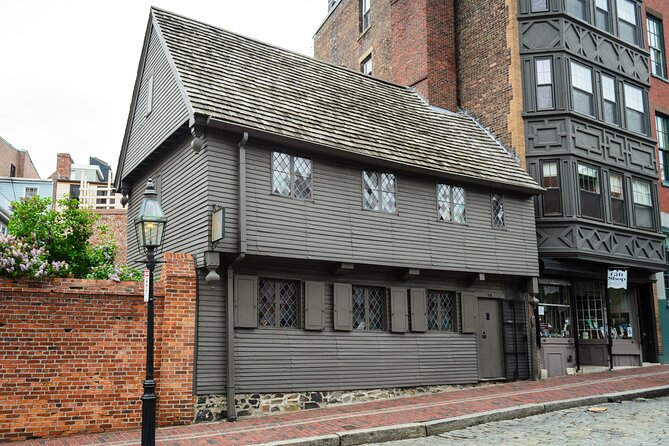
The route continues through the North End to Paul Revere House, where the tour spends about 15 minutes. The house is a useful counterpoint to the larger public buildings earlier in the walk. Here, the Revolution connects with a real home and a working neighborhood.
Paul Revere’s popular image centers on the midnight ride, but the wider story is more interesting. He was a silversmith, messenger, civic participant, and family man. The guide can place the ride within the larger network of warnings and local action rather than treating it as a solo adventure.
Admission inside the house is not part of the $35 price. You will see the site and hear its story from the guide, but you should plan another visit if entering the building is important to you.
The surrounding North End is also a practical advantage. Hanover Street is close by, and the area is known for Italian restaurants and bakeries. Guides such as Cyrus and Maura have been praised for useful food suggestions, so this is a good moment to ask where to eat after the walk.
Old North Church and Copp’s Hill complete the official route
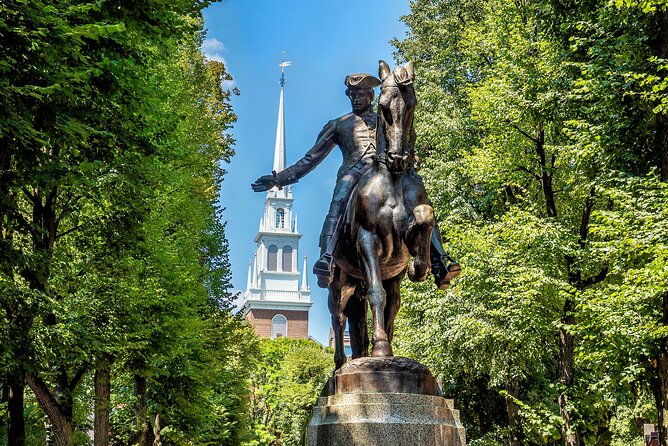
The guide takes you past the Paul Revere statue and Old North Church. The church is tied to the lantern signal story and to the famous warning that British troops were moving by land or sea. The stop lasts about 10 minutes.
This is a popular part of the trail, and large tour groups can gather here. The smaller format helps, but the church area remains a working city neighborhood with traffic and pedestrians. Stay near the guide so you do not lose the thread.
Copp’s Hill Burying Ground follows. Like Granary, it gives the Revolution story a physical setting. The old stones and elevated position also help you see how close the city’s historic districts are to one another.
The route finishes at Copp’s Hill Terrace. From here, you can look across toward the USS Constitution and the Bunker Hill Monument in Charlestown. Those sites are viewed from a distance rather than visited. Charlestown is not included, so do not book this tour expecting to board the Constitution or climb Bunker Hill Monument.
What the $35 price really covers
At $35 per person, the value is strong if you want a clear introduction to Boston’s historic center. You get a live English-speaking guide, a small group, the full Freedom Trail route, and a two-and-a-half-hour explanation of how the Revolution took shape.
The price does not include museum admissions, food, drinks, or a visit to Charlestown. That keeps the basic cost down, but it also means you may spend more if you want to enter Paul Revere House, Old South Meeting House, or other sites afterward.
I see this as a good first-day activity. It helps you understand the city’s layout and gives you a list of places worth revisiting. If you already know Boston well and want extended indoor time at each landmark, the walk may feel too compressed.
Group size, pace, and weather matter
A maximum of 15 people is one of the clearest reasons to choose this tour over a cheaper large-group walk. You can usually hear the guide more easily, ask questions, and stay connected as the route crosses busy streets.
The walk is listed at 150 minutes, but the duration can stretch to three hours. That variation likely depends on the group, questions, street conditions, and the guide’s pace. Plan enough time afterward so you are not rushing to another booking.
The route is about 2 miles and is described as accessible, yet the information also says it is not suitable for people with mobility impairments or low fitness. That is an important contradiction. If you use a wheelchair or have trouble walking for several hours, contact the provider before booking and ask about the current route, stops, and rest options.
Weather can change the feel of the experience. People have completed it in freezing temperatures, heavy snow, rain, and a nor’easter, but that does not mean those conditions are comfortable. Wear weather-appropriate clothing, use supportive shoes, and bring only what you need. Large bags and luggage are not allowed, and video recording is prohibited.
Who will get the most from this Freedom Trail walk
I recommend it for first-time Boston visitors, families with older children, history fans, and anyone who wants the city explained in a logical order. The content suits people who enjoy stories and debate more than silent sightseeing.
Children under six are not permitted. Older children may do well, especially when the guide uses stories rather than a string of dates. One family reported that Maura kept both children and grandparents engaged, which suggests the format can work across age groups when the guide is lively.
This is also a good choice for visitors from outside the United States. The route explains the lead-up to the American Revolution in plain terms, and guides have been praised for making the period understandable without assuming much prior knowledge.
You may want something else if you dislike walking, need frequent seating, want museum interiors, or prefer to explore at your own speed. The tour gives you a strong overview, but it cannot linger at every building.
Should you book the Boston Freedom Trail History Small Group Walking Tour?
Book it if you want a well-paced introduction to Boston’s Revolution story with a group small enough for real contact with the guide. The $35 price is fair for 16 landmarks, an English-speaking guide, and a route that links famous names with the streets where events unfolded.
Skip it if you need a fully indoor experience, cannot comfortably walk 2 miles, or mainly want to visit Charlestown and board the USS Constitution. For most first visits, I would take the tour early in the trip, then return to the sites that caught your interest.
Free cancellation up to 24 hours before departure and the option to reserve now and pay later add useful flexibility. Just remember that the real value depends on the guide, so if you are assigned someone such as Maura, Nick, Cyrus, Alejandro, Zoe, Jon, or Eric, expect a lively and well-prepared presentation.
FAQ
Where does the tour begin?
It begins inside Boston Common at the Boston Foundation Monument, on the northern boundary of the park opposite 50 Beacon Street, Boston, MA 02108.
Where does the tour finish?
The walk ends at Copp’s Hill Terrace in Boston’s North End.
How long does the tour last?
The stated duration is 150 minutes, or about two and a half hours. The full duration can vary but will not be more than three hours.
How far do you walk?
The accessible route travels approximately 2 miles, or 3.2 kilometers.
How many people can join the group?
The group limit is 15 guests.
Is the tour wheelchair accessible?
The activity is listed as wheelchair accessible, but it is also described as unsuitable for people with mobility impairments. Contact the provider before booking to confirm that the current route suits your needs.
Are museum admissions included?
No. Admission inside museums and historic buildings is not included in the tour price.
Does the tour visit Charlestown?
No. The tour provides scenic views of the USS Constitution and Bunker Hill Monument, but Charlestown is not included.
Is there a break during the walk?
Yes. The itinerary includes a 10-minute break at Quincy Market, which you can use for a drink or restroom stop.
What should you bring?
Bring comfortable shoes and clothing suited to the weather. Do not bring luggage or large bags, and video recording is not allowed.
More walking tours in Boston
- Harvard University Campus Guided Walking Tour
★ 4.5 · 3,632 reviews - The Full Revolutionary Story Epic Small Group Boston Walking Tour
★ 5.0 · 2,356 reviews - Boston’s Freedom Trail: A Revolutionary Walking Tour
★ 4.9 · 1,748 reviews - Boston’s Freedom Trail: A Revolutionary Walking Tour
★ 5.0 · 1,343 reviews
Newest Boston tours we have written up
- Boston’s Freedom Trail: A Self-Guided Audio Tour★ 4.0 · 18 reviews
- Boston’s Freedom Trail: A Self-Guided Tour of All 16 Sites★ 5.0 · 14 reviews
- Washington D.C. Cherry Blossom,Baltimore 3-Day Tour from Boston★ 4.5 · 7 reviews
- Boston Self-Guided Audio Tour Bundle: Freedom Trail & More★ 4.5 · 5 reviews
- True Crime Tour of Boston★ 4.0 · 17 reviews
- Family Friendly Guided Bike Tour of Boston★ 4.5 · 22 reviews
- Freedom Trail Experience★ 5.0 · 8 reviews
- The Ghosts of Boston’s Past Haunted Self-guided Tour★ 3.5 · 4 reviews
Boston Freedom Trail Tours, compared.

Freedom Trail History Small Group Walking Tour
Read our review →
Boston Freedom Trail Walking Tour with Costumed Guide
Read our review →
Boston Food & History: Pizza, North End & Freedom Trail
Read our review →
Boston’s Freedom Trail: A Revolutionary Walking Tour
Read our review →Boston’s Freedom Trail: A Revolutionary Walking Tour
Read our review →
Boston Freedom Trail History Pub Crawl Small-Group Tour
Read our review →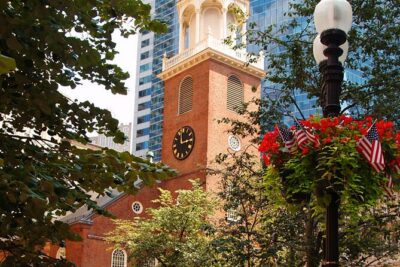
Entire Freedom Trail Walking Tour: Includes Bunker Hill and USS Constitution
Read our review →Browse the lists this tour appears in