
Review · BOSTON FREEDOM TRAIL TOURS
Boston: Tour of The Freedom Trail with Historic North End
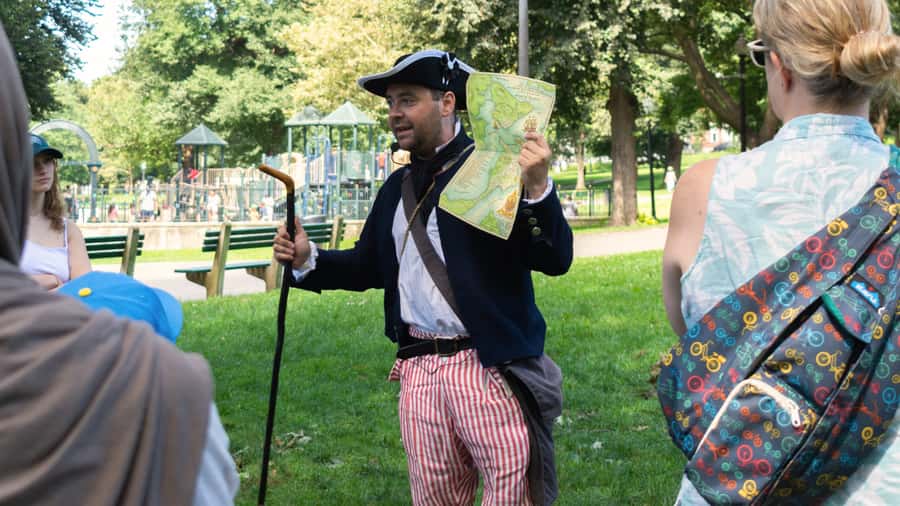
Boston’s Freedom Trail becomes far more interesting when you hear the people behind the names. This 1.3-mile walk begins at Boston Common, passes the city’s best-known Revolutionary-era sites, then continues into the North End to Paul Revere’s House and Paul Revere Mall. The costumed guide supplies the connecting stories that signs alone cannot.
I like the route’s North End extension, since many short Freedom Trail walks stop at Faneuil Hall. I also like the lively delivery. Guides such as Elena, known as Mother Goose, Jeremiah, Steve, and Captain Pickles have been praised for keeping the history fun and clear.
The main consideration is pace. You may walk less than two miles, but you will also stop often and stand while the guide talks. Allow up to two hours, wear good shoes, and remember that admission inside museums and historic buildings is not included.
Key details before you book
- Starts at Boston Common: Meet at the Boston Common Visitor Center, 139 Tremont Street, 15 minutes before departure.
- Covers the central Freedom Trail: See Park Street Church, Granary Burying Ground, the Old State House, the Boston Massacre Site, and Faneuil Hall.
- Continues to the North End: The route goes beyond Faneuil Hall to Paul Revere’s House and Paul Revere Mall.
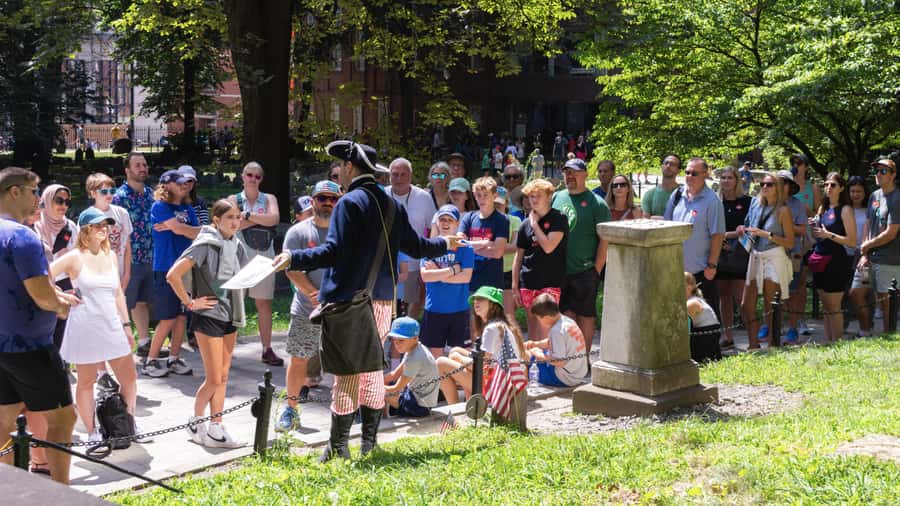
- Uses costumed interpretation: Your English-speaking guide presents colonial history through live narration and period dress.
- Costs $26 per person: That is a fair price for a guided walk of about 105 minutes, especially if you want context rather than a self-guided stroll.
- Does not include interior admission: You view many landmarks from outside unless you arrange and pay for entry separately.
Why this Freedom Trail walk is different
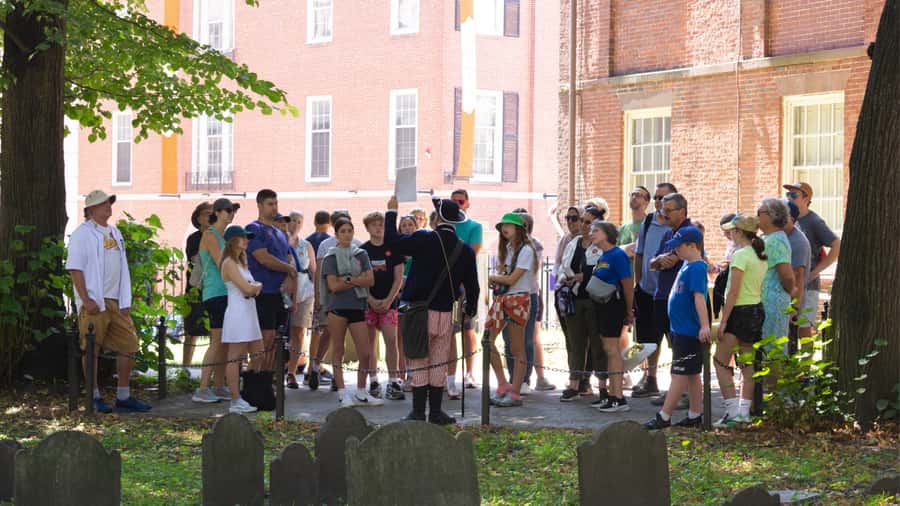
The standard Freedom Trail is easy to follow on your own. A red line leads you through downtown, and plaques identify the major sites. The trouble is that the trail can become a parade of brick buildings and famous names if you do not know how the pieces fit together.
That is where this tour earns its keep. The guide links the burial grounds, churches, meetinghouses, and political sites to the rising conflict between Britain and the American colonies. You hear why a location mattered, not just what it is called.
The route also reaches the North End, which gives the walk a stronger sense of place. Faneuil Hall is an important stopping point, but the story does not end there. Paul Revere’s House and the nearby mall bring the tour into the neighborhood associated with one of Boston’s best-known revolutionary figures.
The guide’s style matters a lot. Elena, also called Mother Goose, is described as an engaging storyteller who uses detail and humor to hold attention. Steve has been praised for keeping a cold-day group laughing while remaining in character. Jeremiah has handled larger groups and made an effort to keep his presentation audible.
Guides can vary, so the personality of your walk will depend on the person leading it. That is part of the charm of a live historical tour, but it also means the experience will not be identical every time.
More ways to walk the Freedom Trail
- Boston: Freedom Trail History Small Group Walking Tour
★ 5.0 · 6,450 reviews - Boston Freedom Trail Walking Tour with Costumed Guide
★ 4.5 · 2,531 reviews - Boston Food & History: Pizza, North End & Freedom Trail
★ 5.0 · 1,772 reviews
Starting at Boston Common and the State House
Meet at the Boston Common Visitor Center at 139 Tremont Street. Arrive 15 minutes early. The tour leaves on time, and finding the meeting point at the last second is a poor way to begin a walking tour.
Boston Common gives the guide a natural opening. It is America’s first public park, and it places the city’s colonial story in a broad, open setting before the route moves into denser streets. You will stop for views and photographs, then walk toward the Massachusetts State House.
The State House is one of the first major sights on the route. The guide uses it to introduce Boston’s political past and the city’s role in the formation of the United States. The tour is primarily an outdoor walk, so expect to see the building and hear its story rather than go inside.
Next comes Park Street Church. Its location near the Common makes it an easy landmark to pass, but the guide gives it a place in the wider story of Boston’s public and religious life. This is a good example of why a guide helps: the building becomes part of a sequence instead of an isolated stop.
Granary Burying Ground and Boston’s early leaders
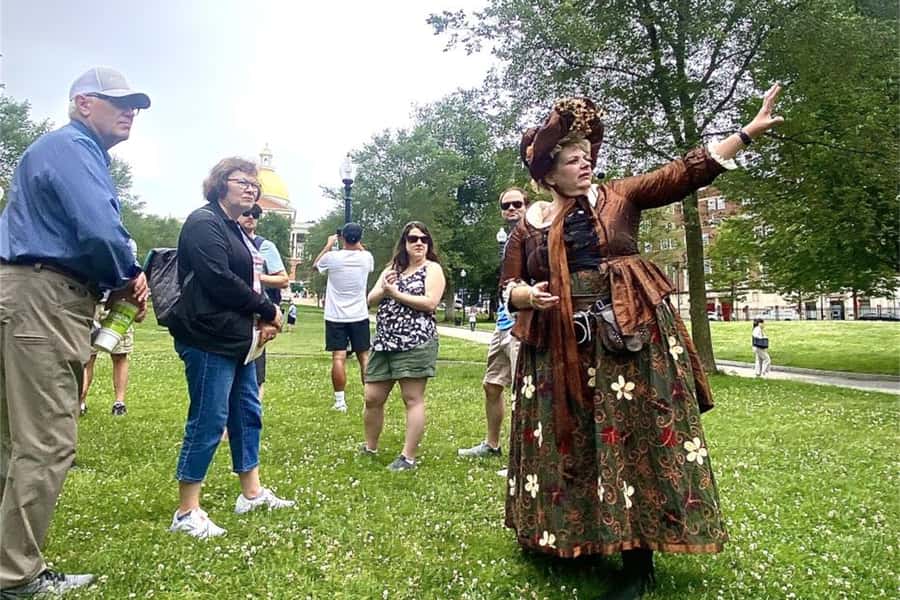
Granary Burying Ground is one of the most memorable stops. The cemetery contains the graves of major figures from America’s founding period, including names that many people recognize from schoolbooks and monuments.
The value here is not simply seeing old stones. The guide explains who is buried there and why the site matters. This helps you connect Boston’s Revolutionary story to real people, families, and political arguments.
You then pass King’s Chapel Burying Ground. The route includes guided commentary and sightseeing here, though it may be a pass-by stop rather than a long visit. The two burial grounds together show how much of Boston’s early story remains embedded in the modern city center.
Expect uneven attention spans in a cemetery setting. Some people will want a detailed explanation of every important grave, while others will prefer a quick overview. The guide has to keep the group moving, and that can mean the storytelling feels brisk at some stops.
Boston Latin School and Benjamin Franklin
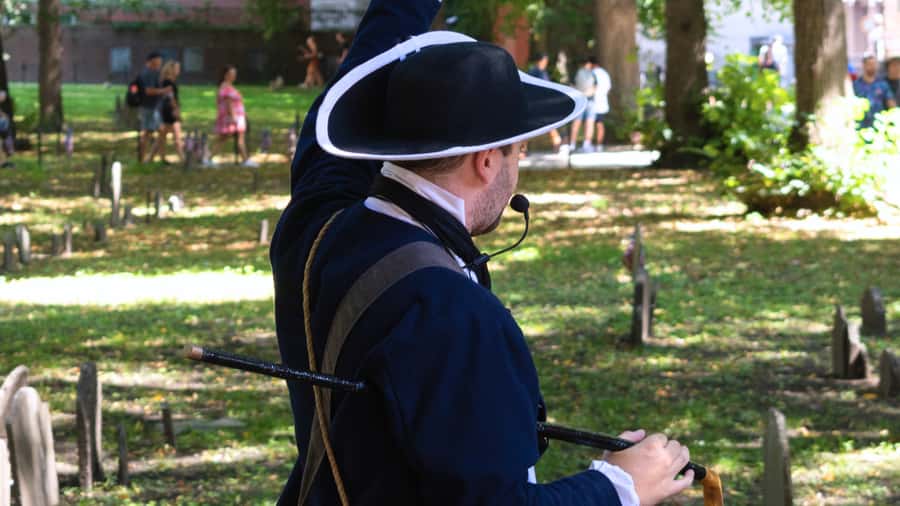
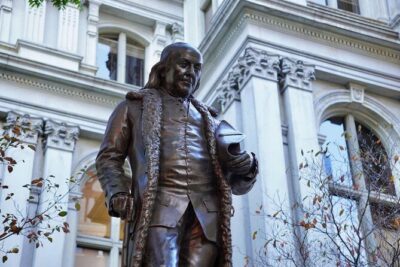
The walk continues to the Boston Latin School site and the statue of Benjamin Franklin. These landmarks add an educational side to the tour.
The Boston Latin School is presented as America’s first public school. The Franklin statue gives the guide a chance to discuss one of Boston’s most famous sons and the ideas tied to education, public life, and the colonial era.
This is one of the spots where a short explanation makes a large difference. You can pass the site alone and recognize the name, but a guide gives you a reason to pause. You also have time for photos, which is useful because the stop is outdoors and part of an active city street scene.
The route then reaches the Old Corner Book Store. Its name hints at Boston’s long connection with printing and publishing. The stop is mainly a photo and storytelling point, but it adds texture to the walk. The Freedom Trail is not only about battles and speeches. It is also about the places where books, newspapers, ideas, and political arguments circulated.
More North End food tours
- Boston North End Food Tour of 6+ Tastings, Cannoli, Lobster Roll
★ 5.0 · 1,404 reviews - Boston’s North End Food Tour: Italian Flavors & Heritage Walk
★ 5.0 · 1,322 reviews - Boston’s North End Food and History Walking Tour
★ 5.0 · 459 reviews - Boston’s Politically Incorrect North End Food Tour
★ 5.0 · 453 reviews
Meetinghouses, the Old State House, and the Boston Massacre
The Old South Meeting House is one of the key locations on the walk. It was a place where large public meetings took place, including gatherings linked to the growing dispute over British taxes and colonial authority.
The guide’s job here is to explain how protest moved from private anger into organized public action. That context makes the next stops easier to understand. Boston’s Revolution was not a single dramatic event. It grew through meetings, speeches, printed arguments, and confrontations.
The Old State House provides another major piece of that story. It was a center of colonial government and public authority. From the street, you get the exterior and the guide’s interpretation. Interior admission is not part of the $26 tour price, so plan to visit separately if you want to explore inside.
Nearby, the Boston Massacre Site marks one of the most charged moments in Boston’s pre-Revolutionary history. This is a small urban site rather than a grand building, and it can be easy to miss without a guide.
The guide explains what happened and why the event became such a powerful political symbol. This is also a useful reminder that historical language can be shaped by politics. The name itself helped frame the event for a colonial audience. A good guide gives you the basic facts and the competing interpretations without turning the stop into a dry lecture.
Faneuil Hall and the route into the North End
Faneuil Hall is the major downtown landmark near the end of the central portion. It is often called the Cradle of Liberty, and the tour uses it as a bridge between Boston’s political story and the North End.
The building is a popular city sight, so crowds can make it hard to hear. One person specifically noted that busy areas sometimes affected how clearly the guide could be heard. Stay close, avoid drifting to the back, and ask for a repeat if you miss an important point.
The tour’s extension beyond Faneuil Hall is its strongest practical advantage. Many visitors see the downtown Freedom Trail and stop here. This experience continues into Boston’s historic North End, giving you a second neighborhood and a more direct connection to Paul Revere.
The North End is not just a collection of revolutionary landmarks. It is a living neighborhood with narrow streets and active foot traffic. The route may feel more crowded here, especially around well-known sights, so keep your group in view and expect occasional pauses while the guide gathers everyone together.
Paul Revere’s House and Paul Revere Mall
Paul Revere’s House is the final major historic stop. From the outside, you get the setting and the guide’s account of Revere’s role in the events leading to the American Revolution. Admission inside the house is not included.
If you want to enter, check separately for opening details and ticket costs. The tour itself is built around outdoor sightseeing and historical interpretation, not an included house visit.
The walk finishes at Paul Revere Mall, near the Old North Church area. The itinerary lists the mall as the end point, while the meeting information also describes the activity as ending back at the meeting point. Because those descriptions differ, confirm the exact end arrangement when booking. In practical terms, you should expect the North End and Paul Revere Mall to be the final part of the route.
The Old North Church is included among the tour’s highlights and is part of the North End setting. The supplied route specifically lists Paul Revere Mall as the final stop, so do not assume you will receive an interior church visit. As with the other historic buildings, interior admission is not included.
How much walking and standing should you expect?
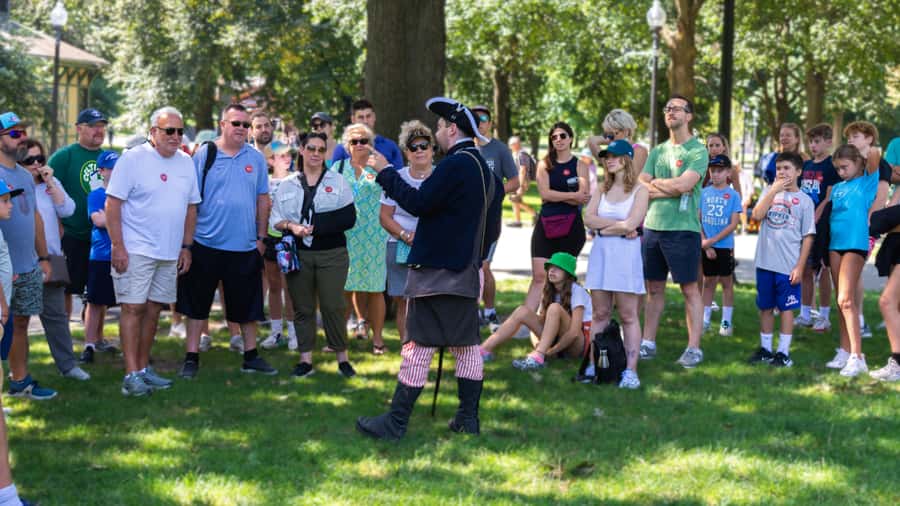
The stated distance is about 1.3 miles, and the duration is 105 minutes. The activity notes also advise allowing up to two hours. That extra time matters because the guide stops at many landmarks and may spend several minutes telling a story at each one.
This is not a hard hike. The challenge is the stop-and-start pattern. You walk, gather around the guide, listen, then move again. One person found the walking manageable but noted that standing for the explanations could be difficult for someone with limited standing tolerance.
The tour is listed as wheelchair accessible, but city sidewalks, crowds, and the need to remain with a moving group can still affect comfort. If you use a wheelchair or have mobility concerns, confirm the current route details before booking.
Wear comfortable shoes and dress for the weather. The tour operates outdoors, and rain or cold can affect your enjoyment. Guides have continued in poor weather, but a rain jacket and sensible layers will serve you better than a stylish but impractical outfit.
Is the $26 price good value?
At $26 per person, this is a reasonably priced introduction to Boston’s central historic district. You are paying for a live guide, historical interpretation, and a route that reaches the North End rather than ending at Faneuil Hall.
The value is strongest if you want stories and direction. A self-guided walk costs less, but you must prepare the history yourself and manage the route. Here, the guide points out the sites, explains their importance, and keeps the walk moving.
The value is weaker if you want long interior visits. Museum and attraction admission is not included, and the tour does not replace a full visit to the Old State House, Old South Meeting House, Paul Revere’s House, or the Old North Church.
Group size can also affect the price experience. A group of around 50 people has been handled successfully, but a large crowd makes it harder to hear and reduces the personal feel. A smaller group costs more on some tours, but this option keeps the basic price modest.
Who will enjoy this tour most?
I would choose this walk for a first visit to Boston, especially if you want the main Freedom Trail sights explained in a single outing. It also suits families and mixed-age groups because the costumed format, humor, and short walking distance keep the subject approachable.
It works well for anyone who has walked the trail before but felt it lacked context. The guide adds names, motives, and connections that are easy to miss when you follow the red line alone.
People from outside the United States may need a little extra patience with the many names and political references. The presentation is centered on American colonial and Revolutionary history, and some of the background may be assumed. You can still learn a lot, but ask questions when the sequence becomes hard to follow.
I would be cautious if you dislike outdoor tours, crowded streets, or standing in one place. I would also avoid treating the tour as a full museum visit. It is a guided overview with many exterior stops, not a ticketed attraction package.
Practical booking advice
The tour is in English. Arrive at the Boston Common Visitor Center 15 minutes early, since the guide will leave on time. Reserve ahead if your schedule is tight, though the reserve-now, pay-later option keeps plans flexible.
Free cancellation is available up to 24 hours before the activity for a full refund. You may want to book an earlier or later start based on weather, since much of the experience takes place outside.
Alcohol, drugs, and intoxication are not allowed. That is ordinary tour policy, but it matters here because the walk depends on staying with the group and listening at busy public sites.
Should you book the Freedom Trail and North End walk?
Book it if you want Boston’s famous sites tied together by a lively storyteller, especially one who can make burial grounds, meetinghouses, and political landmarks feel connected. The North End finish gives this tour more range than a basic Boston Common to Faneuil Hall walk.
Skip it if you want extensive time inside historic buildings, a private experience, or a quiet stroll without scheduled stops. For $26, though, it is a solid way to get your bearings and understand why these places matter. Choose comfortable shoes, prepare for standing, and keep your expectations focused on outdoor storytelling rather than included admissions.
FAQ
Where does the tour start?
It starts at the Boston Common Visitor Center, 139 Tremont Street, Boston, Massachusetts 02108.
How early should I arrive?
Arrive 15 minutes before the scheduled start. The tour leaves on time.
How long does the tour last?
The stated duration is 105 minutes. You should allow up to two hours because the activity includes many stops and stories.
How far does the tour go?
The central portion covers about 1.3 miles from Boston Common toward Faneuil Hall, then continues into the North End.
Does the tour visit Paul Revere’s House?
Yes. Paul Revere’s House is included as a sightseeing stop. Admission inside is not included.
Does the tour go to Charlestown?
No. It covers the standard Freedom Trail section and the North End, but it does not cover Charlestown.
Is admission to historic buildings included?
No. The tour includes the guide, live narration, and historical interpretation, but not admission inside museums or attractions.
What language is the tour conducted in?
The tour is conducted in English by a live guide.
More history tours in Boston
- Tour of Historic Fenway Park, America’s Most Beloved Ballpark
★ 4.5 · 3,013 reviews - Boston: City Cruises Historical Sightseeing Cruise
★ 4.6 · 1,771 reviews - Boston: Freedom Trail History Small Group Walking Tour
★ 4.9 · 1,590 reviews - City Cruises Boston Historic Sightseeing Harbor Cruise
★ 4.5 · 1,388 reviews
Newest Boston tours we have written up
- Boston’s Freedom Trail: A Self-Guided Audio Tour★ 4.0 · 18 reviews
- Boston’s Freedom Trail: A Self-Guided Tour of All 16 Sites★ 5.0 · 14 reviews
- Washington D.C. Cherry Blossom,Baltimore 3-Day Tour from Boston★ 4.5 · 7 reviews
- Boston Self-Guided Audio Tour Bundle: Freedom Trail & More★ 4.5 · 5 reviews
- True Crime Tour of Boston★ 4.0 · 17 reviews
- Family Friendly Guided Bike Tour of Boston★ 4.5 · 22 reviews
- Freedom Trail Experience★ 5.0 · 8 reviews
- Self-Guided Audio Tour of Boston North End★ 4.5 · 3 reviews
Boston Freedom Trail Tours, compared.

Freedom Trail History Small Group Walking Tour
Read our review →
Boston Freedom Trail Walking Tour with Costumed Guide
Read our review →
Boston Food & History: Pizza, North End & Freedom Trail
Read our review →
Boston’s Freedom Trail: A Revolutionary Walking Tour
Read our review →Freedom Trail History Small Group Walking Tour
Read our review →Boston’s Freedom Trail: A Revolutionary Walking Tour
Read our review →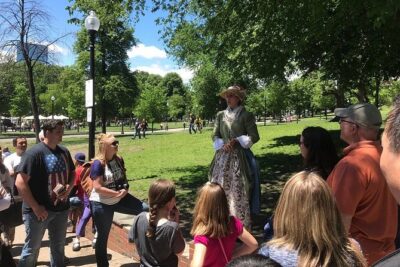
Boston Freedom Trail History Pub Crawl Small-Group Tour
Read our review →Browse the lists this tour appears in