
Review · BOSTON FREEDOM TRAIL TOURS
Boston: Freedom Trail History and Architecture Walking Tour
Boston’s Freedom Trail packs a surprising amount of American history into a short downtown walk. In 70 minutes, this tour links Faneuil Hall and Boston Common while helping you make sense of the old brick buildings, church spires, meeting houses, cemeteries, and modern streets around them.
I like the compact route, which gives you a useful first look at central Boston without taking up half a day. I also like the focus on architecture and city change, not just a list of Revolutionary-era dates. The main thing to consider is the English-only format. One German participant found that a strong command of English was needed to keep up.
Key points at a glance
- Faneuil Hall to Boston Common: Follow one of Boston’s most famous historic routes through the heart of downtown.
- Fourteen or more notable stops: See places such as the Old State House, King’s Chapel, Granary Cemetery, and the Old South Meeting House.
- Architecture with context: Learn how Boston developed from its early settlement to its present mix of old and new buildings.
- A short morning introduction: The 70-minute length works well for a first morning in the city or a tight sightseeing schedule.
- Local guide, English only: Guides explain the sites and answer questions, with Allan praised for his patient and personable approach.
- Flexible booking: You can cancel up to 24 hours before the tour for a full refund and reserve without paying immediately.
Why this short Freedom Trail walk works
The Freedom Trail can feel confusing when you first arrive. It crosses busy streets, turns through compact blocks, and links sites from different periods of Boston’s past. This tour gives you a clear section to follow, from the Faneuil Hall area toward Boston Common, with a guide explaining how the pieces fit together.
That context matters. You are not simply looking at an old cemetery, a church, or a government building in isolation. You are hearing how Boston grew from an early settlement into a major city, and how later construction created the city’s sometimes quirky mix of historic and modern streets.
The tour lasts just 70 minutes. I see that as a strength for many visitors, especially if you want a useful introduction before exploring more on your own. It is not long enough to enter every building or examine each site in detail, so you should view it as an orientation walk rather than a full study of the Freedom Trail.
The listed price is $30 per person. That is fair if you value a live guide who can explain the setting and answer questions. If you prefer to move at your own pace, read plaques, and stop inside the attractions, you may find a self-guided walk more suitable. The value here comes from the connections between the stops and the human stories along the way.
More ways to walk the Freedom Trail
- Boston: Freedom Trail History Small Group Walking Tour
★ 5.0 · 6,450 reviews - Boston Freedom Trail Walking Tour with Costumed Guide
★ 4.5 · 2,531 reviews - Boston Food & History: Pizza, North End & Freedom Trail
★ 5.0 · 1,772 reviews
Starting beside the Old State House

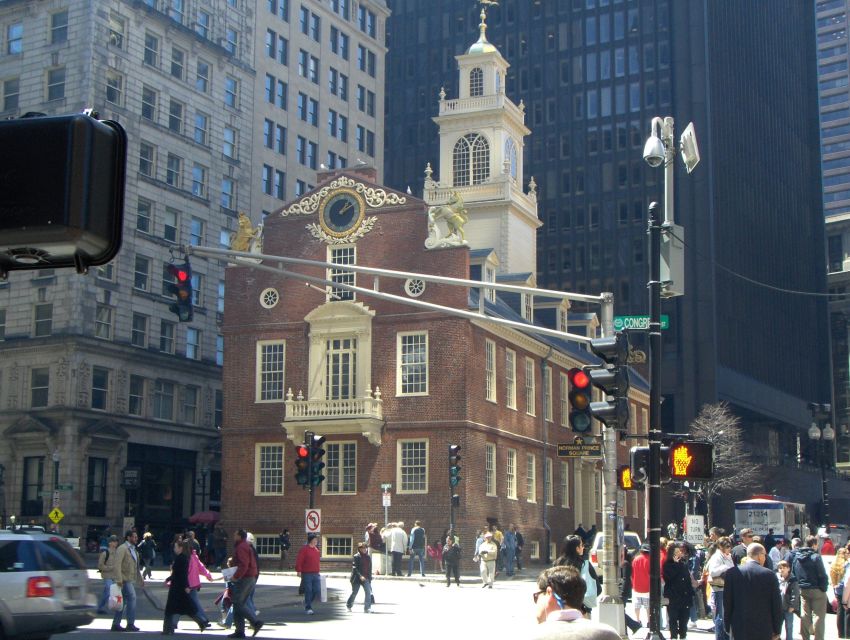
The meeting point is the northwest corner of State and Congress Streets, outside 28 State Street, by Citizens Bank. It is across the street from the Old State House, so you begin in one of the most central parts of Boston.
That location is useful for a first visit because you are already close to several major Freedom Trail sites. It also gives you a clear landmark for finding the group. You should arrive knowing that the tour begins outdoors in a downtown street setting, not inside a visitor center or museum.
The Old State House is among the first major buildings you encounter. Its importance comes from both its political role and its setting. It sits amid modern downtown traffic, which makes the contrast between Boston’s colonial-era core and its later growth easy to see.
The route also brings you near the Boston Massacre Site. This is a small but important location, and it shows why a guide can add value to a walking tour. Without some explanation, the site is easy to miss or misunderstand. With context, it becomes part of the wider story of tension between Boston residents and British authorities.
Faneuil Hall and the city’s public life
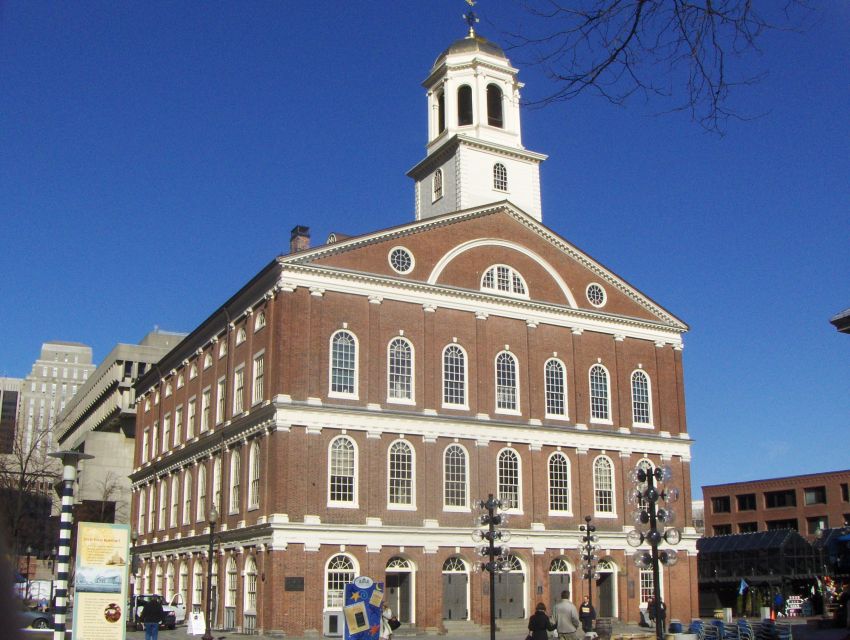
Faneuil Hall is one of the route’s main anchors. It has long been tied to public debate, commerce, and Boston’s civic life. The building and the surrounding area help show that the Freedom Trail is not a museum corridor separated from the modern city. It runs through places that still serve as active downtown spaces.
From here, the walk heads through streets where Boston’s old layout remains visible. You may notice how close together many of the important sites are. That compact arrangement is one reason the Freedom Trail works well on foot, though it also means the tour can cover a lot of information in a short time.
The guide’s role is especially useful around Faneuil Hall because the area can feel busy and commercial. A local guide can point your attention toward the historical details instead of letting the surroundings become a blur of shops, traffic, and passing pedestrians.
You should also expect the tour to keep moving. The duration does not allow for long pauses at every building. If a particular site catches your interest, make a note of it and return later if you have time.
State Houses, meeting houses, and Boston’s political story
The Old and New State Houses show how Boston’s public architecture changed over time. The Old State House belongs to the early civic story of the city, while the New State House represents a later phase of government and urban development.
The tour uses these buildings to explain how Boston evolved, rather than presenting the city as a frozen colonial set. That is one of the more useful parts of the experience. You begin to see why historic Boston contains buildings from different periods, styles, and purposes within a short walk.
The Old South Meeting House adds another layer. Meeting houses were important places for public discussion, religious life, and political organizing. The building helps explain how community decisions were made before modern civic spaces and communication systems existed.
King’s Chapel offers a different architectural and cultural perspective. Its presence on the route helps broaden the story beyond a single version of Boston’s past. Along with Park Street Church, it also gives you a chance to compare religious buildings from different moments in the city’s development.
You will not receive a full architectural course in 70 minutes, but the tour does give you a framework. Look at the buildings as evidence of changing needs and beliefs. Government, worship, trade, protest, education, and burial all appear within this compact part of Boston.
More history tours in Boston
- Tour of Historic Fenway Park, America’s Most Beloved Ballpark
★ 4.5 · 3,013 reviews - Boston: City Cruises Historical Sightseeing Cruise
★ 4.6 · 1,771 reviews - Boston: Freedom Trail History Small Group Walking Tour
★ 4.9 · 1,590 reviews - City Cruises Boston Historic Sightseeing Harbor Cruise
★ 4.5 · 1,388 reviews
The Old Granary Cemetery and Boston’s quieter corners
The Old Granary Cemetery is one of the most memorable stops on this section of the trail. It brings the city’s early history down to a human scale. Instead of focusing only on grand buildings and public events, the cemetery reminds you that Boston’s past is also recorded through individual lives and graves.
The cemetery can also feel like a pause in the city’s busy center. That change of mood is valuable during a walking tour. You move from government buildings and crowded streets into a place that asks for more attention and reflection.
The Old City Hall and the First Schoolhouse Site add civic and educational detail. These stops help you see how the city functioned day to day. The story is not only about famous leaders or dramatic events. It is also about local government, schooling, and the institutions that shaped ordinary life.
The Old Corner Bookstore brings yet another angle. Its connection to Boston’s literary past gives the walk a cultural thread beyond politics and the American Revolution. This variety is a strong reason to choose the tour if you want more than a narrow military or patriotic account.
Reaching Boston Common and the Irish Famine Memorial
Boston Common provides a natural endpoint for the walk. After moving through dense downtown streets and historic blocks, you arrive at one of the city’s best-known public spaces. The Common helps you understand the scale of Boston’s civic life and gives the tour a clear finish.
The Irish Famine Memorial adds a later chapter to the route. Its presence reminds you that Boston’s story continued long after the city’s colonial and Revolutionary periods. Immigration, hardship, memory, and community identity all form part of the city’s cultural background.
This broader time range is important. Many visitors come to Boston focused on the eighteenth century, but the tour also points toward the city’s later history and present-day character. You get an introduction to Boston as a living city, not just a collection of preserved landmarks.
Because the walk ends at Boston Common, you can continue sightseeing afterward. The tour does not include admission to the sites, so you should plan separate visits if you want to go inside any of the buildings. The supplied information confirms the stops encountered along the route, but it does not promise interior access.
What the guide adds to the experience
A good guide matters on a route filled with small sites. The Boston Massacre Site, First Schoolhouse Site, and Old Corner Bookstore can be easy to overlook without someone drawing your attention to them. The guide also provides the links between buildings, which is where much of the tour’s value lies.
A guide named Allan received especially strong praise for being personable, well informed, patient, and willing to answer questions. Another participant noted that the guide handled questions from teenagers well, including questions that were not especially polished. That suggests this tour can work for families with older children and teenagers who might not want a formal lecture.
The experience is conducted in English only. You need to be comfortable listening while walking and keeping up with the group. If English is not your first language, the amount of material in a short period could make the tour harder to follow. The German-language feedback makes this the clearest practical limitation.
The group size is not provided, so I would not book this expecting a private or highly personal tour. The format is a shared walking experience with a professional local guide. You can ask questions, but the time limit means the guide must keep the route moving.
Is $30 a good price for 70 minutes?
At $30, you are paying for explanation, structure, and local perspective rather than entry tickets. That can be good value when you are new to Boston and want to understand the Freedom Trail before exploring independently.
The tour is most worthwhile if you have limited time. A morning introduction lets you see many important sites, then decide which ones deserve a longer visit. It also helps you avoid spending your first few hours wandering between landmarks without knowing their place in the city’s story.
The value is less clear if you already know Boston well or want extended time at each location. Seventy minutes is brisk. You will see many sites, but you should not expect detailed interior visits, long photography stops, or a slow examination of every building.
The flexible terms make the booking less risky. You can reserve now and pay later, and cancellation is allowed up to 24 hours in advance for a full refund. Starting times vary, so you need to check availability for your chosen date.
Who should book this Boston walking tour?
I would recommend it to first-time visitors, families with teenagers, and anyone who wants a quick historical introduction before spending more time around downtown. The route covers political, religious, literary, educational, and memorial sites, so it suits people with broad interests.
It is also a good fit if you like city architecture but do not want a technical lecture. The guide explains how Boston changed over time while keeping the focus on the streets and buildings in front of you.
I would be more cautious if you need a tour in a language other than English, want a private experience, or prefer a slow pace. You should also choose another format if your main goal is to enter every major site. This is an outdoor overview, not a series of museum visits.
My verdict on the Freedom Trail History and Architecture Tour
Book this tour if you want a short, organized introduction to central Boston with a local English-speaking guide. The route from Faneuil Hall to Boston Common covers an unusually useful mix of landmarks, and the architecture focus gives the walk more shape than a simple list of famous names.
At $30, it offers solid value for a first morning, especially when Allan or a similarly patient guide is leading the group. Just keep your expectations in check: the pace is brisk, the language is English only, and the 70-minute schedule gives you an overview rather than a complete study of the Freedom Trail.
FAQ
How long does the Boston Freedom Trail walking tour last?
The tour lasts 70 minutes.
How much does the tour cost?
The price is $30 per person.
Where does the tour meet?
It meets at the northwest corner of State and Congress Streets, outside 28 State Street by Citizens Bank, across from the Old State House.
Where does the walking route go?
The tour follows the Freedom Trail from the Faneuil Hall area to Boston Common.
Which language is the tour conducted in?
The live tour is conducted in English, and the listed language is English only.
Can I cancel the tour for a refund?
Yes. You can cancel up to 24 hours in advance for a full refund. You can also reserve now and pay later.
More walking tours in Boston
- Harvard University Campus Guided Walking Tour
★ 4.5 · 3,632 reviews - The Full Revolutionary Story Epic Small Group Boston Walking Tour
★ 5.0 · 2,356 reviews - Boston’s Freedom Trail: A Revolutionary Walking Tour
★ 4.9 · 1,748 reviews - Boston’s Freedom Trail: A Revolutionary Walking Tour
★ 5.0 · 1,343 reviews
Newest Boston tours we have written up
- Boston’s Freedom Trail: A Self-Guided Audio Tour★ 4.0 · 18 reviews
- Boston’s Freedom Trail: A Self-Guided Tour of All 16 Sites★ 5.0 · 14 reviews
- Washington D.C. Cherry Blossom,Baltimore 3-Day Tour from Boston★ 4.5 · 7 reviews
- Boston Self-Guided Audio Tour Bundle: Freedom Trail & More★ 4.5 · 5 reviews
- True Crime Tour of Boston★ 4.0 · 17 reviews
- Family Friendly Guided Bike Tour of Boston★ 4.5 · 22 reviews
- Freedom Trail Experience★ 5.0 · 8 reviews
- The Ghosts of Boston’s Past Haunted Self-guided Tour★ 3.5 · 4 reviews
Boston Freedom Trail Tours, compared.

Freedom Trail History Small Group Walking Tour
Read our review →
Boston Freedom Trail Walking Tour with Costumed Guide
Read our review →
Boston Food & History: Pizza, North End & Freedom Trail
Read our review →
Boston’s Freedom Trail: A Revolutionary Walking Tour
Read our review →Freedom Trail History Small Group Walking Tour
Read our review →Boston’s Freedom Trail: A Revolutionary Walking Tour
Read our review →

Boston Freedom Trail History Pub Crawl Small-Group Tour
Read our review →Browse the lists this tour appears in