
Review · BOSTON FREEDOM TRAIL TOURS
Freedom Trail: Boston Common, Old State House, Faneuil Hall
Boston’s Revolution-era story unfolds in just two hours on this walk from Boston Common to Faneuil Hall. You’ll pass graves, churches, meeting halls, and the exact streets where colonial protest turned into a fight for independence. Guide Brian brings plenty of humor, trivia, and a real Boston accent to the route.
I like the efficient path, which covers the major Freedom Trail sights without making you spend half a day on your feet. I also like the storytelling: Brian is especially good at keeping children and serious American history fans interested at the same time.
The main drawback is simple: this is a brisk overview, not an inside look at every building. You’ll see many landmarks from outside, and the two-hour route involves continuous walking, even though the tour is wheelchair accessible.
Key points to know before you book
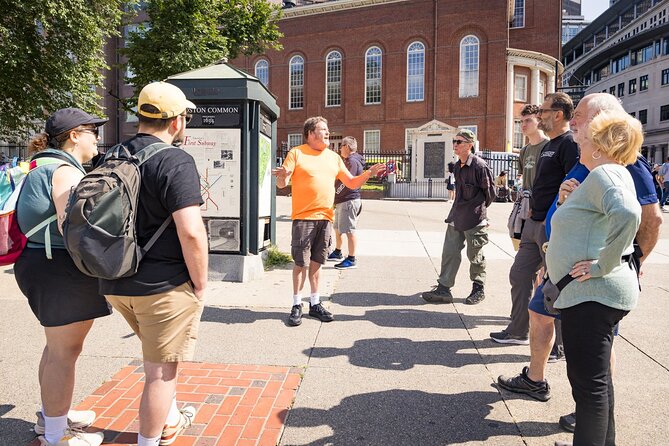
- Start at America’s oldest public park: Meet outside Park Street T Station on the eastern edge of Boston Common.
- Follow the Revolution in order: The route moves from early Boston through the Boston Massacre, the Tea Party, and the fight for independence.
- Visit famous burial grounds: Granary Burying Ground includes the graves of Paul Revere, Samuel Adams, John Hancock, and Crispus Attucks.
- Hear the stories behind the buildings: Old South Meeting House, Old State House, and Faneuil Hall mattered because people gathered there, argued there, and acted there.
- Finish at Faneuil Hall: The endpoint puts you near one of Boston’s best-known meeting halls and marketplaces.
- Expect an English walking tour: It lasts two hours, usually takes place in the morning, and costs $39 per person.
Why this short Freedom Trail walk works
The Freedom Trail can feel confusing when you first arrive. Boston’s historic center is compact, but the important places sit among modern streets, office buildings, shops, and traffic. A guide gives the route a clear shape.
You begin with Boston Common and finish at Faneuil Hall, following a useful west-to-east line through the old center. That means you are not simply collecting landmarks. You are watching Boston’s political mood change from a strict Puritan settlement into a city at the heart of American independence.
I like this format for a first morning in Boston. Two hours is enough to understand the main story without committing your entire day. Afterward, you can return to the places that caught your attention, visit a museum, or continue toward the waterfront.
The tour costs $39 per person. That is more than walking the red-brick trail on your own, but the value comes from the explanation. The guide connects names, dates, buildings, and events in a way that is difficult to get from trail markers alone.
The strongest praise for this experience focuses on the guide’s delivery. Brian is described as entertaining, approachable, and full of useful details. His humor and enthusiasm help the tour work for families, while his command of American history gives serious history fans plenty to think about.
More ways to walk the Freedom Trail
- Boston: Freedom Trail History Small Group Walking Tour
★ 5.0 · 6,450 reviews - Boston Freedom Trail Walking Tour with Costumed Guide
★ 4.5 · 2,531 reviews - Boston Food & History: Pizza, North End & Freedom Trail
★ 5.0 · 1,772 reviews
Starting beneath the golden dome at Boston Common
Meet outside Park Street T Station, on the eastern edge of Boston Common. This is a practical meeting point because the station is easy to reach and the park gives the group room to gather before setting off.
Boston Common dates to 1634 and is recognized as America’s oldest public park. It began as shared land for the early settlement and later served many purposes, including a British troop camp during the Revolutionary War and a setting for civil rights rallies in the 20th century.
That range of uses gives the opening stop real weight. You are not starting at a decorative garden. You are standing in a public space that has witnessed military occupation, political protest, and daily city life over centuries.
The park also provides a gentle beginning. You can get used to the guide’s pace before entering the denser streets. Take a few minutes to look around, but do not wander far from Park Street T Station if you arrive early.
Massachusetts State House and Park Street Church
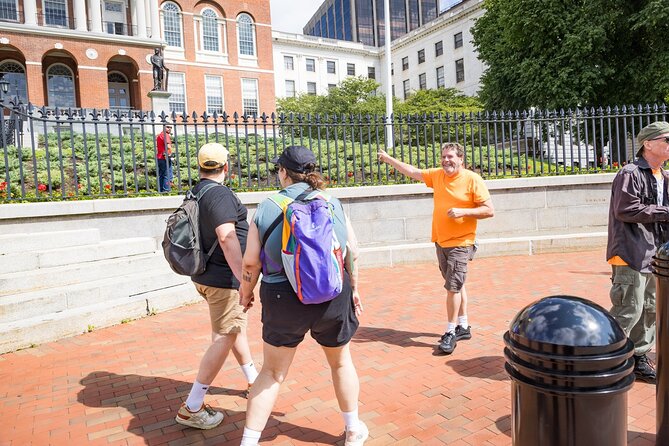
From Boston Common, the route reaches the Massachusetts State House, completed in 1798. Its golden dome is one of Boston’s most recognizable sights, and the building remains the seat of state government.
The State House helps explain the difference between the colonial period and the later American republic. It is not one of the oldest stops on the trail, but it connects the Revolution to the government that followed it.
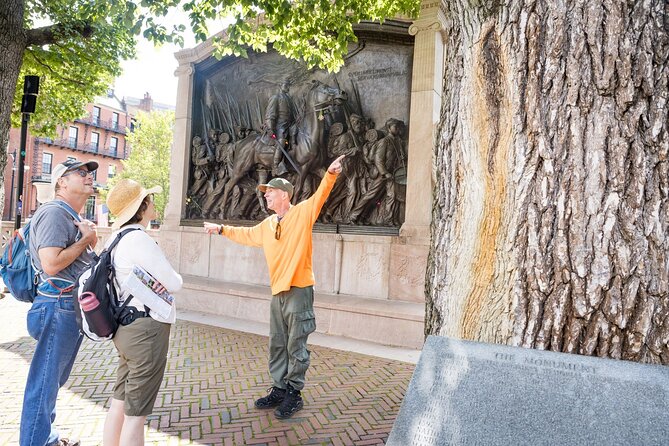
Next comes Park Street Church, built in 1809. The church hosted the first public anti-slavery address in the United States, giving the walk a wider view of American liberty. The Freedom Trail is often presented as a straight story about independence from Britain, but this stop points to later arguments over who would actually share in that liberty.
The church’s tall steeple also helps you understand old Boston’s skyline. In a city filled with newer buildings, these older landmarks provide useful reference points as you walk.
Granary Burying Ground and Boston’s revolutionary names
Granary Burying Ground is one of the most affecting stops on the route. It contains the graves of several major figures from the American Revolution, including Paul Revere, Samuel Adams, and John Hancock.
You can also pay respects at the grave of Crispus Attucks, who was killed in the Boston Massacre and is remembered as the first casualty of that event. His presence gives the cemetery a human dimension that a list of famous names cannot provide.
The stones are close together, and the setting feels more intimate than a modern memorial. A guide can explain who these people were and why their names mattered, rather than leaving you to read dates without context.
This is also one of the places where the two-hour schedule requires some discipline. You will have time for photographs and explanation, but not for a slow, solitary examination of every grave. If one person catches your interest, make a note and return after the tour.
A few more Boston tours and tickets worth a look
- Boston Duck Boat Sightseeing City Tour with Cruise Along Charles River
★ 4.5 · 9,378 reviews - Boston Hop-On Hop-Off Trolley Tour with 13 Stops
★ 4.5 · 5,576 reviews - Boston: City Cruises Whale Watching Cruise
★ 4.5 · 4,710 reviews - Boston Duck Tour: The Original and World-Famous
★ 4.6 · 3,935 reviews
King’s Chapel and the problem of loyalty
King’s Chapel dates to 1754 and is a fine example of Georgian architecture. Its history also opens a window onto the divided loyalties of Boston before and during the Revolution.
The church had ties to loyalist congregants, reminding you that independence was not a universal cause. Boston contained people with competing views, interests, and allegiances. The Revolution was not simply a united population facing an outside enemy.
That kind of detail makes a guided walk more useful than a checklist. You learn that the same street could hold supporters of the Crown, advocates for colonial rights, merchants worried about trade, and ordinary residents caught in the middle.
You may not go inside King’s Chapel on this tour, so treat the stop mainly as an exterior landmark and a chance to hear its story. The route is designed to cover highlights rather than provide long interior visits.
Old South Meeting House and the Tea Party debate
The Old South Meeting House was built in 1729 and became the place where colonists gathered to discuss freedom, taxes, and government. Plans connected to the Boston Tea Party were set in motion here.
The important point is that the Tea Party did not begin as a random act of destruction. It grew from meetings, speeches, organized resistance, and a dispute over who had the right to impose taxes. Inside a meeting house, political argument became public action.
The building also lets you picture the scale of colonial gatherings. This was a working meeting place, not a monument designed after the fact. People came here to hear speakers, make decisions, and test the mood of the crowd.
If you want to explore the interior in detail, you may need a separate visit. On this tour, the guide’s account is the main event. That is a fair trade for anyone who wants to cover more ground in a short time.
Old Corner Bookstore and the literary side of Boston
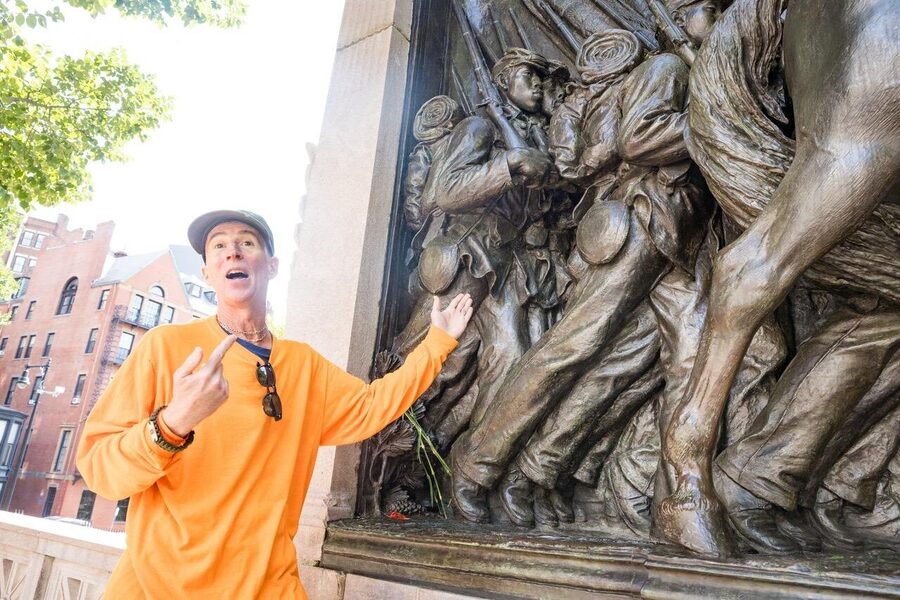
The Old Corner Bookstore adds a different note to the walk. In the 19th century, it became a meeting point for Boston’s literary world and published works by authors such as Louisa May Alcott.
This stop reminds you that Boston’s importance did not end with the Revolution. The city later became a major center for publishing, education, reform, and public debate.
It is also a useful pause between political landmarks. Instead of hearing only about soldiers, taxes, and protest, you get a glimpse of the people who shaped American culture through books and ideas.
The bookstore’s importance is mostly historical, so do not expect a long shopping stop. Listen for the connection between the old commercial center and the wider intellectual life of the city.
Old State House and the Declaration of Independence
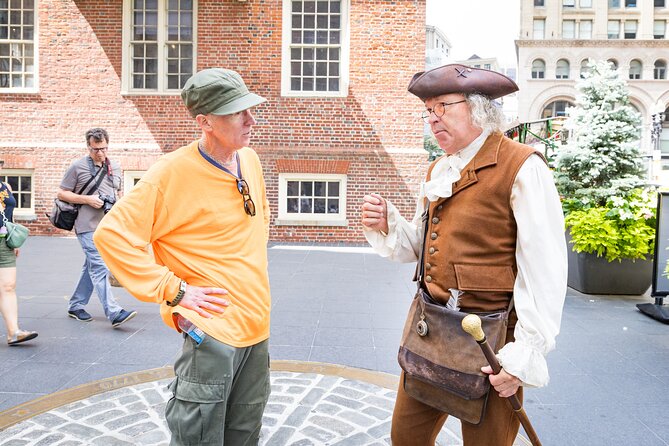
The Old State House, dating to 1713, was the seat of colonial government. Its balcony became famous when the Declaration of Independence was read to the public.
This is one of the clearest moments on the tour because the building links words to public reaction. The declaration was not just a document stored in an archive. It was read aloud from a balcony to people gathered in the street.
The Old State House also helps explain how colonial authority worked before independence. Government, commerce, protest, and public ceremony occupied the same tight section of the city. You can still see how close the buildings are, which makes the events feel less abstract.
The exterior view is enough to understand why the building matters, but those interested in museum displays may want to return separately. The walking tour keeps moving, and its goal is to place the building within the larger story.
The Boston Massacre site
A circular marker on the street identifies the site of the Boston Massacre in 1770. British soldiers fired into a crowd during a period of rising tension, killing five people, including Crispus Attucks.
This was a turning point in the colonial argument against British rule. The incident became powerful propaganda for those who wanted to show British authority as dangerous and abusive.
The site itself is easy to miss if you are walking alone. It sits in an active part of the city, surrounded by modern movement. That contrast is part of the lesson. Major events do not always happen in preserved settings. Sometimes they took place in ordinary streets that later changed around them.
Your guide can also help separate the facts of the event from the political use made of it afterward. That balance matters, especially for families and students who may know only a simplified version from school.
Faneuil Hall, the Cradle of Liberty
The tour ends at Faneuil Hall, which has served as a marketplace and meeting hall since 1742. It hosted speeches and debates in favor of independence, earning its famous nickname, the Cradle of Liberty.
Ending here makes sense. You have followed the story from public park to cemetery, church, meeting house, government building, and site of violence. Faneuil Hall brings those threads together in a place built for both commerce and public argument.
The ending is practical, too. You are left in a central part of Boston, with no need to retrace the route to your starting point. Since food and drinks are not included, Faneuil Hall can also serve as a convenient place to decide what to do next, though the tour itself does not promise a meal or market tasting.
Plan to take your final photographs before the guide departs. The walk finishes at Faneuil Hall rather than returning to Boston Common.
Pace, guide style, and family appeal
This is a walking tour, so comfortable shoes matter. The route takes two hours and includes outdoor stops throughout. Weather can affect your comfort, but the guide’s role becomes even more useful when conditions are less than perfect.
Brian receives especially strong praise for his energy, humor, real Boston accent, and ability to answer questions. He is also described as approachable, which matters when you want practical help about the city as well as historical facts.
Families should take a close look at this option. Children who might lose interest in a lecture can respond better to stories tied to actual streets, graves, and buildings. The pace includes time for photographs, and the storytelling is designed to keep the group moving without feeling hurried.
History fans should not assume the tour is too basic. The route covers familiar names, but the guide adds smaller details and connections that can make well-known events feel fresh.
The tour is offered in English and is wheelchair accessible. The provided information does not specify the exact group size or the condition of every surface, so if you have particular mobility needs, it is sensible to confirm the route details before booking.
Who should book this Boston walk
I would choose this tour if you have only a short stay in Boston, if you want a clear introduction before exploring alone, or if your group includes people with different levels of interest in American history.
It is also a strong first-morning activity. The usual morning timing lets you learn the city’s basic layout early, then return to the Old South Meeting House, Old State House, or other sites that deserve more time.
I would choose a longer or more specialized experience if you want extensive interior visits, a slow examination of every cemetery marker, or a tour focused on one narrow subject. This route covers a lot, and coverage always means less time at individual stops.
You do not need hotel transport because the meeting point is at Park Street T Station and the tour ends at Faneuil Hall. Food and drinks are not included, so plan those separately.
Free cancellation is available up to 24 hours before the start time, and you can reserve now and pay later. Those terms are useful if your schedule is still shifting.
Should you book the Freedom Trail highlights tour?
Book it if you want Boston’s main revolutionary landmarks explained by an engaging guide in two efficient hours. The combination of Boston Common, Granary Burying Ground, the Old South Meeting House, Old State House, the Boston Massacre site, and Faneuil Hall gives you a solid framework for the city.
The best reason to choose it is the guide-led storytelling. Brian’s energy, humor, and willingness to answer questions help the route work for adults, children, history fans, and first-time visitors alike.
Skip it if you prefer to wander alone, spend long stretches inside historic buildings, or avoid a set walking pace. For most people making a first visit to Boston, though, $39 buys a useful orientation and a much better sense of what happened on these old streets.
FAQ
How long does the Freedom Trail tour last?
The tour lasts two hours.
Where does the tour begin?
The meeting point is outside Park Street T Station on the eastern edge of Boston Common.
Where does the tour end?
The tour ends at Faneuil Hall.
What language is the tour conducted in?
The live guided tour is conducted in English.
Is the tour wheelchair accessible?
Yes, the activity is listed as wheelchair accessible.
What is included in the price?
The $39 price includes a guided highlights tour with an expert licensed guide.
Are food and drinks included?
No. Food and drinks are not included.
Is hotel pickup and drop-off provided?
No. Hotel pickup and drop-off are not included.
Can I cancel the booking?
Yes. You can cancel up to 24 hours in advance for a full refund. You can also reserve now and pay later.
Newest Boston tours we have written up
- Boston’s Freedom Trail: A Self-Guided Audio Tour★ 4.0 · 18 reviews
- Boston’s Freedom Trail: A Self-Guided Tour of All 16 Sites★ 5.0 · 14 reviews
- Washington D.C. Cherry Blossom,Baltimore 3-Day Tour from Boston★ 4.5 · 7 reviews
- Boston Self-Guided Audio Tour Bundle: Freedom Trail & More★ 4.5 · 5 reviews
- True Crime Tour of Boston★ 4.0 · 17 reviews
- Family Friendly Guided Bike Tour of Boston★ 4.5 · 22 reviews
- Freedom Trail Experience★ 5.0 · 8 reviews
- The Ghosts of Boston’s Past Haunted Self-guided Tour★ 3.5 · 4 reviews
Boston Freedom Trail Tours, compared.

Freedom Trail History Small Group Walking Tour
Read our review →
Boston Freedom Trail Walking Tour with Costumed Guide
Read our review →
Boston Food & History: Pizza, North End & Freedom Trail
Read our review →
Boston’s Freedom Trail: A Revolutionary Walking Tour
Read our review →Freedom Trail History Small Group Walking Tour
Read our review →Boston’s Freedom Trail: A Revolutionary Walking Tour
Read our review →
Boston Freedom Trail History Pub Crawl Small-Group Tour
Read our review →Browse the lists this tour appears in