
Review · BOSTON FREEDOM TRAIL TOURS
Heart of the Freedom Trail – 60 Minute Private Walking Tour
Boston’s Revolution began with arguments in meetinghouses, decisions in government rooms, and ordinary people pushing back against power. This private walk links four of those places in a tight 60-minute introduction to the Freedom Trail, from Faneuil Hall to the area near Beacon Street.
I like the private format, which gives your group its own guide instead of placing you in a large crowd. I also like the frank treatment of people left out of the Revolution, including women and African Americans. The main drawback is time: four stops in one hour means each visit gets about 15 minutes, so this is a sharp overview, not a full tour of every site.
Key points to know before you book
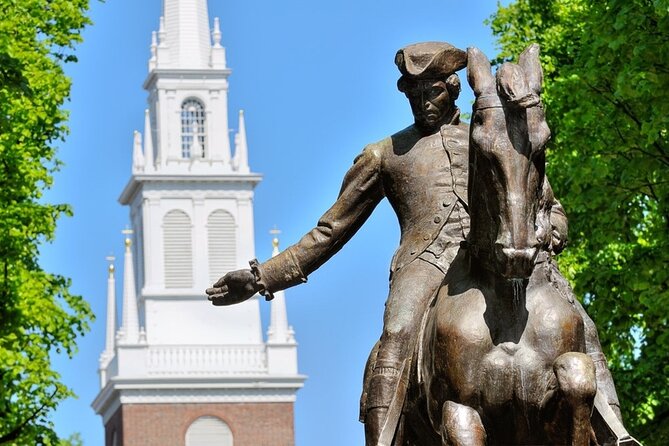
- Four major Freedom Trail sites: Visit the Old State House, Faneuil Hall, King’s Chapel, and Old South Meeting House.
- A true private tour: Your group alone participates, with a maximum of 12 people.
- Strong storytelling: Guides such as Kate and Marcie have been praised for making complex events clear and lively, including for children.
- A useful price calculation: The $175 group price works out to about $14.58 per person when 12 people join.
- A compact route: The walk begins at 1 Faneuil Hall Market Place and ends near 1 Beacon Street.
- Free cancellation: Cancel at least 24 hours before the start time for a full refund.
Four places that explain how Boston reached rebellion
This is not a long march along the entire Freedom Trail. It is a short, concentrated route through four places where Boston’s political, religious, and commercial pressures came together.
That focus is useful if you have only an hour, or if you want a guide to give shape to the red-brick buildings you might otherwise pass without much thought. You will hear about public meetings, royal authority, trade, slavery, religion, protest, and the personal choices behind the Revolution.
The tour moves on foot, with no private transportation included. Since the stops are close enough to connect in a one-hour route, you should think of this as a walking conversation with repeated pauses, not a museum tour with long indoor visits.
More ways to walk the Freedom Trail
- Boston: Freedom Trail History Small Group Walking Tour
★ 5.0 · 6,450 reviews - Boston Freedom Trail Walking Tour with Costumed Guide
★ 4.5 · 2,531 reviews - Boston Food & History: Pizza, North End & Freedom Trail
★ 5.0 · 1,772 reviews
Old State House: where royal power met public resistance
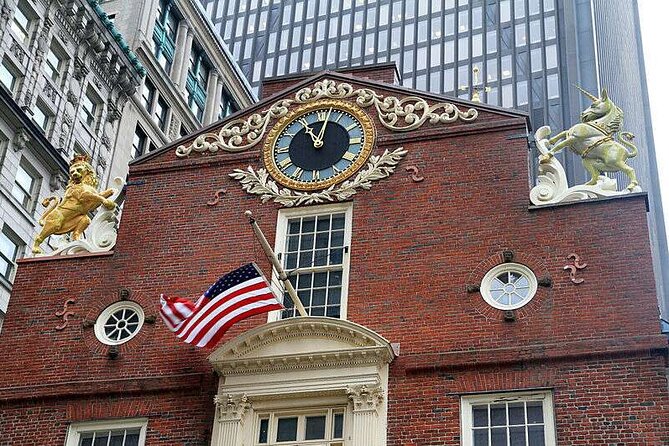
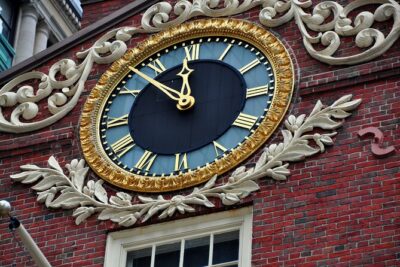
The Old State House is the natural place to begin the story. Built in 1713, it is Boston’s oldest public building, though government business had taken place on this site since 1658. Its height once made a deliberate statement: royal authority had a large, visible home in the middle of town.
Your guide uses the building to explain political change. Royal governors once proclaimed the king’s decrees from its balcony. On July 18, 1776, that same balcony was used for the public reading of the Declaration of Independence. The contrast is striking. The spot that once announced obedience to a distant king became a platform for independence.
I like this stop because it turns a familiar date into a physical scene. You are not simply hearing that Boston supported independence. You are learning where the news was delivered, and how the meaning of the building changed as the political mood shifted.
The story also needs a clear limit. The promise of liberty did not reach everyone. African Americans and women remained without a political voice, and the tour addresses that gap rather than presenting the Revolution as a finished victory for all. That makes the stop more useful than a simple list of patriotic milestones.
You will spend about 15 minutes here, with admission listed as free. That is enough time to grasp the building’s role and hear the key story, but not enough for a detailed examination of every room or exhibit. If you want an extended visit inside the Old State House, plan separate time before or after the walk.
Faneuil Hall: trade, public debate, and an uncomfortable fortune
Faneuil Hall brings money and commerce into the story. In 1742, Boston had about 14,000 residents, a protected harbor, busy docks, and active trade with Europe and the West Indies. Wealthy merchants had a strong influence on the town, and Peter Faneuil offered a central marketplace modeled on those found in major European cities.
The offer was not accepted at once. Town leaders worried that a public marketplace could affect existing businesses. The town accepted it by a slim margin, and Faneuil added a second floor at the last moment. That upper space became important for public meetings, giving the building a role beyond buying and selling.
The detail I find most important is the source of Faneuil’s wealth. His fortune came from the transatlantic slave trade. A tour about liberty that leaves this out would give you a distorted picture of colonial Boston. Here, the setting lets you consider how commercial success, forced labor, public life, and political protest were tied together.
Faneuil Hall is often treated as a quick photo stop, but its real value is the tension between its civic purpose and its financial origins. The same town that gathered to debate rights also benefited from an economy connected to slavery. That is not a side note. It is part of understanding the people and institutions behind the Revolution.
The stop lasts about 15 minutes. Admission is free, and the tour begins at 1 Faneuil Hall Market Place, so this location serves as both a practical meeting point and an early lesson in Boston’s commercial past. You may find the surrounding marketplace active during your visit, but the tour’s focus is the historic role of the hall itself.
King’s Chapel: religion, loyalty, and Joseph Warren
King’s Chapel shifts the story from commerce to religion and loyalty. In 1686, it became Boston’s first Church of England congregation, established partly to give the newly appointed royal governor a place to worship.
Its location beside Boston’s oldest burying ground added to its political meaning. For many colonists, the church represented the authority and religious ties of England. By the time of the Revolution, its presence had become a symbol of the institutions many Patriots opposed.
The guide also introduces Dr. Joseph Warren, one of Boston’s most important Patriot leaders. Warren was a physician who treated both Patriots and Loyalists, while also becoming an influential organizer, politician, and militia leader. At only 34, he had already built an unusually broad public role.
Warren’s connection to King’s Chapel is especially personal. He was eulogized there after his death. That gives the site emotional weight without turning the tour into a single-hero story. His medical work, political organizing, and relationships with people on both sides show how the conflict could divide communities that still had to live and work together.
I like this stop because it makes the Revolution feel less like a clean contest between two fixed teams. People held several roles at once. A doctor could care for Loyalists and still help lead the Patriot cause. A church could represent royal power and later become part of the memory of revolution.
Again, the visit is about 15 minutes, and admission is free. You should not expect a full religious or architectural tour in this time. The value comes from the guide’s explanation of why this church mattered to Boston’s political life.
More walking tours in Boston
- Harvard University Campus Guided Walking Tour
★ 4.5 · 3,632 reviews - The Full Revolutionary Story Epic Small Group Boston Walking Tour
★ 5.0 · 2,356 reviews - Boston’s Freedom Trail: A Revolutionary Walking Tour
★ 4.9 · 1,748 reviews - Boston: Freedom Trail History Small Group Walking Tour
★ 4.9 · 1,590 reviews
Old South Meeting House: the room that held the tea debate
The Old South Meeting House was built in 1729 and was the largest meeting space in Boston. Its size came from the way Puritans worshiped and organized community life, but the room also made an ideal setting for public debate.
The most famous meeting took place on December 16, 1773, when Bostonians gathered to discuss the tea crisis. The East India Company was one of the world’s largest companies and was struggling during a weak European economy. Parliament responded with the Tea Act of 1773, giving the company special access to sell tea to the colonies.
Those facts matter because the protest was not simply a reaction to a tax in isolation. The act connected colonial anger to corporate privilege, economic fear, and Parliament’s decision to support a major company. The meetinghouse became the place where a public crowd considered what to do next.
Your guide can use the building to show how protest grew from discussion. Before the famous destruction of the tea, people gathered, argued, and made demands here. The room’s scale helps explain how Boston could turn a political dispute into a mass public event.
This is a strong final stop because it brings together the themes introduced earlier: trade at Faneuil Hall, royal authority at the Old State House, and religious community life at King’s Chapel. The Old South Meeting House shows those pressures becoming organized resistance.
You will have about 15 minutes here, with admission listed as free. That is sufficient for the tea meeting and its political setting, but you will want extra time if your main goal is to study the building itself.
Why the private format matters in only one hour
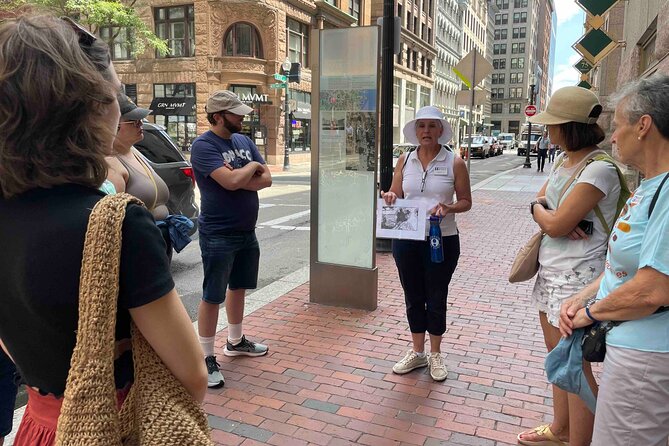
A private tour changes the pace and the tone. You are not sharing the hour with unrelated groups, so your guide can address your party directly and adjust the explanation to your interests. The maximum group size is 12, which is small enough for a more personal conversation without making the price unreasonable for a family or group of friends.
The feedback attached to this experience gives two guides specific praise. Kate was described as engaging and strong with the stories, while Marcie was praised for making familiar Boston history feel fresh, even to people who had lived in the city for decades. Another account specifically noted patience with young children.
Those details matter if you are booking for a mixed-age group. A one-hour walk can lose younger children quickly if it becomes a lecture. The available feedback suggests that the guides can keep the tone friendly and adjust to children, but the tour still covers serious subjects and moves at a steady pace.
The private format also helps if your group wants to ask questions. The supplied information does not promise a custom route or unlimited time at each stop, so do not assume you can turn this into a longer private lesson. Still, having the guide’s attention for your own group is a real advantage over a large public walk.
The $175 price: good value for a full group
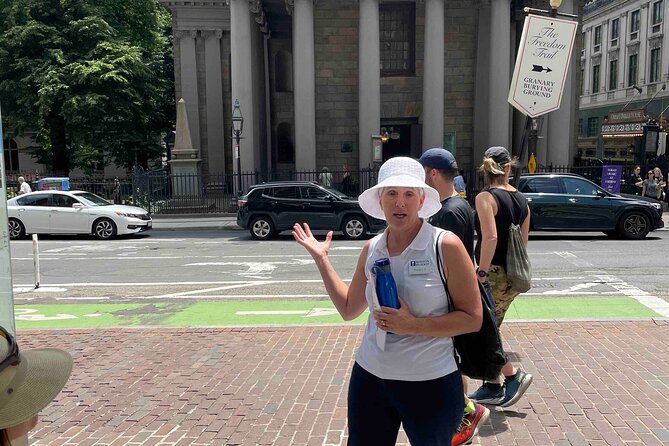
The cost is $175 per group, up to 12 people. With a full group, that works out to about $14.58 per person, which is a fair price for a private guide and a concentrated introduction to four central sites.
For two people, the calculation is very different: the same tour costs $87.50 each. For a family of four, it comes to $43.75 per person. I would consider the price strongest for families, reunions, or groups of friends who want a private hour without paying individual admission fees at each stop.
The four stops list free admission, so you are paying mainly for the guide’s time, organization, and storytelling. That is important when judging value. If you only want to follow the red-brick path and read signs, you can explore Boston without this expense. If you want the connections between the buildings, people, and political events, the guide is the point.
The one-hour limit keeps the total cost manageable, but it also limits depth. You get a brisk introduction rather than a full day of colonial Boston. I would book it early in a Boston visit, then return on your own to the site that interests you most.
Timing, meeting point, and walking expectations
The tour starts at 1 Faneuil Hall Market Place in Boston and finishes in the general area of 1 Beacon Street. That ending point is near the Massachusetts State House area, making it practical for continuing your sightseeing on foot or using nearby public transportation.
The tour lasts approximately one hour. The planned structure gives each of the four main stops about 15 minutes, so arrive ready to keep moving between locations. Comfortable shoes are sensible, even though this is a short walk.
There is no private transportation. That is not a problem for this route, but it matters if anyone in your party expects a vehicle between sites. Most people can participate, and service animals are allowed. The experience is near public transportation, which makes the start and end points convenient within central Boston.
A mobile ticket is provided, so keep the booking confirmation available on your phone. Confirmation arrives when you book. If your plans change, cancellation is free when made at least 24 hours before the start time. Cancellations or changes made inside that window are not accepted for a refund.
Who will get the most from this Freedom Trail walk?
I would choose this tour for a first visit to Boston when you want the Revolution explained without spending half a day on a larger route. It also suits a family that wants a private guide, a small group celebrating a special occasion, or friends who prefer conversation over a formal lecture.
It is a good match if you care about the human and political complications of the period. The tour does not stop at patriotic slogans. It addresses slavery, the absence of political rights for women and African Americans, religious tension, commercial power, and the different roles played by people such as Joseph Warren.
You may want something longer if you already know these four sites well, or if you want extensive interior visits. The short schedule leaves little room for side streets, extra buildings, or a detailed architectural study. You also should not book it expecting transportation or a full tour of the entire Freedom Trail.
Should you book the Heart of the Freedom Trail tour?
Book it if you want a focused private introduction to Boston’s Revolutionary story, especially when your group can share the $175 cost. The four stops are well chosen, and the guide’s job is to connect them rather than simply point them out.
I would be most inclined to book this early in your stay. It gives you a useful framework for later visits to Boston’s historic sites, and the one-hour length leaves the rest of your day open.
Skip it if you prefer to explore entirely at your own pace, need long indoor visits, or are traveling alone and find the private group price too high. For families and groups, though, the personal guide, free admissions, and clear route make this a practical way to get the essential Freedom Trail story in one compact hour.
FAQ
How long is the Heart of the Freedom Trail tour?
The walking tour lasts approximately one hour.
How much does the private tour cost?
The price is $175 per group, with up to 12 people included.
Which historic sites are visited?
The tour visits the Old State House, Faneuil Hall Marketplace, King’s Chapel, and the Old South Meeting House.
Where does the tour begin and end?
It begins at 1 Faneuil Hall Market Place, Boston, Massachusetts. It ends in the general area of 1 Beacon Street.
Is transportation included?
No. Private transportation is not included. This is a walking tour.
Can I cancel for a full refund?
Yes. You can cancel for a full refund if you do so at least 24 hours before the experience start time. Changes or cancellations made less than 24 hours in advance are not accepted for a refund.
Newest Boston tours we have written up
- Boston’s Freedom Trail: A Self-Guided Audio Tour★ 4.0 · 18 reviews
- Boston’s Freedom Trail: A Self-Guided Tour of All 16 Sites★ 5.0 · 14 reviews
- Washington D.C. Cherry Blossom,Baltimore 3-Day Tour from Boston★ 4.5 · 7 reviews
- Boston Self-Guided Audio Tour Bundle: Freedom Trail & More★ 4.5 · 5 reviews
- True Crime Tour of Boston★ 4.0 · 17 reviews
- Family Friendly Guided Bike Tour of Boston★ 4.5 · 22 reviews
- Freedom Trail Experience★ 5.0 · 8 reviews
- The Ghosts of Boston’s Past Haunted Self-guided Tour★ 3.5 · 4 reviews
Boston Freedom Trail Tours, compared.
Freedom Trail History Small Group Walking Tour
Read our review →
Boston Freedom Trail Walking Tour with Costumed Guide
Read our review →
Boston Food & History: Pizza, North End & Freedom Trail
Read our review →
Boston’s Freedom Trail: A Revolutionary Walking Tour
Read our review →Freedom Trail History Small Group Walking Tour
Read our review →Boston’s Freedom Trail: A Revolutionary Walking Tour
Read our review →
Boston Freedom Trail History Pub Crawl Small-Group Tour
Read our review →Browse the lists this tour appears in