
Review · HISTORICAL TOURS
2 Hour Boston Historical and Heritage Walking Tour
Boston’s past comes at you fast on this $5, one-mile walk from Boston Common to Faneuil Hall. Guide Stephen Uys covers Puritan Boston, abolition, the Revolution, immigration, literature, and city politics, often adding the small human stories that guidebooks skip.
I like the unusually broad subject range, and I like that you can ask questions instead of simply trailing behind a rehearsed script. The small maximum group of 24 also helps. The main caution is pace: Stephen has so much to share that the tour can run long, move quickly, or feel like too much information at once.
Key points at a glance
- Start with Boston Common: Explore America’s oldest public park, once used for cattle pasture, military drills, public punishments, and political gatherings.
- Meet Stephen Uys: Expect an animated guide with a strong command of Boston and Massachusetts history, plus plenty of stories about personalities and politics.
- Follow a serious historical arc: The route links the 54th Massachusetts, the Boston Massacre, the Tea Party, Irish immigration, and the city’s literary world.
- Allow extra time: The advertised length is about two hours, but Stephen has sometimes continued for nearly three hours.
- Wear weather-ready shoes and clothing: This is an outdoor walk with little opportunity to sit, and rain or wind can affect both comfort and hearing.
- Finish near Faneuil Hall: The endpoint puts you beside Faneuil Hall, the Union Oyster House, Bell in Hand, and the entrance to the North End.
Boston Common gives the tour its proper opening
Meet at 11 a.m. by the Boston Common Tablet at 1634 Freedom Trail. This is a sensible starting point because Boston Common is not just a pleasant patch of grass. Its 45 acres have served as pasture, military ground, execution site, parade space, and a gathering place for civil rights rallies and public events.
You get about ten minutes here, though the guide may spend longer on the opening explanation. Stephen once received criticism for talking for roughly half an hour before reaching the first main stop, and he says he has shortened that introduction to about ten minutes. That is useful to know if you prefer a brisk start.
I like the way the Common sets up the rest of the walk. Boston is not presented as a collection of famous buildings. You begin with the idea that public space has always reflected the city’s arguments, beliefs, and power struggles.
From here, you move toward Park Street Church, a short stop with a surprisingly large historical footprint. The church played a role in abolitionist activity and missionary work, and it hosted the first public performance of Samuel Francis Smith’s My Country, ’Tis of Thee on July 4, 1831.
More history tours in Boston
- Boston: Freedom Trail History Small Group Walking Tour
★ 5.0 · 6,450 reviews - Tour of Historic Fenway Park, America’s Most Beloved Ballpark
★ 4.5 · 3,013 reviews - Boston Food & History: Pizza, North End & Freedom Trail
★ 5.0 · 1,772 reviews
Park Street and the 54th Massachusetts tell harder stories
At Park Street Church, Stephen connects religious conviction with public action. You hear about speeches and people who argued for freedom and justice, rather than simply admiring the church’s exterior.
The next major stop is the Robert Gould Shaw and 54th Regiment Memorial. This is one of the strongest moments on the route. The memorial honors the African American Civil War regiment and its commander, and the story gives the walk moral weight beyond the usual colonial highlights.
If you know little about the 54th Massachusetts, this stop provides an important correction to a Revolution-only view of Boston. The city’s story includes slavery, abolition, military service, race, and the long struggle over who could claim full citizenship.
The Massachusetts State House follows, with its famous golden dome and a history reaching back to 1798. You pause near statues including General Joseph Hooker and Mary Dyer, who was hanged for her Quaker beliefs. That pairing says much about the city: political authority, religious conflict, and changing ideas about liberty all appear within a few steps.
The stop itself is listed at about five minutes, so you should not expect an interior tour of the State House. This walk is about context from the pavement, not admission to each building.
Boston’s Brahmins and literary circles appear in the side stories
One unusual thread concerns the private library of Boston’s Brahmins. The phrase refers to the city’s old upper class, whose books, education, and social influence helped shape American intellectual life.
This is one reason the tour feels different from a standard Freedom Trail stroll. Stephen does not stop with battles and dates. He links political history to reading, publishing, religion, and social class.
The Old Corner Bookstore makes that literary side more concrete. Built in 1718 as a residence and apothecary, it became a bookstore in 1828 and later housed Ticknor and Fields publishers. Authors associated with the site include Henry Wadsworth Longfellow, Nathaniel Hawthorne, Oliver Wendell Holmes Sr., and Ralph Waldo Emerson.
You have only about five minutes here, so treat it as a storytelling stop rather than a chance to browse inside. The value lies in understanding how Boston’s writers and publishers met, worked, and helped shape the country’s literary culture.
Scollay Square and the Old State House reveal a changing city
The West End portion includes the story of Scollay Square, once an entertainment district filled with theaters, vaudeville shows, and colorful characters. The square no longer survives in its old form, which makes the stop a useful reminder that cities erase and rebuild themselves.
You also hear about the Kennedy family’s Love Nest, a more personal and romantic detail amid the public history. It is the sort of anecdote that helps break up a long run of dates, monuments, and political disputes.
The Old State House then brings the route back to the Revolution. From here, a copy of the Declaration of Independence was read to Boston citizens in 1776. The building later fell into poor condition, and Chicago offered to buy it. Bostonians saved it instead and carefully restored it over time.
That rescue story is worth noting because Boston’s famous sites were not always treated as priceless. Preservation took money, public interest, and a belief that old buildings still had something to say.
More walking tours in Boston
- Harvard University Campus Guided Walking Tour
★ 4.5 · 3,632 reviews - Boston Freedom Trail Walking Tour with Costumed Guide
★ 4.5 · 2,531 reviews - The Full Revolutionary Story Epic Small Group Boston Walking Tour
★ 5.0 · 2,356 reviews - Boston’s Freedom Trail: A Revolutionary Walking Tour
★ 4.9 · 1,748 reviews
The Boston Massacre and Tea Party bring the Revolution to street level
At the Boston Massacre site, Stephen recounts the confrontation between British soldiers and Boston colonists. The event helped stir anger against British rule and became powerful political material in the years before independence.
This is a compact stop, about ten minutes, but it benefits from a guide who can explain how an event becomes a political symbol. The facts matter, but so does the way the story was spread and used.
Nearby, you hear about the December 16, 1773 meeting during the tea crisis. About 5,000 citizens gathered to oppose the landing of the British tea ships. Men disguised as Mohawk Indians then led a group down Milk Street to Griffiths Wharf, where the tea was thrown overboard.
The setting is easy to overlook if you are moving quickly through downtown. That is why a walking explanation helps. You can connect ordinary streets, meeting places, and wharves with the decisions that pushed Boston toward rebellion.
The route does not offer admission to the Old State House or other indoor attractions. If you want museum time, schedule it separately.
The Irish Famine Memorial widens the Boston story
The Boston Irish Famine Memorial honors the thousands of Irish immigrants who fled the Great Famine of 1845 to 1852. By 1850, Irish immigrants had become Boston’s largest ethnic group.
This five-minute stop gives the walk a needed shift in focus. Boston was not created only by ministers, merchants, military leaders, and famous writers. It was also shaped by people arriving with little, building communities, and changing the city’s identity.
The memorial also honors immigrant groups more broadly. I like this part because it connects a specific historical tragedy with the continuing question of who gets to call Boston home.
The stop is brief, so do not expect a long memorial visit. You will get the story, a moment to look, and then continue toward the city’s bookshops, schools, markets, and political buildings.
School Street links education, hotels, and a patient donkey
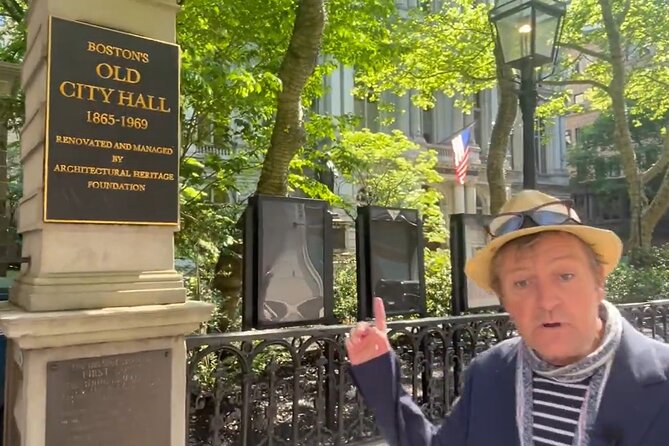
School Street passes the former site of Boston Latin School, founded as the first public school in the United States. The route also takes in King’s Chapel, Old City Hall, and the Parker House.
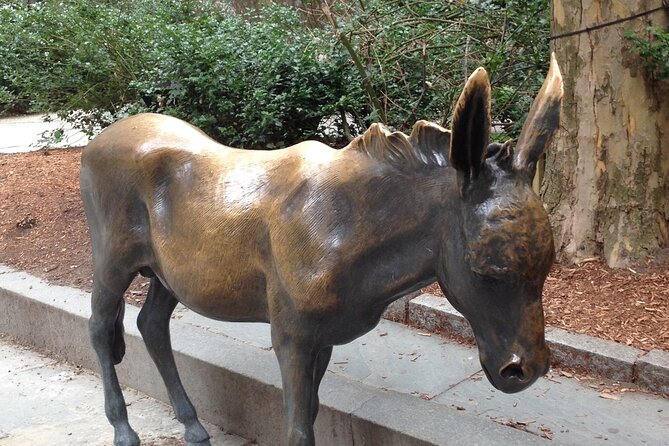
This stretch packs several layers into a small area. You move from public education to religion, municipal government, and one of Boston’s best-known hotels. Stephen also points out Boston’s beloved donkey waiting on School Street, a lighter moment after the more serious accounts of war, famine, and religious persecution.
The itinerary allows about ten minutes here. Keep your camera ready, but do not expect long photo breaks at every address. Several parts of the walk are in busy downtown surroundings, and city noise can make it harder to hear.
Faneuil Hall is both symbol and contradiction
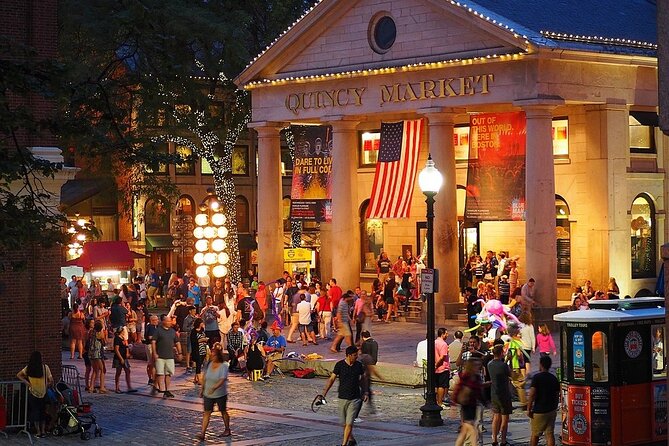
Faneuil Hall Marketplace is the grand finale before the short walk to Boston City Hall. Its grasshopper weathervane is said to be modeled after the one at London’s Royal Exchange, and Faneuil Hall became known as the Cradle of Liberty because revolutionary leaders used it as a meeting place.
The building was given to Boston by Peter Faneuil, a slave trader. That fact complicates the heroic label, and it is exactly the kind of contradiction this tour is willing to discuss. American liberty and human bondage existed side by side, including in places later celebrated as birthplaces of democracy.
Faneuil Hall is also connected with the Ancient and Honorable Artillery Company of Massachusetts, described as the oldest military body in the Western Hemisphere, with a charter dating to 1637. The marketplace around it is now busy and commercial, but the building itself still carries the political memory of the city.
The route ends across from Faneuil Hall, near Boston City Hall. You are well placed for lunch, a walk into the North End, or a visit to nearby historic buildings.
Curley, oysters, and the North End make a useful finish
The final stop is beside two statues of James Michael Curley. Curley served four times as Boston mayor, as governor of Massachusetts, and as a congressman. His long political career made him a flamboyant city boss, and his story gives the tour a look at Boston politics far beyond the colonial era.
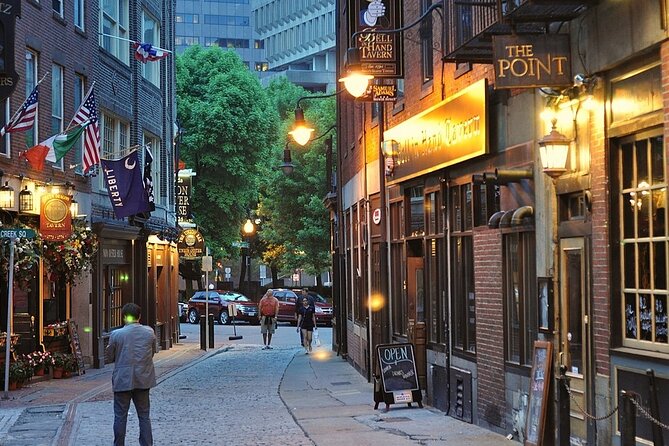
A few steps away are the Union Oyster House, Bell in Hand tavern, and Hanover Street, the gateway to the North End. The location is practical. You can continue exploring without needing a taxi or subway ride.
The listed endpoint is the James Michael Curley Statues area at Congress Street and North Street, directly across from Faneuil Hall. The route is about one mile, though the walking time depends on how long the guide spends on stories and questions.
Why the $5 price offers unusual value
At $5 per person, this is hard to fault on price. You receive an in-person English guide, a two-hour introduction to central Boston, and access to a wide range of historical subjects without paying admission at each stop.
The real value depends on your preferred touring style. If you want a quick route with short facts and plenty of independent photo time, this may feel inefficient. If you like history delivered as connected stories, the price is remarkably low.
The listed group maximum is 24. That is not a private tour, but it is smaller than the very large groups often gathered along the Freedom Trail. A smaller group also gives you a better chance to ask questions.
The walk accepts mobile tickets, operates near public transportation, and allows service animals. Most people can participate, but you should be ready to walk continuously and remain outdoors.
The main caution is pace, sound, and timing
Stephen Uys is praised for his energy, storytelling, and command of local history. He can connect a church, a book publisher, a Civil War regiment, and a political boss in ways that make the city feel like one long conversation.
That same strength can become a weakness. Several people found the presentation too fast or too information-heavy. One particularly important criticism was that the opening explanation delayed the first stop, though Stephen says he has shortened it. Another issue is timing: the scheduled two-hour tour has sometimes stretched close to three hours.
You should also expect background noise. Duck tours, traffic, and downtown activity can make some sections difficult to hear. Stephen has added a voice amplifier, but you should stay near him and ask him to repeat anything you miss.
Dress for the forecast. Wind, rain, and cold have affected the experience, and there are few built-in breaks. The tour requires good weather, so a cancellation caused by poor conditions brings either another date or a full refund. You can cancel for a full refund up to 24 hours before the start time.
Who should book this Boston walk?
I would choose this tour if you want a serious history lesson with personality and prefer stories about people, power, religion, race, immigration, and literature instead of a quick list of famous sites.
It suits adults, older children with a strong interest in history, solo visitors, and anyone who wants orientation before exploring the Freedom Trail alone. The small group limit and question-friendly format are useful if you do not like anonymous crowds.
I would think twice if you need a tightly timed two-hour schedule, speak English as a second language and find fast speech difficult, or want frequent sitting and photography stops. Families with very young children may also find the information load demanding.
Should you book the 2 Hour Boston Historical and Heritage Walking Tour?
Book it if the $5 price, broad subject range, and lively guide appeal to you. Stephen Uys brings far more than the standard Revolution script, including the 54th Massachusetts, Boston’s Irish community, the Brahmins, publishing, the Kennedys, and James Michael Curley.
Go in expecting an energetic lecture on foot, not a relaxed stroll. Stay close, wear comfortable shoes, allow more than two hours if possible, and treat the extra stories as part of the bargain. If you want Boston explained through its arguments and personalities, this is a strong value.
FAQ
How much does the tour cost?
The tour costs $5 per person.
How long is the walking tour?
It is scheduled to last about two hours. It covers roughly one mile, but it can run longer depending on the guide’s stories, questions, and route.
What time does the tour start?
The tour starts at 11 a.m.
Where does the tour begin?
It begins at the Boston Common Tablet at 1634 Freedom Trail, Boston, Massachusetts 02108.
Where does the tour end?
It ends near the James Michael Curley statues at Congress Street and North Street, directly across from Faneuil Hall.
What language is the tour offered in?
The in-person tour is offered in English.
Is admission to the historic sites included?
The listed stops have free admission, but the experience is an outdoor walking tour and does not include interior admission to the buildings.
How large can the group be?
The maximum group size is 24 people.
Can I cancel the booking?
You can cancel up to 24 hours before the start time for a full refund. If poor weather causes the tour to be canceled, you are offered another date or a full refund.
More 2-Hour Experiences in Boston
- 2-Hour Beacon Hill True Crime Expert Guided Tour
★ 5.0 · 182 reviews - 2 Hour North End ‘Little Italy’ Walking Tour
★ 4.5 · 125 reviews - Boston: 2-Hour Historic Walking Tour
★ 4.7 · 88 reviews - 2 Hour Boston Segway Tour
★ 5.0 · 77 reviews
Newest Boston tours we have written up
- Boston’s Freedom Trail: A Self-Guided Audio Tour★ 4.0 · 18 reviews
- Boston’s Freedom Trail: A Self-Guided Tour of All 16 Sites★ 5.0 · 14 reviews
- Washington D.C. Cherry Blossom,Baltimore 3-Day Tour from Boston★ 4.5 · 7 reviews
- Boston Self-Guided Audio Tour Bundle: Freedom Trail & More★ 4.5 · 5 reviews
- True Crime Tour of Boston★ 4.0 · 17 reviews
- Family Friendly Guided Bike Tour of Boston★ 4.5 · 22 reviews
- Freedom Trail Experience★ 5.0 · 8 reviews
- The Ghosts of Boston’s Past Haunted Self-guided Tour★ 3.5 · 4 reviews
Historical Tours, compared.
History and Hauntings of Salem Guided Walking Tour
Read our review →
Freedom Trail History Small Group Walking Tour
Read our review →
Tour of Historic Fenway Park, America’s Most Beloved Ballpark
Read our review →
Boston Food & History: Pizza, North End & Freedom Trail
Read our review →Freedom Trail History Small Group Walking Tour
Read our review →
City Cruises Boston Historic Sightseeing Harbor Cruise
Read our review →
Boston’s North End Food Tour: Italian Flavors & Heritage Walk
Read our review →
Boston Pizza Lovers Food and History Walking Food Tour
Read our review →Browse the lists this tour appears in