
Review · BOSTON FREEDOM TRAIL TOURS
Boston: Freedom Trail History Small Group Walking Tour
Boston’s Freedom Trail is best understood on foot, and this tour follows the whole official route from Boston Common to the North End. Your guide connects the years from 1760 to 1775, when taxes, protests, soldiers, newspapers, and town meetings pushed Boston toward revolution.
I like the small group limit of 16, which gives you room to ask questions. I also like the chronological approach used by guides such as Jon, Maura, Mark, and Alejandro. The route makes more sense when events build in order, rather than arriving as a jumble of famous names.
The catch is simple: you will spend about two and a half hours standing and walking outdoors. Buildings are viewed from outside, and museum admission is not included. In cold weather, bring serious layers. Several recent winter tours were praised for warm-up breaks and considerate guides, but Boston wind is still Boston wind.
Key points to know before you book
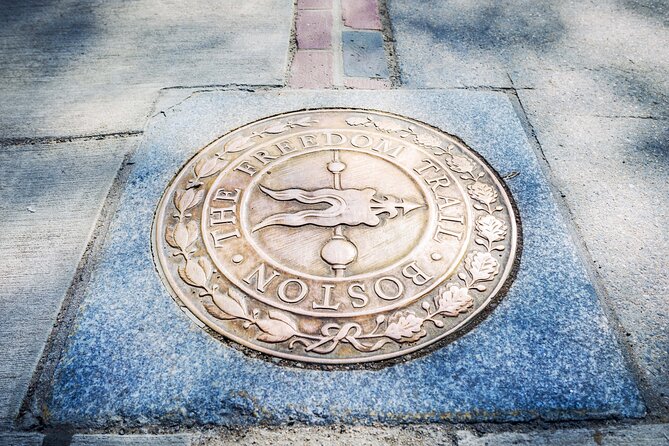
- All 16 official Freedom Trail landmarks: You follow the full downtown and North End route, not just a short highlight walk.
- A history-first presentation: The focus is on 1760 to 1775, with political context, direct quotations from historical figures, and plenty of time for questions.
- A maximum of 16 people: The small group makes it easier to hear the guide and take part in the discussion.
- A strong first-day activity: The walk gives you a useful map of central Boston and ends near Hanover Street restaurants and pastry shops.
- Outdoor sightseeing for 2.5 hours: Wear comfortable shoes and plan for standing, uneven city surfaces, and changing weather.
- Good access for wheelchairs and strollers: The tour is listed as accessible, with service animals allowed and public transportation nearby.
Boston Common sets the story in motion
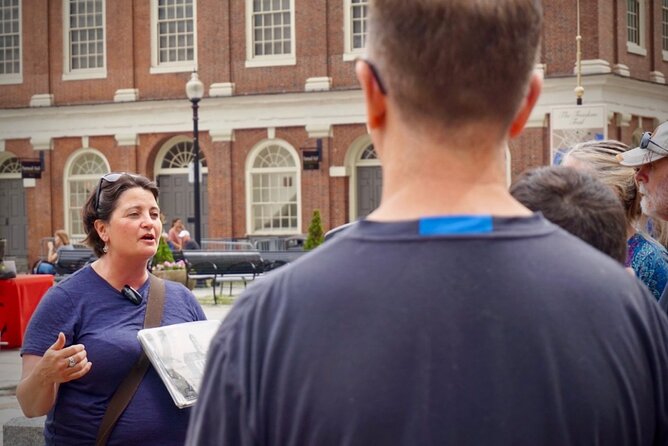
Meet your guide at the Boston Foundation Monument inside Boston Common, near the northern edge of the park and opposite 50 Beacon Street. The granite memorial shows two men shaking hands, recalling the Puritan arrival in 1630.
This is a useful starting point because the tour begins before the Revolution itself. Boston was already an old colonial town by the time the famous protests began, and the guide uses the setting to explain how the settlement developed.
Boston Common follows, with about 20 minutes devoted to the oldest public land in the Americas. Originally used as communal pasture, the Common also gives you a sense of Boston’s compact scale. The route is not simply a string of isolated monuments. You are walking through the city’s civic center, where public space, politics, religion, and commerce have always pressed close together.
The Massachusetts State House appears along this early stretch. The building dates to 1798 and carries Boston’s old nickname, the Hub of the Solar System. The name sounds grand, but it reflects the city’s long habit of seeing itself as the center of New England politics and trade.
You will also pass an active church that was Boston’s tallest building in the 19th century. The itinerary does not include interior visits, so your guide’s explanation matters here. This is one of the places where a strong storyteller can give the street corner a sense of time and purpose.
More ways to walk the Freedom Trail
- Boston Freedom Trail Walking Tour with Costumed Guide
★ 4.5 · 2,531 reviews - Boston Food & History: Pizza, North End & Freedom Trail
★ 5.0 · 1,772 reviews - Boston’s Freedom Trail: A Revolutionary Walking Tour
★ 4.9 · 1,748 reviews
Granary Burying Ground puts names to the Revolution
Granary Burying Ground is one of the longest stops, at roughly 20 minutes. Founded in 1660, it is Boston’s third-oldest burying ground and the final resting place of several major figures from Revolutionary Boston.
This stop helps turn large political events into human stories. You are not only hearing about laws, taxes, and resistance. You are standing among the graves of people who shaped the arguments that led to independence.
The route also passes King’s Chapel, the first Church of England in Puritan Boston, founded in 1686 and rebuilt in 1754. Nearby are Boston’s oldest burying ground, the center of Boston politics for more than a century, and the former publishing house of Ticknor & Fields.
Those stops broaden the tour beyond battle stories. Boston’s Revolution grew out of religious tension, printed arguments, local government, and commercial life. I find that useful because the Freedom Trail can otherwise become a parade of famous men and dramatic incidents.
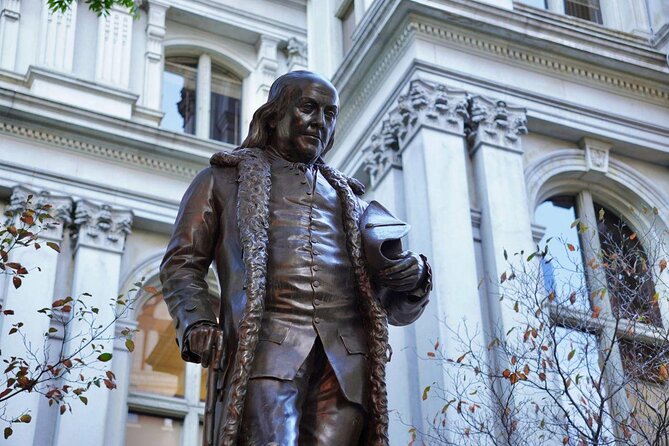
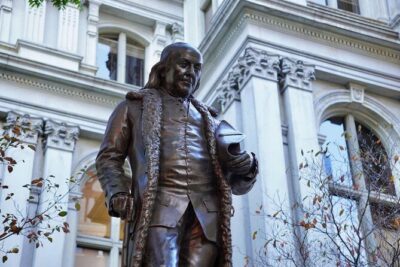
At Boston Latin School’s former site, you will see the Statue of Benjamin Franklin. Franklin attended the school, which was founded in 1635 and is considered the oldest public school in the Americas. The stop takes about 10 minutes and gives the guide a chance to talk about education, public life, and the way Boston produced political thinkers.
Meeting houses and government buildings explain the pressure
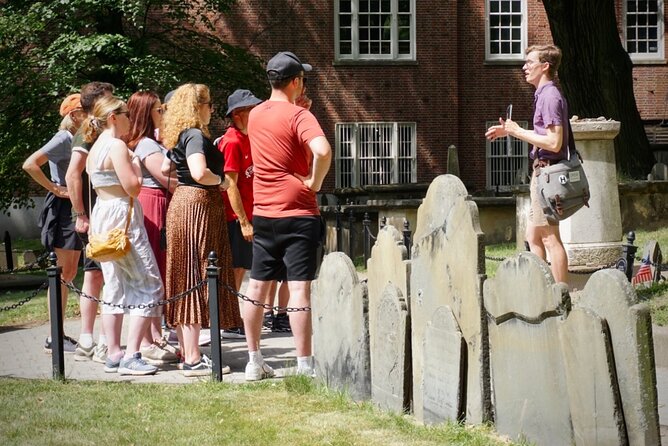
The next section moves through several places tied to Boston’s political arguments. You will pass the Old South Meeting House, a Congregationalist meeting house founded in 1729 and linked to the gathering that led to the Boston Tea Party in 1773.
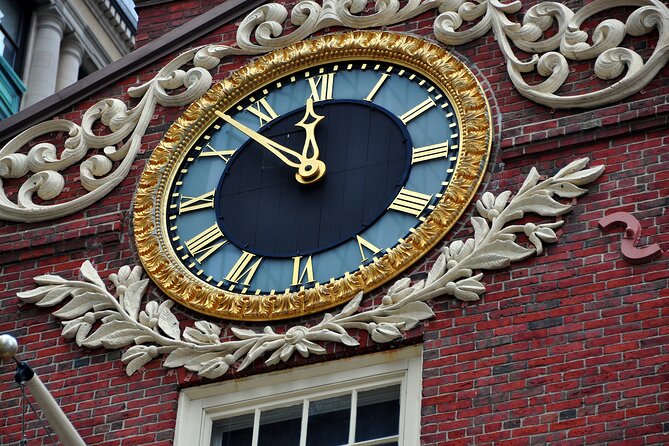
The Old State House follows. Built in 1713, it served as the colonial capitol of Massachusetts Bay Colony and is the oldest public building in Boston. The building’s importance is easy to miss if you only stop for a photograph. Your guide can explain how colonial authority worked and why this location became a focus of public conflict.
This is also the part of the route where the guide’s command of dates and personalities becomes especially useful. The best presentations, like those described by people who joined guides Jon, Kiera, and Maura, keep the sequence clear. The events are complicated, but the walk works better when you can see how one confrontation led to the next.
The tour also passes the former publishing house of Ticknor & Fields and the political center that shaped Boston for more than a century. These are not always the headline stops, yet they help explain how ideas moved through the city. If you enjoy political history, ask questions here. The small group format gives you a better chance of getting a real answer rather than a quick scripted line.
The Boston Massacre Site reveals how one image changed politics
The Boston Massacre Site receives about 20 minutes, making it one of the main teaching stops. On March 5, 1770, British soldiers killed five Bostonians. The incident quickly became a powerful symbol for colonial resistance.
The guide can help you separate the event itself from the way it was presented to the public. That distinction is important. Political leaders used speeches, printed images, and public mourning to shape opinion, and the massacre became part of a wider argument against British military presence.
This is one of the spots where I would encourage you to listen for the political details, not just the violence. The tour’s stated focus on 1760 to 1775 gives the guide room to explain the years of growing pressure between the massacre and the outbreak of fighting.
You will also pass the site associated with a leading figure of Boston’s Sons of Liberty. The trail then reaches Faneuil Hall Marketplace, which receives about 10 minutes. Faneuil Hall hosted Boston’s town meeting and became known as the Cradle of Liberty.
Today, the surrounding area is full of shops and food stops, so the historic purpose can be easy to overlook. The tour places the marketplace in its political setting. This was a place for public argument and organizing, not just a convenient place to buy a snack.
Nearby is a historic building from 1704 that now houses the oldest restaurant in the United States, founded in 1826. The restaurant itself is not included as a meal stop, but the building adds another layer to the walk. Boston’s famous sites are woven into ordinary city blocks, restaurants, offices, streets, and shops.
More history tours in Boston
- Tour of Historic Fenway Park, America’s Most Beloved Ballpark
★ 4.5 · 3,013 reviews - Boston: City Cruises Historical Sightseeing Cruise
★ 4.6 · 1,771 reviews - Boston: Freedom Trail History Small Group Walking Tour
★ 4.9 · 1,590 reviews - City Cruises Boston Historic Sightseeing Harbor Cruise
★ 4.5 · 1,388 reviews
North Square and Paul Revere bring the route into the North End
North Square Park marks the shift into Boston’s North End. The square dates to 1634 and remains an important public space in this part of the city. You spend about 20 minutes here, enough time to hear about the neighborhood and the people connected with it.
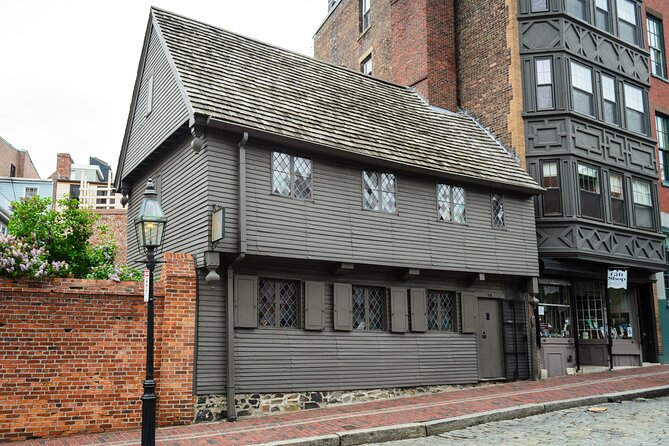
Paul Revere’s House is the main attraction in this stretch. Built around 1680, it is the oldest structure in downtown Boston and was Revere’s home during the period associated with his famous ride.
The exterior visit is included, but entry inside the house is not. That distinction matters because some readers may expect a house tour after hearing Paul Revere’s name. If you want to explore interiors, museum admission must be handled separately.
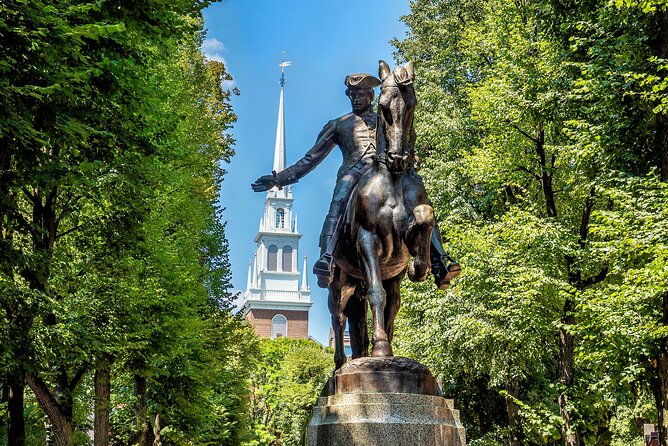
The Paul Revere Statue follows, in a pedestrian-only space honoring the 1775 Midnight Ride. You will have about 20 minutes here. The open setting works well for a story, and a good guide can explain what the popular version leaves out without losing the drama of the event.
The tour then reaches the Old North Church, the church associated with the signal lanterns used during the Midnight Ride. You also pass Copp’s Hill Burying Ground, Boston’s second-oldest burying ground.
These stops are especially satisfying because the route has finally built up to 1775. You have already seen the political arguments, public meetings, religious divisions, graves, and street corners that made the Midnight Ride meaningful. The event lands better when you understand the tension surrounding it.
Copp’s Hill Terrace gives the tour a useful finish
The walk ends at Copp’s Hill Terrace after about 20 minutes. From here, you can look toward Boston Harbor, the USS Constitution, and the Bunker Hill Monument across the Charles River.
This is a strong ending because it points beyond the downtown trail. Charlestown and the Bunker Hill Monument are not included in this tour, but you can see the connection from the terrace. The ending also leaves you in the North End, close to Hanover Street restaurants, pastry shops, and pizza places.
If you are planning your day, this location makes lunch or dinner easy to add. It also means you should not expect the tour to return you to Boston Common. The route is one-way, crossing the city from south to north.
What the $35.10 price really buys you
At $35.10 per person, this is not the cheapest way to glance at the Freedom Trail. You can follow the red brick path on your own for free, and many landmarks are visible from public streets.
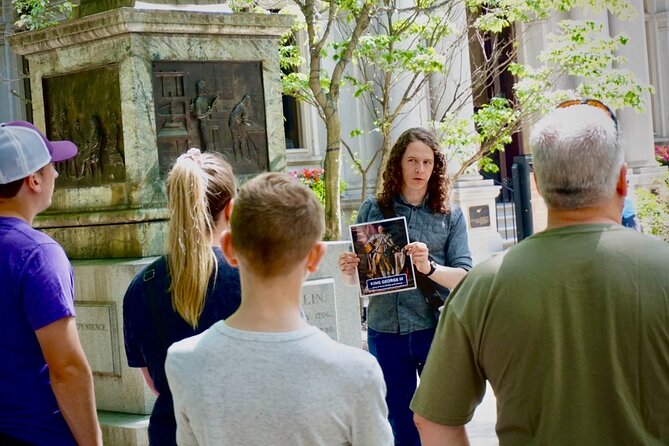
The paid value comes from structure and interpretation. A guide gives you a two-and-a-half-hour sequence, points out less obvious locations, answers questions, and helps you understand why the landmarks matter. You also see all 16 official sites rather than choosing only the most famous four or five.
The group cap matters here. With no more than 16 people, you should have a better chance of hearing the guide at busy corners and asking about details that catch your attention. The strong ratings, at 4.9 from 6,450 reviews with 98 percent recommending the experience, also suggest consistent satisfaction, though no walking tour can guarantee that every guide will match your personal style.
The guides named in the recent feedback include Jon, Maura, Mark, Alejandro, Meaghan, Nick, Kiera, Miles, Amelia, Maz, Cal, Cyrus, and Will. The repeated praise centers on clear storytelling, strong preparation, enthusiasm, and the ability to connect events in order.
Weather, walking, and access
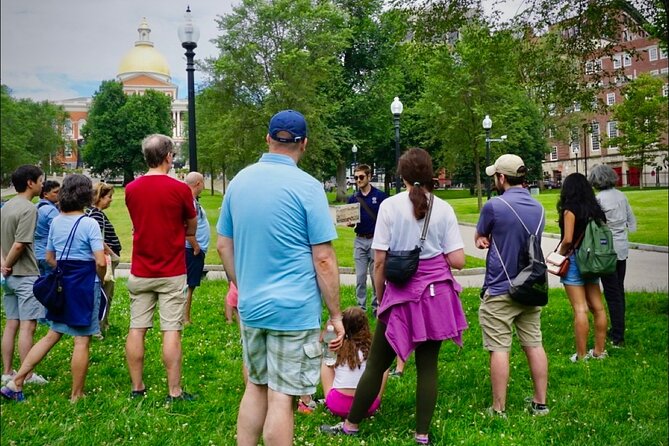
You should treat this as an outdoor activity, even though the guide may use indoor or covered spaces for a break. Winter reports describe freezing temperatures, strong wind, and guides who adjusted the route or used available indoor areas to help the group warm up.
Wear layers, gloves, and shoes that can handle two and a half hours of walking. The tour is not recommended if you have difficulty standing for long periods. A moderate fitness level is expected, though the walk was described as manageable for families with children aged 11 and 14.
The experience is wheelchair and stroller accessible, and service animals are allowed. It is near public transportation. Since the route ends in the North End rather than at the starting point, check your onward plans before booking.
You receive confirmation when booking, and the mobile ticket makes entry and check-in straightforward. Gratuity is optional. Museum admission is not included, and Charlestown is outside the route.
Who should book this Freedom Trail walk?
I would book this tour if you are visiting Boston for the first time, enjoy political or colonial history, or want a clear orientation before exploring on your own. It is also a good fit for families with older children who can manage extended walking and standing.
You may prefer a self-guided walk if you want to enter several churches and museums, stop often for food, or set your own pace. Since the tour views the buildings from outside, you will need extra time and separate admission if Old South Meeting House, Old North Church, King’s Chapel, or another interior interests you.
A useful tip is to plan a return visit. Old South Meeting House and Old North Church offer discounted admission with a Hub Town Tours ticket, according to the tour provider, and King’s Chapel is expected to offer the same discount soon. Confirm the current arrangement before you go.
Should you book it?
Book it if you want the Freedom Trail explained as a connected story rather than a list of red-brick stops. The small group, full route, and historian-led presentation make $35.10 a fair price for a first look at Boston.
Skip it if you dislike long outdoor walks or want a museum-heavy experience. For everyone else, schedule it early in your visit, dress for the forecast, listen closely at the less famous stops, and leave time afterward for the North End and any interiors you want to see.
FAQ
How long does the Freedom Trail tour last?
The tour lasts approximately 2 hours and 30 minutes.
Where does the tour start?
It starts at the Boston Foundation Monument inside Boston Common, near the northern boundary of the park and opposite 50 Beacon Street, Boston, Massachusetts 02108.
Where does the tour end?
The tour ends at Copp’s Hill Terrace at 520 Commercial Street in Boston’s North End.
Does the tour include all 16 Freedom Trail landmarks?
Yes. The experience includes all 16 official Freedom Trail landmarks along the downtown Boston and North End route.
Are museum and church admissions included?
No. Admission inside museums and historic buildings is not included. The tour primarily explains the sites from outside.
Is the tour wheelchair and stroller accessible?
Yes. The experience is listed as wheelchair and stroller accessible, and service animals are allowed. You should still be comfortable with extended walking and standing.
What happens if I need to cancel?
You can receive a full refund if you cancel at least 24 hours before the start time. Cancellations or changes within 24 hours are not refunded. If poor weather or an insufficient number of bookings cancels the tour, you will be offered another date or experience, or a full refund.
More walking tours in Boston
- Harvard University Campus Guided Walking Tour
★ 4.5 · 3,632 reviews - The Full Revolutionary Story Epic Small Group Boston Walking Tour
★ 5.0 · 2,356 reviews - Boston’s Freedom Trail: A Revolutionary Walking Tour
★ 5.0 · 1,343 reviews - Boston’s North End Food Tour: Italian Flavors & Heritage Walk
★ 5.0 · 1,322 reviews
Newest Boston tours we have written up
- Boston’s Freedom Trail: A Self-Guided Audio Tour★ 4.0 · 18 reviews
- Boston’s Freedom Trail: A Self-Guided Tour of All 16 Sites★ 5.0 · 14 reviews
- Washington D.C. Cherry Blossom,Baltimore 3-Day Tour from Boston★ 4.5 · 7 reviews
- Boston Self-Guided Audio Tour Bundle: Freedom Trail & More★ 4.5 · 5 reviews
- True Crime Tour of Boston★ 4.0 · 17 reviews
- Family Friendly Guided Bike Tour of Boston★ 4.5 · 22 reviews
- Freedom Trail Experience★ 5.0 · 8 reviews
- Self-Guided Audio Tour of Boston North End★ 4.5 · 3 reviews
Boston Freedom Trail Tours, compared.
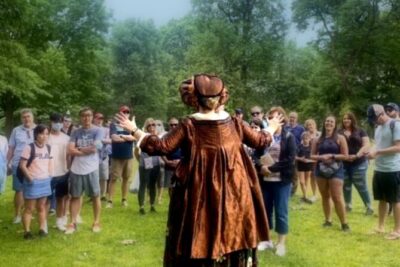
Boston Freedom Trail Walking Tour with Costumed Guide
Read our review →
Boston Food & History: Pizza, North End & Freedom Trail
Read our review →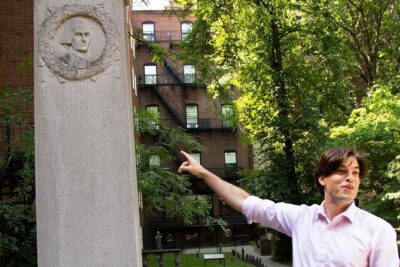
Boston’s Freedom Trail: A Revolutionary Walking Tour
Read our review →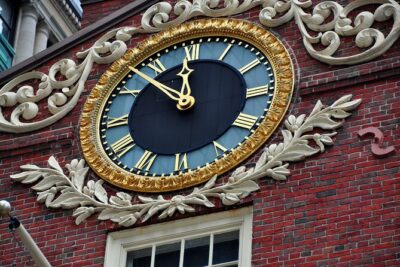
Freedom Trail History Small Group Walking Tour
Read our review →Boston’s Freedom Trail: A Revolutionary Walking Tour
Read our review →
Boston Freedom Trail History Pub Crawl Small-Group Tour
Read our review →
Entire Freedom Trail Walking Tour: Includes Bunker Hill and USS Constitution
Read our review →Browse the lists this tour appears in