
Review · BOSTON FREEDOM TRAIL TOURS
Boston’s Freedom Trail: A Revolutionary Walking Tour
Boston’s Freedom Trail packs four centuries of Boston life into one brisk walk. You’ll trace the road from the State House and the Boston Massacre site to Paul Revere’s home, Old North Church, and the North End, while your guide connects famous patriots with abolitionists, writers, immigrants, and reformers.
I like that the tour covers all 16 official sites and that guides such as Kenny, Alissa, Jim, Julia, and Alfred bring plenty of wit to the storytelling. I also like the useful end point at Copp’s Hill Terrace, where you can see Bunker Hill Monument and the USS Constitution. The catch is simple: this is a lot of ground in 2.5 hours, so the pace can feel quick, especially if you use a walking stick or want long stops at each place.
Key points to know before you book
- Every official Freedom Trail site in one outing: The route checks off all 16 marked locations, from Boston Common to the North End.
- A story-led history lesson: Expect Redcoats, smugglers, midnight riders, abolitionists, women’s rights, and the Boston Tea Party.
- A brisk city walk: You cover several miles, with short stretches between many stops but little time to linger.
- Strong guide factor: Kenny, Alissa, Jim, Julia, Alfred, Sam, and others are praised for clear explanations, humor, and good pacing.
- A useful final view: Copp’s Hill Terrace looks toward Bunker Hill Monument and the USS Constitution.
- Good value at $31: You pay for a focused guide, not admission to a collection of interiors, so the value comes from the interpretation.
Why this Freedom Trail walk works so well
Boston’s Freedom Trail is easy to follow on your own, but the red line on the pavement cannot explain why a graveyard mattered to the Revolution, how a church helped spread an alarm, or why a marketplace became a center of protest. That is where this tour earns its price.
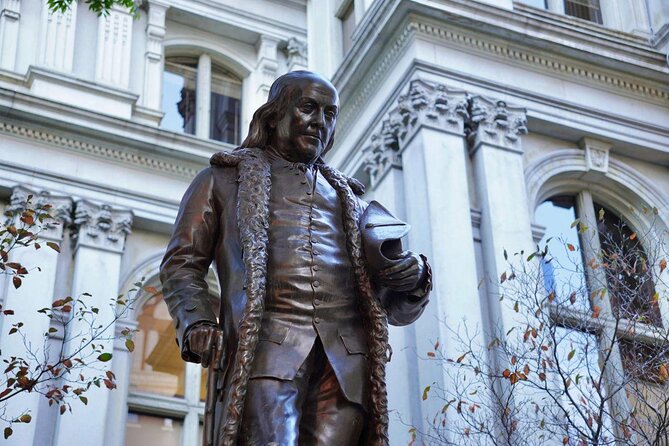
For $31, you get about two and a half hours with a guide and a group capped at 25 people. The tour moves through downtown Boston and the North End, turning a string of old buildings into a connected story. You hear about Paul Revere and John Hancock, but also about abolition, education, women’s rights, immigration, publishing, and the difficult work of building a democracy.
The best guides add character without burying the facts. Kenny is praised for answering detailed questions, Alissa for well-timed humor, and Jim for clear storytelling. Julia has handled crowded conditions and construction with good flexibility. Alfred is noted for balancing information, humor, and pace. Since guides vary, your experience will have its own personality, but the strongest pattern here is a serious command of Boston’s past delivered in an approachable way.
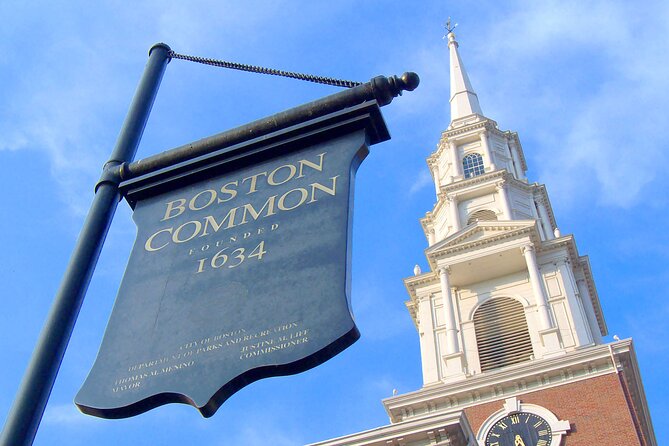
The tour begins beside The Embrace at 139 Tremont Street, next to the Boston Common Visitor Information Center. This large sculpture honoring Martin Luther King Jr. and Coretta Scott King gives the opening a useful modern frame. Boston’s story is not only about 1775. The tour also points toward the city’s later work in civil rights and reform.
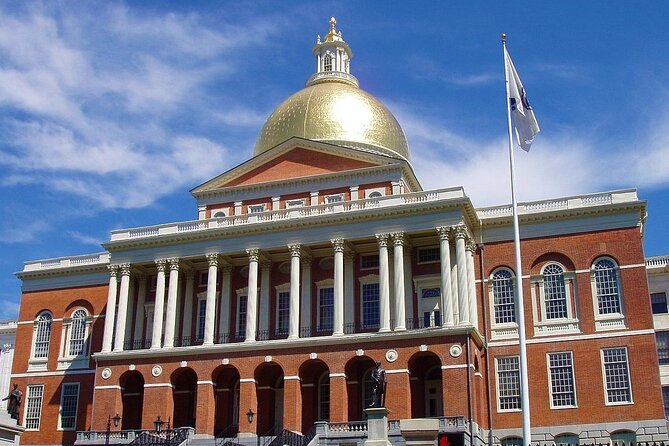
From there, you head toward the Massachusetts State House. Its golden dome is an obvious landmark, but the details make the stop worthwhile. Samuel Adams laid the cornerstone in 1795, and the building remains the seat of Massachusetts state government. It is a quick reminder that the Revolution did not end the story. It began a long experiment in public government.
More ways to walk the Freedom Trail
- Boston: Freedom Trail History Small Group Walking Tour
★ 5.0 · 6,450 reviews - Boston Freedom Trail Walking Tour with Costumed Guide
★ 4.5 · 2,531 reviews - Boston Food & History: Pizza, North End & Freedom Trail
★ 5.0 · 1,772 reviews
From abolitionist speeches to colonial graves
The next portion brings in a side of Boston that a quick Revolution tour can miss. You visit a red brick church built in 1809, where abolitionists delivered forceful anti-slavery speeches. This stop broadens the route beyond musket fire and famous white men. It shows how Boston’s meetinghouses and churches also became places for arguments about freedom and human rights.
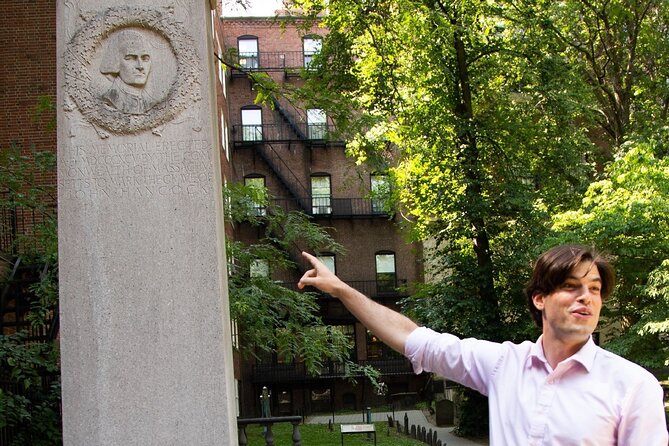
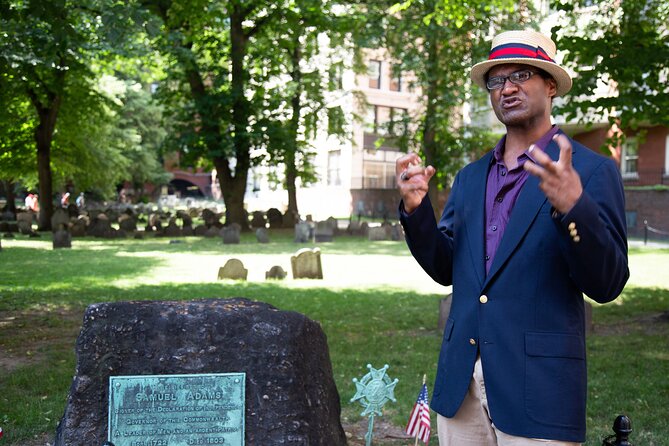
Granary Burying Ground dates to 1660 and contains the graves of John Hancock, Paul Revere, and Samuel Adams. The cemetery is one of the tour’s most useful stops because the names on the stones are not left as decoration. Your guide connects each person to the political crisis that led to independence.
You should expect some time here. One person specifically felt the tour spent too long in the cemetery while moving too quickly elsewhere. If you enjoy stories tied to individual people, you may appreciate the extra attention. If you have limited mobility, crowded paths and the need to keep up can make this section harder.
King’s Chapel adds another layer. Built in 1754, it was Boston’s first Anglican church. The stop includes its adjoining burying ground and the crypts beneath the building, along with the story of how an Anglican presence fit into a largely Puritan city.
The tour does not treat religion as background scenery. These churches and meetinghouses shaped public debate, civic identity, and political loyalties. That context helps explain why Boston’s religious buildings became central stages for arguments over British rule.
The meetinghouse where the Tea Party began
The Old South Meeting House is one of the most important stops on the route. Built in 1729 as a Puritan meetinghouse, it hosted the gathering that set the Boston Tea Party in motion. The building matters because the protest began with a public debate and a large crowd, not with a sudden burst of chaos at the harbor.
The guide explains how political anger gathered inside the meetinghouse before the action moved outdoors. One point to keep in mind is that this tour gives you a broad route, so the Tea Party story may not receive the same detail as a dedicated Tea Party visit. If you want the exact timeline, crowd size, and events of that evening, you may want to pursue that separately after the walk.
Next comes a less obvious stop: a 1718 brick building that began as the home of a colonial apothecary and later housed the publishing firm Ticknor & Fields. This is a welcome change of pace. The building connects the colonial city to Boston’s later literary life and the writers whose work passed through its publishing world.
The Old State House then brings you back to the sharp edge of the imperial crisis. Built in 1713 and decorated with the British Lion and Unicorn, it was the center of British government in Massachusetts. Inside and around it, public speeches and confrontations helped turn political disagreement into open resistance.
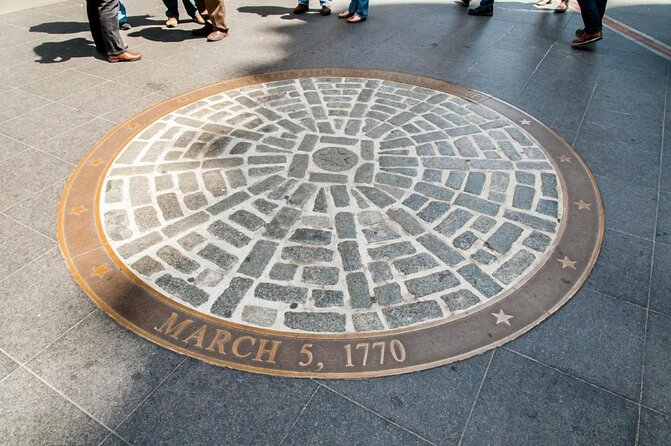
At the Boston Massacre site, a simple circle of stones marks the location of the 1770 shooting. Your guide reconstructs the night when British soldiers killed five colonists. The value here is the careful sequence of events. The name Boston Massacre already tells you how later political messaging framed the incident, but the physical site helps you picture how a tense street encounter became a powerful revolutionary symbol.
Faneuil Hall and the road to Paul Revere’s house
Faneuil Hall is often called the Cradle of Liberty, and the tour explains why. Built in 1743 as a marketplace, its second-floor meeting hall became a place for speeches that stirred opposition to British rule. The stop links commerce, public debate, and political action in one compact space.
The route then heads into the North End, where the streets become especially atmospheric and the walking feels more enclosed. Paul Revere House dates to 1680 and is Boston’s oldest building. It was the Revere family home, and the guide uses it to discuss Revere as a husband, father, craftsman, businessman, messenger, and political actor.
That wider picture is useful. Paul Revere is often reduced to one midnight ride, but his life involved much more than that famous night. The house gives the story a domestic setting and helps you picture the neighborhood from which he left to play his part in the revolutionary crisis.
Old North Church follows. Its steeple became the setting for the famous lantern signal on April 18, 1775. The guide explains the meaning of one lantern by land and two by sea, along with how the warning was arranged with Paul Revere.
This part of the tour works best when you listen for the uncertainty behind the legend. Revere’s ride was not a tidy scene from a schoolbook. It was part of a tense communication effort involving local riders, church officials, military movements, and the fear that British troops were about to march.
More Revolutionary War tours in Boston
- Boston Tea Party Ships and Museum Admission
★ 4.5 · 2,512 reviews - The Full Revolutionary Story Epic Small Group Boston Walking Tour
★ 5.0 · 2,356 reviews - Boston’s Freedom Trail: A Revolutionary Walking Tour
★ 4.9 · 1,748 reviews - Entire Freedom Trail Walking Tour: Includes Bunker Hill and USS Constitution
★ 5.0 · 732 reviews
Copp’s Hill, Bunker Hill, and Old Ironsides
Copp’s Hill Burying Ground dates to 1660 and later served as a British cannon position during the Battle of Bunker Hill. The cemetery gives you both a military view and a human one, since notable Bostonians are buried there.
From Copp’s Hill Terrace, you can view the 221-foot Bunker Hill Monument. The monument marks the location where colonial militia held hastily built earthworks and repelled two British attacks before retreating. The fight is famous for the order to wait until you could see the whites of their eyes, but the site also shows how costly and confused the battle was.
The tour ends at Copp’s Hill Terrace, at 7 Jackson Avenue in the North End. From here, you can look across toward Bunker Hill Monument in Charlestown and see the masts and rigging of USS Constitution. Known as Old Ironsides, the ship won battles in the War of 1812 and remains the oldest warship afloat anywhere in the world.
This ending is practical as well as scenic. You finish near North End restaurants and historic streets, with an easy chance to continue exploring on your own. The group does not return to Boston Common, so plan your afternoon around ending in this part of town.
What the pace feels like on foot
The tour lasts about 2 hours and 30 minutes, but the distance makes it feel like an active half-day. Some stretches are short and easy. Other parts require steady walking through busy downtown streets and the North End.
Comfortable shoes are essential. You should also be ready to stand while listening, since much of the interpretation happens outdoors at the sites rather than in a seated room. The tour requires a moderate level of physical fitness.
Pacing varies by guide and group. Several guides are praised for keeping the walk moving without making it feel rushed. Alissa, Julia, Jim, and Charles R. are singled out for clear delivery and well-managed timing. At least one outing felt too fast, with some people struggling to hear or keep up.
Sound can be an issue in a group of up to 25. If the guide is not facing you, city noise and nearby groups may make words hard to catch. Stay near the guide, ask to move closer when possible, and do not hesitate to speak up if you miss a key point.
The tour operates in English and accepts mobile tickets. Service animals are allowed, and the start and finish are near public transportation. The experience requires good weather. If poor weather cancels it, you can choose another date or receive a full refund.
Who gets the best value from the $31 price
I think the price is fair if you want one organized introduction to Boston’s historic core. You receive a guide for 2.5 hours, cover the full official trail, and gain context that would be difficult to assemble from plaques alone.
The value is strongest for first-time visitors, families with older children, and anyone who wants the main story before exploring individual buildings in more detail. Teenagers can enjoy the tales of riots, spies, smugglers, and midnight riders, especially with a guide who uses humor well.
History fans should also find plenty to like, since the route includes less obvious subjects such as abolitionist speeches, publishing, immigration, and the political role of churches. Still, the broad coverage means no single stop gets a long, museum-style visit.
The cost is less attractive if you prefer a slow walk, have trouble with several miles of pavement, or want to enter every building. This is primarily an outdoor guided walk. Its strength is the connection between sites, not extensive interior access.
You can cancel for a full refund up to 24 hours before the start time. Changes made inside that window are not accepted, and late cancellations are not refunded. That policy is worth noting because the tour depends on good weather.
Should you book Boston’s Revolutionary Walking Tour?
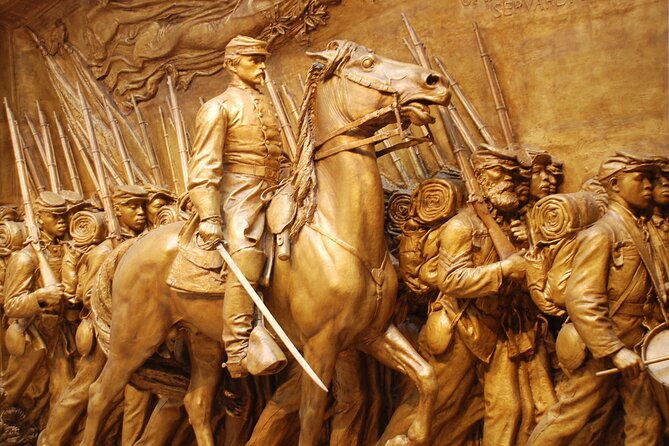
Book it if you want to understand how Boston’s famous places fit together. The tour is especially useful at the start of a visit, when you need a clear map of downtown, the North End, and the central events of the Revolution.
Go in ready to walk at a steady pace and listen in an outdoor setting. If you have mobility concerns, contact the provider before booking or choose a slower plan. If you want an intimate, highly detailed visit to each building, this is not the right format.
For most first visits, I would book it. The combination of all 16 sites, lively guides, strong historical coverage, and the final views from Copp’s Hill makes $31 a sensible way to get oriented. Just allow extra time afterward for the places that catch your interest.
FAQ
Where does the Freedom Trail tour begin?
The tour begins at The Embrace, located at 139 Tremont Street beside the Boston Common Visitor Information Center in Boston.
Where does the tour end?
The tour ends at Copp’s Hill Terrace in Boston’s North End. The stated address is 7 Jackson Avenue, Boston, Massachusetts 02113. From the end point, you can see Bunker Hill Monument and the USS Constitution in Charlestown.
How long does the walking tour last?
The tour lasts approximately 2 hours and 30 minutes.
How much does the tour cost?
The listed price is $31 per person.
How many sites does the tour cover?
The walk covers all 16 official sites of Boston’s Freedom Trail.
Is the tour suitable for people with limited mobility?
You should have a moderate level of physical fitness. The walk covers several miles, and one reported experience found the pace difficult while using a walking stick. Comfortable walking shoes are recommended.
What happens if bad weather cancels the tour?
The experience requires good weather. If it is canceled because of poor weather, you will be offered another date or a full refund. You can also cancel for a full refund up to 24 hours before the start time.
More walking tours in Boston
- Harvard University Campus Guided Walking Tour
★ 4.5 · 3,632 reviews - Boston: Freedom Trail History Small Group Walking Tour
★ 4.9 · 1,590 reviews - Boston’s North End Food Tour: Italian Flavors & Heritage Walk
★ 5.0 · 1,322 reviews - Freedom Trail Walking Tour 250
★ 4.5 · 1,118 reviews
Newest Boston tours we have written up
- Boston’s Freedom Trail: A Self-Guided Audio Tour★ 4.0 · 18 reviews
- Boston’s Freedom Trail: A Self-Guided Tour of All 16 Sites★ 5.0 · 14 reviews
- Boston Self-Guided Audio Tour Bundle: Freedom Trail & More★ 4.5 · 5 reviews
- Washington D.C. Cherry Blossom,Baltimore 3-Day Tour from Boston★ 4.5 · 7 reviews
- True Crime Tour of Boston★ 4.0 · 17 reviews
- Family Friendly Guided Bike Tour of Boston★ 4.5 · 22 reviews
- Freedom Trail Experience★ 5.0 · 8 reviews
- Self-Guided Audio Tour of Boston North End★ 4.5 · 3 reviews
Boston Freedom Trail Tours, compared.

Freedom Trail History Small Group Walking Tour
Read our review →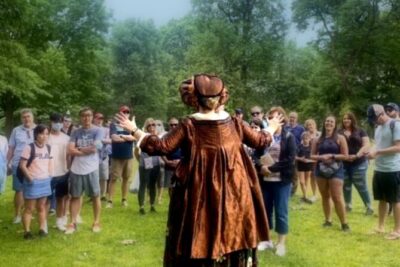
Boston Freedom Trail Walking Tour with Costumed Guide
Read our review →
Boston Food & History: Pizza, North End & Freedom Trail
Read our review →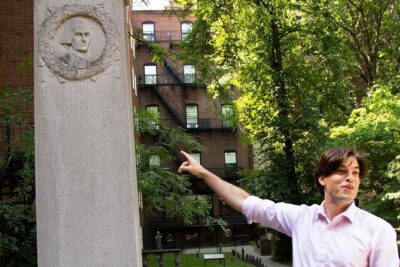
Boston’s Freedom Trail: A Revolutionary Walking Tour
Read our review →Freedom Trail History Small Group Walking Tour
Read our review →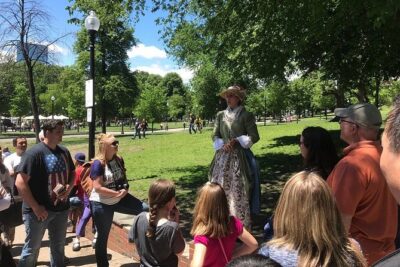
Boston Freedom Trail History Pub Crawl Small-Group Tour
Read our review →
Entire Freedom Trail Walking Tour: Includes Bunker Hill and USS Constitution
Read our review →Browse the lists this tour appears in