
Review · BEACON HILL TOURS
Boston: Underground Railroad History Tour of Beacon Hill
Boston’s Beacon Hill is more than handsome brick homes and cobbled lanes. This 2.5-hour walk follows the lives of Black Bostonians, abolitionists, educators, soldiers, and escapees who made Boston a center of the fight against slavery. You’ll visit the African Meeting House and the Hayden safe house, then finish at the powerful memorial to the 54th Massachusetts Regiment.
I like the small group limit of 16, which makes it easier to hear a guide such as Dana, Will, Meghan, or Lin and ask questions. I also like the way the route places Black history beside the homes of Boston’s elite, showing how sharply different communities lived within the same few blocks. The main drawback is simple: this is a hilly walking tour with long periods of standing, uneven surfaces, and about 2.5 hours on foot.
Key points to know before you book

- The route covers all 10 landmarks on Boston’s Black Heritage Trail, including the African Meeting House and the Hayden house.
- The African Meeting House is the only interior visit included, with about 25 minutes set aside there.
- Guides bring strong teaching and storytelling skills, with Dana, Will, Meghan, Lin, Joe, Dave, and Drew among the guides named in tour feedback.
- Beacon Hill’s hills and cobblestones matter, so wear supportive shoes and bring water.
- The tour links local places to national events, including abolition, the Civil War, and the 54th Massachusetts Regiment.
- At $35, the tour offers focused historical instruction, but it is best value for anyone who wants more than a quick photo walk through Beacon Hill.
Why Beacon Hill tells a different Boston story
Many first-time visitors associate Boston with the Revolution, Paul Revere, and the Freedom Trail. This walk shifts the focus to the decades before and during the Civil War, when Beacon Hill was home to a strong African American community and a determined abolitionist movement.
You’ll see elegant streets associated with Boston’s old upper class, often called the Boston Brahmins, alongside homes, schools, churches, and meeting places tied to Black life and the campaign against slavery. That contrast gives the tour its shape. You are not simply moving from one historic building to another. You are seeing how social power, race, education, religion, and reform occupied the same compact neighborhood.
The subject is serious. Slavery, racial violence, segregation, and the dangerous work of helping enslaved people escape are central to the tour. The route also makes room for courage, organizing, education, and community life. That balance matters. Boston’s role in abolition was important, but it was never simple or free from racial prejudice.
The guides are a major part of the experience. Dana is described as an educator and former National Park Service ranger, while Will is known for his work as a historian and research manager. Meghan, Lin, Joe, Dave, and Drew are also named as guides who bring their own teaching styles to the walk. Since the guide varies by departure, you should expect the same subject and route, but not an identical presentation.
More Beacon Hill tours
- Downtown Freedom Trail, Beacon Hill & Back Bay Walking Tour
★ 4.5 · 473 reviews - 2-Hour Beacon Hill True Crime Expert Guided Tour
★ 5.0 · 182 reviews - Beacon Hill Boston History + Photo Walking Tour (SMALL Group)
★ 5.0 · 163 reviews
Starting at Boston Common with the Soldiers and Sailors Monument
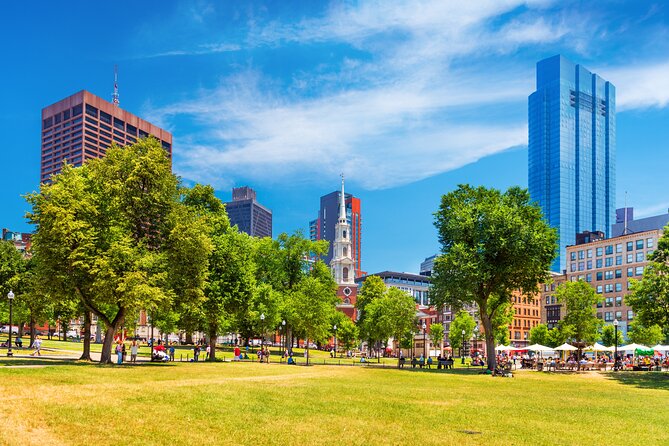
The meeting point is the Soldiers and Sailors Monument in the center of Boston Common, close to the Boston Common Visitors Center at 139 Tremont Street. Look for the white granite column topped by a female figure holding a flag, with four bronze figures around its base.
This is a useful starting place because Boston Common is easy to reach by public transportation and familiar to most visitors. The guide begins by placing Beacon Hill in the wider story of Boston. You learn that the Common dates to 1634 and is described as the oldest public land in the Americas, originally used as a shared grazing pasture.
The first stop is brief, about 10 minutes, but it gives you a sense of how public space shaped the city. It also helps you get oriented before heading toward Beacon Hill. Arrive with enough time to find the monument, since the Common has several statues and paths that can be confusing at first.
Acorn Street and the polished face of Beacon Hill
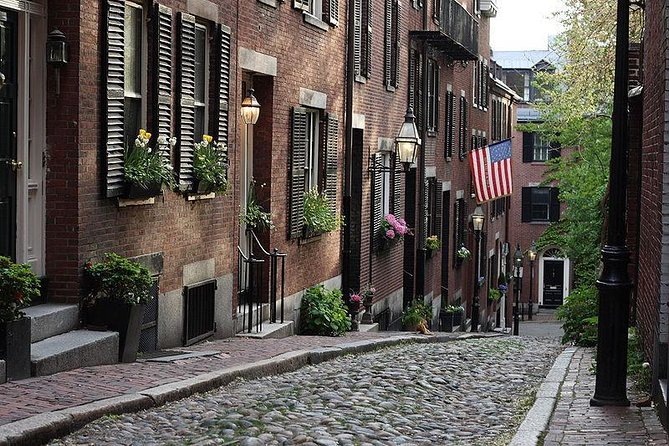
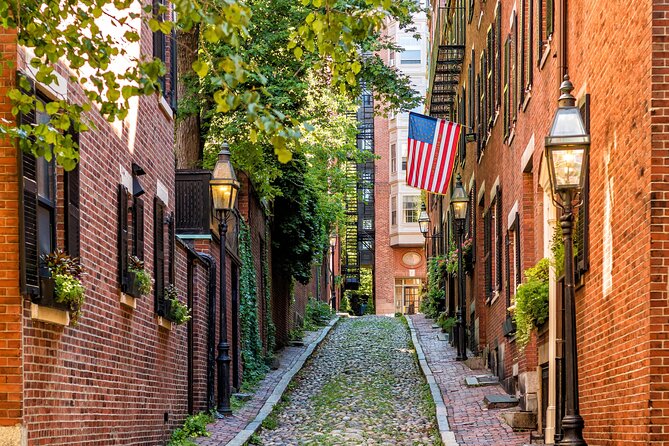
Acorn Street provides the postcard moment. Its narrow cobblestones and old homes show the carefully preserved side of Beacon Hill that appears in many Boston photographs.
Your guide uses this setting to discuss the neighborhood’s elite world and its elegant squares. The architecture is attractive, but the historical point is more important than the picture. The homes and streets reflect the social power of wealthy white Bostonians, while nearby addresses tell the story of Black residents who organized, taught, worshipped, and fought for freedom.
You will spend roughly 10 minutes here. The cobbles can be awkward, especially in poor footwear, and the lane is narrow. Take photographs quickly and stay with the group so the stop does not become only a photo break.
Phillips School and the fight over education
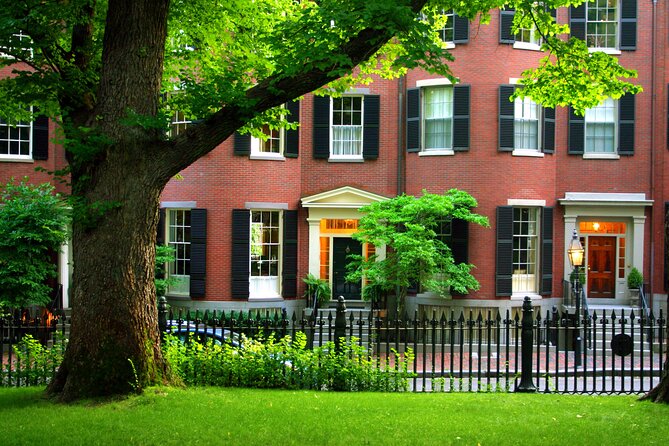
The former Phillips School shows how education became a battleground. Built in 1824 as a whites-only school, it was among Boston’s first schools to integrate by 1855.
This stop turns a broad subject into a local one. Instead of hearing only about laws and national leaders, you see where children and families faced the daily effects of segregation. The story also shows that change required pressure and persistence. Boston’s reputation as a center of reform did not mean equality came easily.
The stop lasts about 10 minutes. The building is viewed from the street, and admission is not included because there is no interior museum visit here. That is typical of the tour: the value comes from the guide’s explanation and the places themselves.
More history tours in Boston
- Boston: Freedom Trail History Small Group Walking Tour
★ 5.0 · 6,450 reviews - Tour of Historic Fenway Park, America’s Most Beloved Ballpark
★ 4.5 · 3,013 reviews - Boston Food & History: Pizza, North End & Freedom Trail
★ 5.0 · 1,772 reviews - Boston: City Cruises Historical Sightseeing Cruise
★ 4.6 · 1,771 reviews
Abolitionists in their homes and meeting places
The John J. Smith House is one of the route’s strongest examples of how political work grew from ordinary neighborhood life. Smith was a leading abolitionist, state legislator, and former barber. His home connects public leadership with the work of a local resident who built influence over time.
The route then follows parts of Beacon Hill’s main thoroughfare, lined with shops and restaurants. This is a practical point to remember: the tour is conducted in an active neighborhood, not a closed historic village. You will encounter traffic, pedestrians, and regular city activity between the historic stops.
At the Charles Street Meeting House, the story moves into religious and political debate. Built in 1807, the meeting house became a site of fierce arguments over racial integration. The stop lasts about 15 minutes and shows how churches could serve as places of worship, organizing, and conflict.
You also hear about the home of an African American community activist and abolitionist. These smaller stops help fill in the story around the better-known buildings. The route is particularly good at showing that social movements depend on many people, not just the names printed on monuments.
The Hayden safe house at 66 Phillips Street
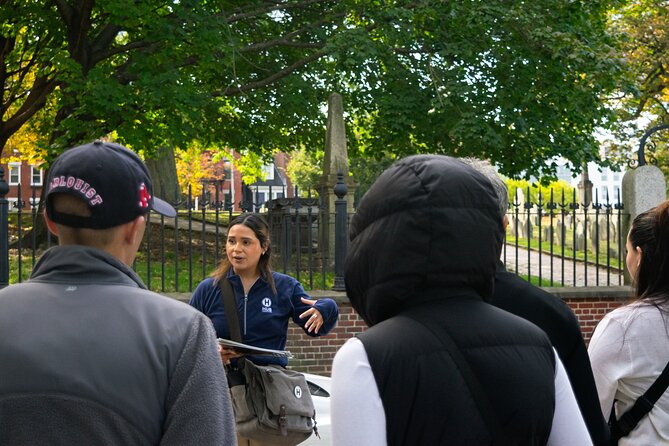
At 66 Phillips Street, the tour reaches one of its clearest Underground Railroad sites. The house was owned by the Haydens, staunch abolitionists who had formerly been enslaved. It served as a safe house for people escaping slavery.
This stop gives the Underground Railroad a physical setting. The phrase can sound abstract when discussed only in classrooms, but here you stand outside an actual Beacon Hill address connected to the work. The stories involve danger, secrecy, and a network of people willing to risk punishment and violence.
The stop lasts about 15 minutes. Some tour feedback highlights secret passages and lesser-known details, including the contributions of women whose names are often missing from plaques. The guide’s storytelling is especially important here, since the house is viewed from outside and the experience does not promise a full interior tour.
Otis House and the sharp contrast of Beacon Hill
The Otis House, built in 1796 for Harrison Gray Otis, brings you back to the world of Boston’s political and social elite. Otis was a Boston mayor and nephew of revolutionary figure James Otis Jr.
Placed beside the nearby African American sites, this address makes the neighborhood’s contrasts easier to understand. Wealth, influence, abolition, resistance, and exclusion were not separate Boston stories. They were happening within walking distance of one another.
The tour also passes an 1806 church designed by architect Asher Benjamin, the home of an outspoken abolitionist and US senator who was beaten unconscious in the Capitol in 1856, and homes connected to African American abolitionists including historian William Cooper Nell.
These short stops can feel information-heavy. The route covers a lot between the major landmarks, so you may want to take brief notes or mark names you would like to research later. The payoff is a wider cast of characters than you usually get on a standard Boston sightseeing walk.
Schools, churches, and the African Meeting House
The route includes a school founded in 1835 for Boston’s African American children. This helps show how the community built its own institutions when access to white schools was limited or denied.
The main interior visit is the African Meeting House, with about 25 minutes scheduled inside. Built in 1806, it is described as the oldest surviving Black church building in the United States and served as a cultural center for Boston’s African American community.
This is the tour’s most substantial stop. The building ties together worship, education, abolition, public meetings, and community leadership. It also gives you a break from the sidewalk, though you should still expect to stand and listen for much of the tour.
Admission to the African Meeting House is included. Admission to other museums is not part of the price, so do not assume the tour includes every interior connected with the Black Heritage Trail.
5 Pinckney Street and the final memorial
At 5 Pinckney Street, you see the oldest surviving house in Beacon Hill, dating to 1787. It was home to an African American Revolutionary War veteran, another reminder that Black participation in the nation’s founding reaches far beyond the better-known textbook figures.
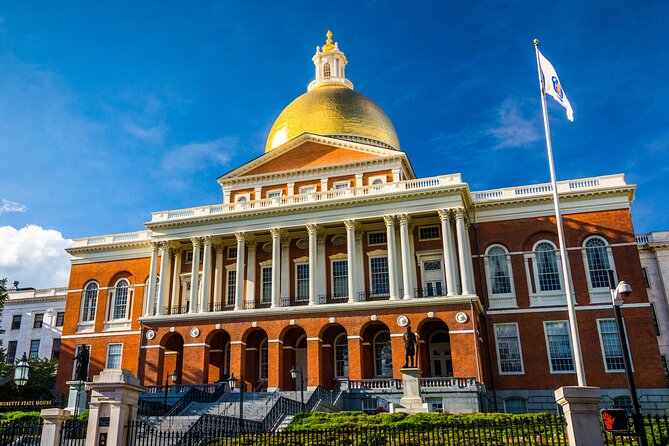
The route then passes the Massachusetts State House, completed in 1798 and famously associated with Boston’s nickname, the Hub of the Solar System. The grand government setting provides a fitting contrast to the smaller homes and meeting places visited earlier.
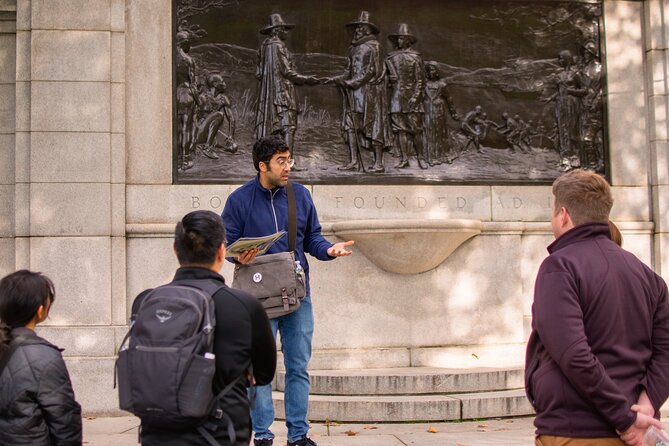
The tour ends at the Robert Gould Shaw and 54th Regiment Memorial, opposite the State House near 24 to 26 Beacon Street. The memorial honors the Black soldiers of the 54th Massachusetts Regiment and the white officer who led them. The final stop lasts about 15 minutes and brings the walk’s themes into the Civil War era.
The ending is well chosen. You finish with a public monument connected to military service, citizenship, and the fight to end slavery, rather than simply returning to a pretty residential street. The endpoint is within about 0.2 miles of the starting area, though the precise return route may vary.
What $35 gets you
At $35 per person, this is a reasonably priced guided walk if you want sustained explanation rather than a quick orientation. The route lasts about 2.5 hours, includes the Black Heritage Trail landmarks, and provides admission to the African Meeting House.
You are paying mainly for the guide’s preparation and presentation. A self-guided walk would cost less, but you would need to research the people, dates, and connections yourself. On this tour, the guide links the Hayden house to the Underground Railroad, the Phillips School to integration, and the 54th Regiment Memorial to the Civil War.
The small-group cap of 16 improves the value. A group that size is easier to hear and more comfortable at narrow street corners than a large crowd. You also have a better chance to ask about a person or building that catches your attention.
The tour does not include museum admissions beyond the African Meeting House, transportation, or a guide in period costume. Gratuity is optional. The experience is about interpretation, walking, and real places, not staged reenactment.
Walking conditions and who should book
You need a moderate level of fitness. The route includes hills, cobblestones, uneven surfaces, and long periods of standing. Several people found the pace measured, with regular stops, but the full experience can run longer than two hours and thirty minutes if the guide spends extra time on questions.
Wear comfortable shoes. Bring water, especially in warm weather. Service animals are allowed, and the route is near public transportation, but the physical demands may be difficult if you have trouble standing for extended periods.
I would recommend this tour to adults, history students, families with older children, and anyone who wants Boston’s Black history placed at the center rather than treated as a footnote. Children aged 12 or 13 may enjoy it with an engaging guide, but the length and subject matter can be a lot for younger children. One family found that children as young as 10 and 13 stayed interested, while another found the longer walk tiring for children aged 8 and 12.
The subject suits people with at least some interest in American history from roughly 1770 to 1865. You do not need prior expertise. The guides explain the material clearly, and Dana, Will, Meghan, and Lin have each been praised for strong storytelling and an ability to answer questions.
Weather, timing, and cancellation details
This is an outdoor activity, so poor weather can cancel the tour. If that happens, you are offered another date or a full refund. The same applies if the minimum number of participants is not reached.
You can cancel for a full refund up to 24 hours before the start time. Changes or cancellations made inside that 24-hour window are not accepted for a refund.
Because the tour is often booked about 29 days ahead, reserve early if your Boston dates are fixed. You receive confirmation at booking, and the ticket is mobile.
Should you book the Beacon Hill Underground Railroad tour?
Book it if you want a serious, place-based look at Boston’s role in abolition and the Civil War. I especially recommend it if you have already seen the standard Revolutionary Boston sights and want to understand the people and institutions that shaped the next great American crisis.
Skip it if you want a short, mostly photographic walk, dislike standing, or have difficulty with hills and cobblestones. For everyone else, $35 buys a focused route, a small group, access to the African Meeting House, and a guide who can connect quiet Beacon Hill addresses to national events. Choose comfortable shoes, allow a little extra time, and let the neighborhood’s less familiar stories take the lead.
FAQ
Where does the tour begin?
The tour begins at the Soldiers and Sailors Monument in Boston Common, near the Boston Common Visitors Center at 139 Tremont Street.
Where does the tour end?
It ends at the Robert Gould Shaw and 54th Regiment Memorial near 24 to 26 Beacon Street, opposite the Massachusetts State House.
How long does the tour last?
The scheduled duration is approximately 2 hours and 30 minutes.
How much does the tour cost?
The listed price is $35 per person.
Is the African Meeting House included?
Yes. Admission to the African Meeting House is included. Admission to other museums is not included.
How large is the group?
The tour has a maximum of 16 participants.
Is the tour suitable for people with limited mobility?
The tour requires a moderate level of physical fitness and includes hills, uneven surfaces, walking, and extended periods of standing. It may not suit people who have difficulty standing for long periods.
Newest Boston tours we have written up
- Boston’s Freedom Trail: A Self-Guided Audio Tour★ 4.0 · 18 reviews
- Boston’s Freedom Trail: A Self-Guided Tour of All 16 Sites★ 5.0 · 14 reviews
- Washington D.C. Cherry Blossom,Baltimore 3-Day Tour from Boston★ 4.5 · 7 reviews
- Boston Self-Guided Audio Tour Bundle: Freedom Trail & More★ 4.5 · 5 reviews
- True Crime Tour of Boston★ 4.0 · 17 reviews
- Family Friendly Guided Bike Tour of Boston★ 4.5 · 22 reviews
- Freedom Trail Experience★ 5.0 · 8 reviews
- The Ghosts of Boston’s Past Haunted Self-guided Tour★ 3.5 · 4 reviews
Beacon Hill Tours, compared.
Downtown Freedom Trail, Beacon Hill & Back Bay Walking Tour
Read our review →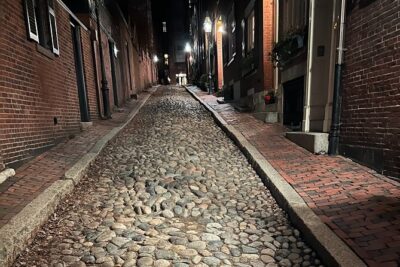
2-Hour Beacon Hill True Crime Expert Guided Tour
Read our review →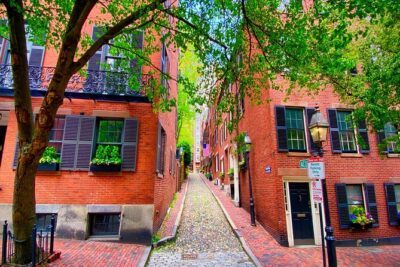
Beacon Hill Boston History + Photo Walking Tour (SMALL Group)
Read our review →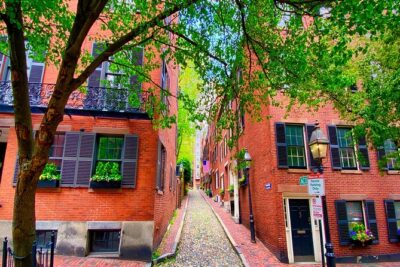
Beacon Hill + Back Bay History + Photo Walking Tour(SMALL Group)
Read our review →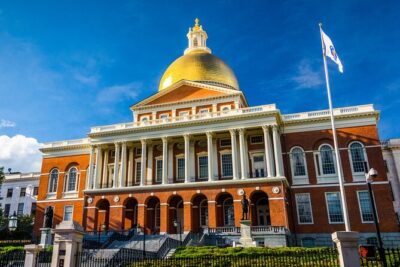
Underground Railroad History Tour of Beacon Hill
Read our review →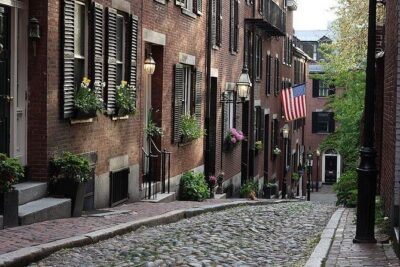
Self-Guided Boston’s Beacon Hill Underground Railroad Audio Tour Walking Tour
Read our review →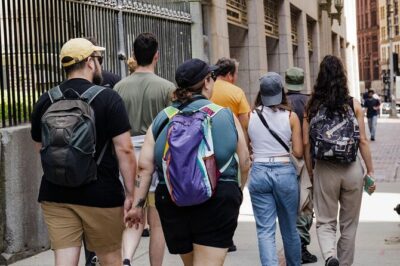
Browse the lists this tour appears in